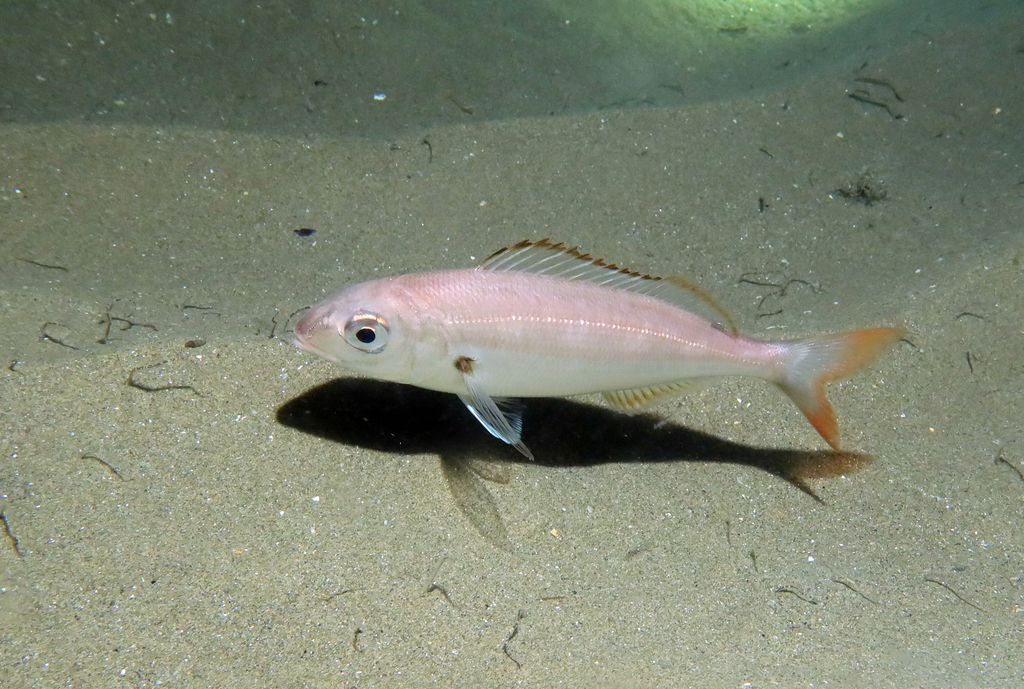
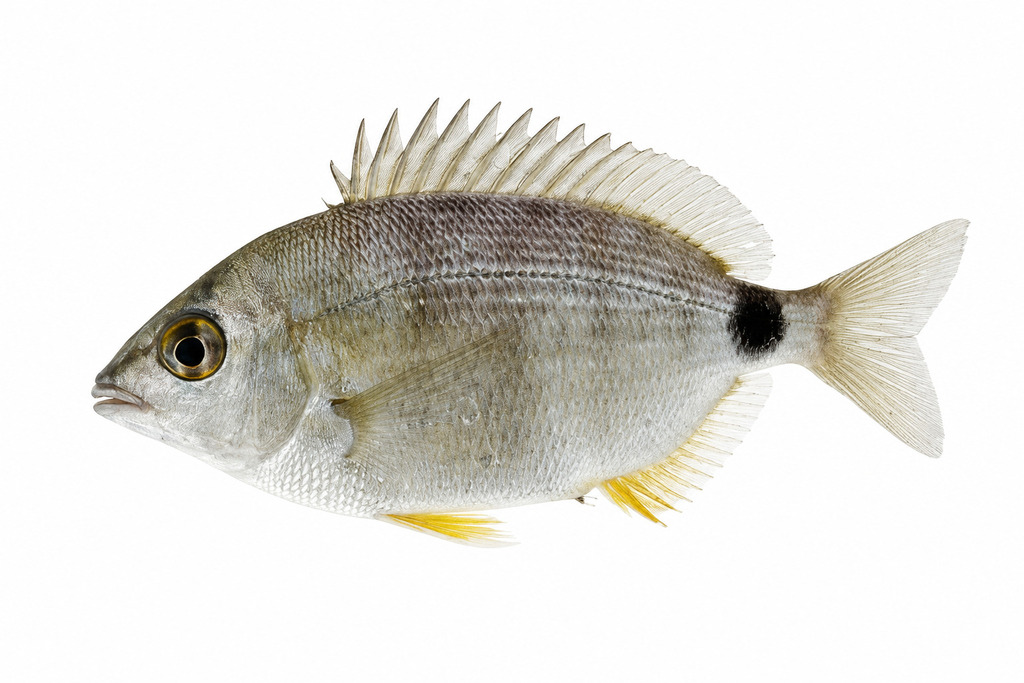
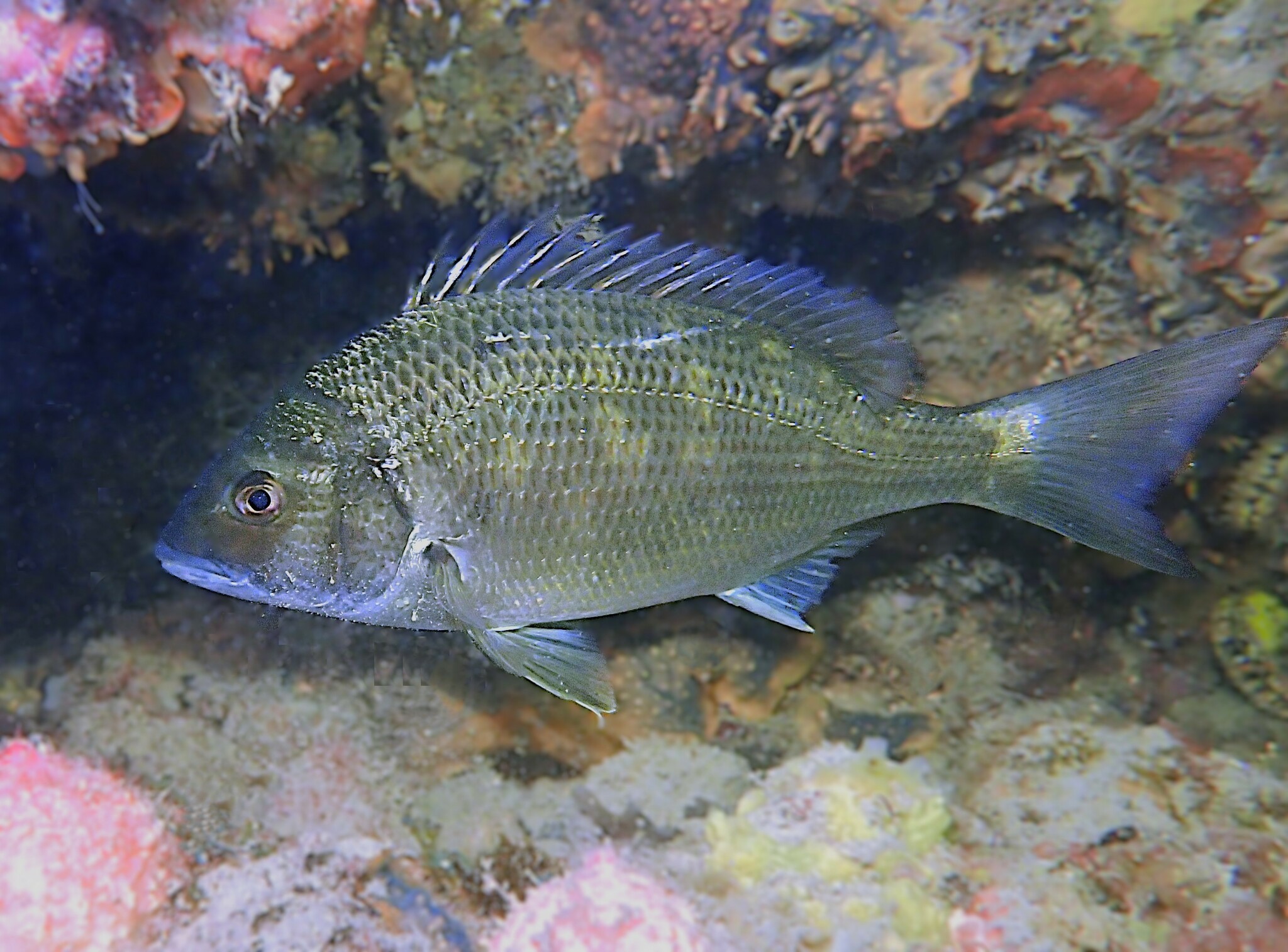
Axillary seabream (Pagellus acarne) is a fish of the family Sparidae. FishBase gives its range as: Eastern Atlantic and Mediterranean Sea: Bay of Biscay to Senegal, Madeira, the Canary Islands, Cape Verde; rare in the British Isles but recorded occasionally off Denmark. Azores. It is recorded from 0 to 500 m, in subtropical water. The recorded maximum is 36 cm SL. Diet includes crustaceans, fishes and worms. IUCN status: Least Concern (LC). Chinese name: .
SL is not the number on your ruler
Standard length stops at the base of the caudal fin; total length continues to the tail tip. FishBase labels the maximum and common lengths of this species as SL, and this is not a detail to skim: for a slender sparid the caudal fin adds a visible amount, and the record gives no factor to add.
The right response is not to estimate the difference. Any percentage applied here would come from a different species, a different population, or a different measuring convention. The right response is to keep the two measurements apart: when the source says 36 cm SL, write "36 SL" in the log, and when you measure a fish, write "TL" beside your own number.
Thirty-six centimetres, minus a tail
The maximum is 36 cm SL. That is the largest fish on the record, measured the standard way, and it is not a fish you can check against a total-length mark on a measure board.
For a target, the figure is still useful as an upper bound: a fish at 36 SL is a large specimen, and a fish that looks much longer than that on the board is either a genuine record or a measuring error. The distinction matters because the number circulates in both forms online, and a 36 TL fish is a smaller animal than a 36 SL fish.
Twenty-five common, same ruler?
The common length is 25 cm SL. Because both figures use the same basis, the relationship between them is sound: the typical fish is roughly two-thirds the size of the largest, a normal shape for a sparid population.
The relationship breaks the moment one of the two is converted and the other is not. A 25 cm SL common length compared with a 36 cm TL maximum would understate the gap; a 25 cm TL common length compared with a 36 cm SL maximum would overstate it. Keep the pair on one basis or do not compare them.
The maturity figure with no unit
First maturity is given as 15.0 cm, with no length type attached and no range. That is the weakest of the three numbers: it is precise to a decimal place while leaving out the one piece of information that would make the precision meaningful.
Two readings are possible and the record does not choose. The 15.0 could be on the same standard-length basis as the other two, in which case it sits well below the common length of 25 SL. Or it could come from a source using total length, in which case the true SL equivalent is somewhat lower. Either way, 15 cm is a small fish, and a release line set there is a floor rather than a target.
A zero depth and a zero meaning
The depth range is 0 to 500 metres, with a usual band of 40 to 100 metres. The 500 m figure is a deep record; the 40–100 m band is where the fish is normally found; the 0 is the odd one.
A zero minimum in a depth field can mean the surface, or it can mean that the shallow end was never established and was coded as zero. The record does not resolve it. The usual band is the more useful number, and it says the fish is a shelf and upper-slope species, not a surface one. Fish the 40–100 m band and treat the 0 as a coding artefact until a source proves otherwise.
Seven names and one misspelling
The English table lists Axillary seabream, Axillary sea-bream, Axillary bream, Spanish bream, Spanish seabream and — with a doubled L — Auxillary seabream. iNaturalist uses Axillary seabream.
The misspelling is worth naming because it is the kind of thing that breaks a search: a database keyed to Auxillary will not return the correctly spelled record unless the query is fuzzy. The two "Spanish" names are also a reminder that a common name can point at a country the fish is not restricted to: the country table runs to 37 entries, and its northern edge includes Denmark and Scotland, well outside Spain. For matching records, use the binomial.
GBIF's twelve declarations put the country-level records in Spain, Portugal (Azores), Greece and Israel, with Denmark and Norway each contributing a single national-checklist entry and Sweden marked irregular. Wikipedia's revision 1354750695 sums the range as the eastern Atlantic and the Mediterranean. The northern entries are therefore edges, not a second centre: a Danish or Norwegian record does not make the species a North Sea target, and the size and bag rule to check is the one set by Portugal, Spain or Greece.
All twelve months, eight records
Spawning is recorded in every month, drawn from eight entries. A twelve-month table normally means one of two things: a species that spawns year-round across its range, or a set of local records that happen to cover every month between them. With eight entries across the Mediterranean and the eastern Atlantic, the second explanation is at least as likely as the first.
The practical consequence is the same either way. There is no closed season to plan around from this table alone, and no month in which every fish is post-spawn. The table is a range of observations, not a reproductive calendar.
What to write in the log
Write two things beside every length: the measurement basis and the source. "31 TL, measured" and "25 SL, record" are both usable; "31 cm" alone is not, because the next person cannot tell which ruler produced it.
For release, the 15.0 cm maturity figure is the only line the record supplies, and its missing unit means it should be treated as a conservative floor rather than a precise threshold. The 25 cm SL common fish and the 36 cm SL maximum describe the population; the maturity figure describes the cut-off. Keep them in separate columns.
Regulations before you keep it
These are the published regulations for this fish. Read the number first. The notice below it is the actual regulation.
Minimum size3
≥20 cm
Spain — Canary Islands · ES-CN
The minimum size for Axillary seabream in the Canary Islands is ≥20 cm.
| Aligote (Pagellus acarne) | Besuguito aligote | 20 |
The minimum size for Axillary seabream in France is ≥17 cm.
| PAGEOT ACARNE | Pagellus acarne | 17 cm |
The minimum size for Axillary seabream in Portugal is ≥18 cm.
Besugo (Pagellus acarne) | 18 cm
Every record above names its source and the date it was retrieved. See the regulation register for the full list, or how to read these regulations.
Where these facts come from
Check these pages before you rely on a size, range or protection status.
-
FishBase — Pagellus acarne
— FishBase · T2
-
GBIF — Pagellus acarne occurrence records
— GBIF · T2
-
IUCN Red List — Pagellus acarne
— IUCN · T1
-
Photo record — iNaturalist
— iNaturalist · T3