
Faskar
Acanthopagrus bifasciatus is a Sparidae seabream of the Red Sea and Persian Gulf, found from 2 to 20 m over reef and rock. It is recognised by two vertical black bars on the head and yellow dorsal and caudal fins. FishBase records a maximum of 36.2 cm standard length, a common length of 40 cm total length, a maximum age of 19 years and maturity at 26.4 cm.
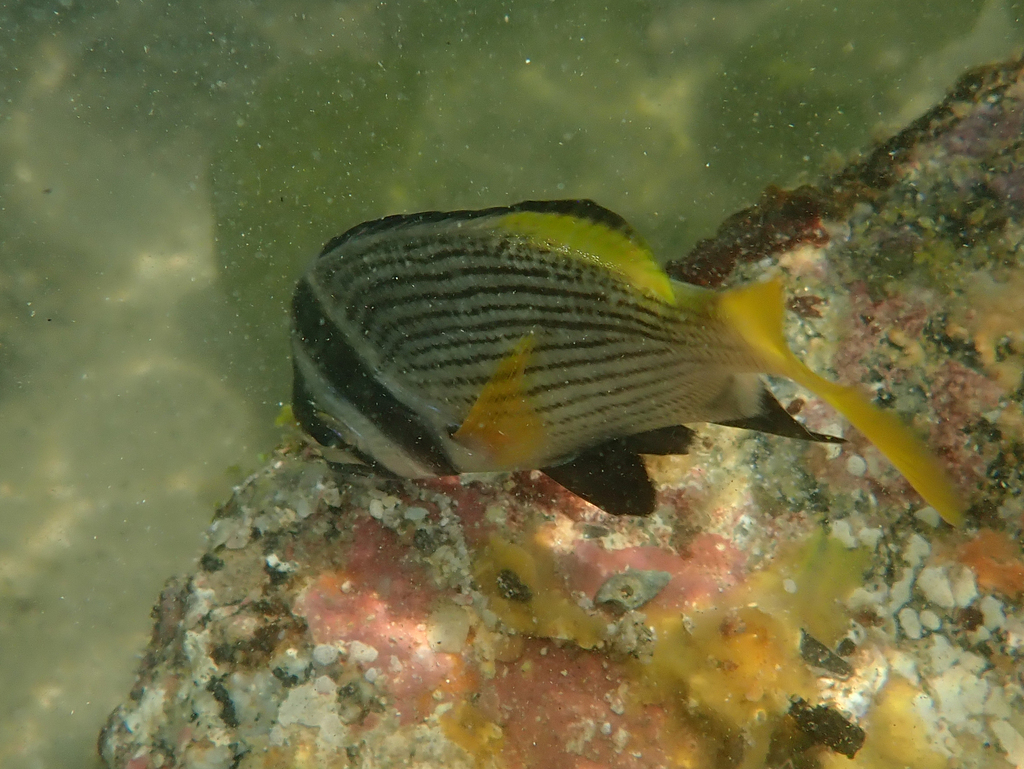
Acanthopagrus bifasciatus is a Sparidae seabream of the Red Sea and Persian Gulf, found from 2 to 20 m over reef and rock. It is recognised by two vertical black bars on the head and yellow dorsal and caudal fins. FishBase records a maximum of 36.2 cm standard length, a common length of 40 cm total length, a maximum age of 19 years and maturity at 26.4 cm. Gulf states regulate it under different names: faskar in the UAE, with a 27 cm minimum, and no published species-specific size in Oman or Saudi Arabia.
Identification
A Sparidae seabream with a deep, compressed body and a continuous dorsal fin. The field mark is the head: a first black bar runs from the occiput through the eye and across the cheek to the rear of the maxilla, and a second runs from the nape to the opercle. The dorsal and caudal fins are yellow, with no dense black margin on the dorsal fin and no narrow black edge on the caudal fin.
Fin counts are XI, 12-15 dorsal rays and III, 10-11 anal rays; there are two rows of molars on each side of the upper jaw, a naked interorbital area and a naked preopercle flange. FishBase gives a maximum of 36.2 cm standard length and a common length of 40 cm total length; the two figures use different measures and should not be converted by eye.
Maximum age is 19 years and first maturity is 26.4 cm. In the Gulf the name faskar is a collective term for this fish and close relatives, so the scientific name, not the local name, should anchor identification.
Distribution and Habitat
Western Indian Ocean: the Red Sea, the Persian Gulf and southern Oman, but not the Gulf of Oman; the range probably continues along the southern coast of the Arabian Peninsula and east to Iran and Pakistan. FishBase lists 18 territories.
The recorded depth is 2 to 20 m, reef-associated, and the species tolerates brackish water. It is a tropical fish with a latitudinal envelope of 32°N to 10°N and a longitudinal range of 33°E to 65°E.
That shallow band makes it a shore, breakwater and shallow-reef fish rather than a deep-boat target. A 20 m floor is reachable by boat on steep ground, but the centre of the range is much shallower.
Habits and Diet
FishBase records only that the species occurs in small groups; it does not list stomach contents or diet items for this species. Other Acanthopagrus are benthic invertebrate feeders, but that is a genus-level pattern and should not be presented as a species-level fact.
For an angler the useful part is the grouping behaviour and the shallow, reef-sand edge. Fishing the sand apron beside the reef rather than the reef core matches how the fish is described moving, and it also reduces tackle loss.
Small groups also mean that a hooked fish can bring others to the same spot. Mark the exact cast rather than the general area, and give the patch ten or fifteen minutes before moving.
Fishing Methods
Light bottom fishing is the main method: a small hook with shrimp, crab or sandworm, one to three ounces of lead, fished on the sand edge. The mouth is small and the molars are strong, so bait must survive picking and the hook gape should stay narrow.
Small soft plastics, micro jigs and sinking minnows work on the same ground when worked slowly along the bottom. Fish are usually small, so the priority after hooking is to pull them away from the reef before they can cut the leader.
Gear and Approach
A 7 to 8 ft medium-light saltwater rod, a 2500 to 3000 spinning reel, 1.0 to 1.5 PE braid and a 20 to 25 lb fluorocarbon leader are enough. Use size 8 to 10 hooks or the local equivalent.
From a breakwater, 20 to 40 g running sinkers hold in the wash; from a boat, add weight only as current requires. Keep the leader short, 30 to 50 cm, so the bait stays close to the lead and the abrasion point is predictable.
Seasonal Window
FishBase records spawning off Abu Dhabi from January to April. The Red Sea table has month cells for Egypt but does not mark specific months, so the Red Sea season should be treated as unstated rather than copied from the Gulf.
The weeks around spawning are the most reliable shallow-reef window. Within a day, moving water beats slack water; night fishing under breakwater lights produces fish, but there is no species-specific night record to cite.
Edibility and Handling
FishBase notes it is marketed fresh or dried. The flesh is firm and the bones are few, which suits steaming, pan-frying or soup; small specimens are softer and are better released or used for stock.
Bleed, gill and ice the fish promptly. Reef fish carry a general ciguatera risk that should not be judged by size alone, so large individuals from any reef should be treated with caution. The thin body also means the fish heats quickly in a bucket; a cooler with slurry is better than a dry box.
Regulations and Conservation
United Arab Emirates: Ministerial Decree No. 580 of 2015 lists faskar at a minimum total length of 27 cm for catching and sale. Recreational fishing requires a licence; Abu Dhabi issues an annual permit for AED 120 or a weekly permit for AED 30 to applicants aged 18 and over.
Oman: a recreational licence costs OMR 2 per day or OMR 30 per year. The five-species minimum-size table in Ministerial Decision 67/2020 does not include this species, so no species-specific size is published.
Saudi Arabia: the Agriculture Law Implementing Regulation defines a recreational fisher and requires ministerial licensing, but no species-specific size or bag limit for this fish was located; treat that as unverified. IUCN global status is Least Concern, assessed in 2013.
How to catch it
Boat bottom fishing
1–3
Bait fishing
Lure fishing
Where these facts come from
Check these pages before you rely on a size, range or protection status.
- FishBase — Acanthopagrus bifasciatus — FishBase · T2
- GBIF — Acanthopagrus bifasciatus occurrence records — GBIF · T2
- IUCN Red List — Acanthopagrus bifasciatus — IUCN · T1
- Photo record — iNaturalist — iNaturalist · T3
Fish in the same water
These fish live in the same place.
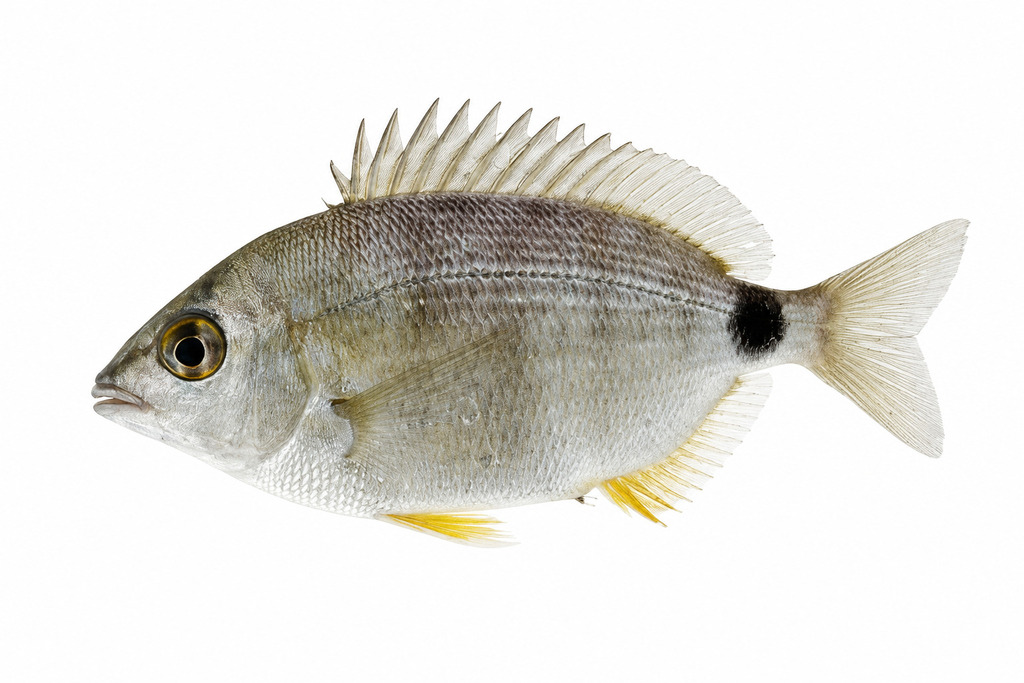
Annular seabream
- Family
- Sparidae
- Depth
- 0–90 m
- Season
- Jan, Feb, Mar, Apr, May, Jun, Jul, Aug, Sep
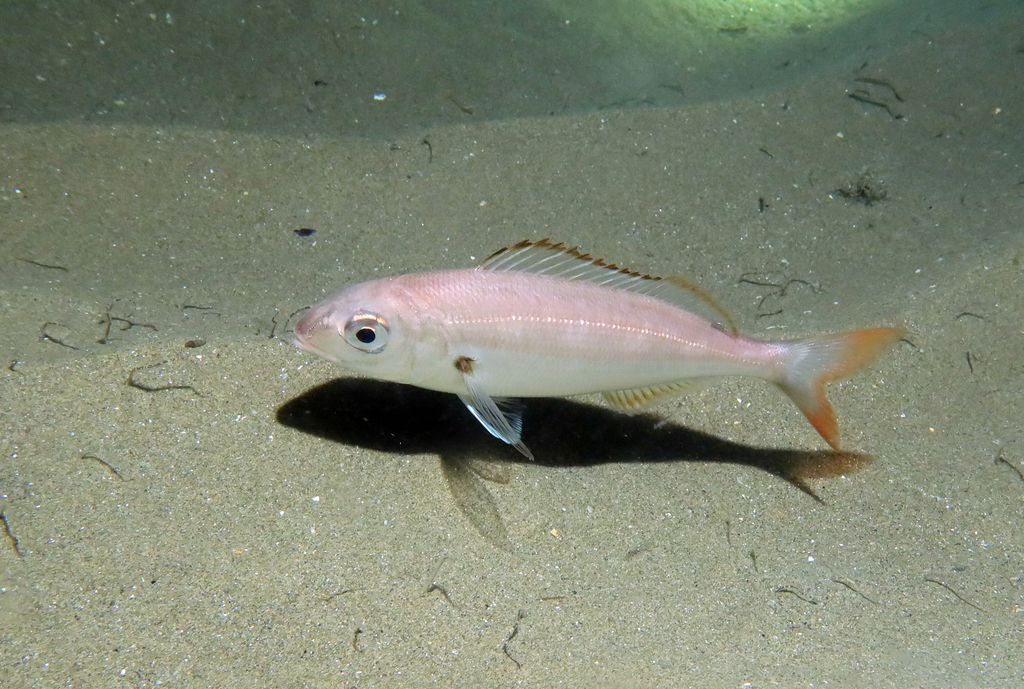
Axillary seabream
- Family
- Sparidae
- Depth
- 0–500 m
- Season
- Jan, Feb, Mar, Apr, May, Jun, Jul, Aug, Sep, Oct, Nov, Dec
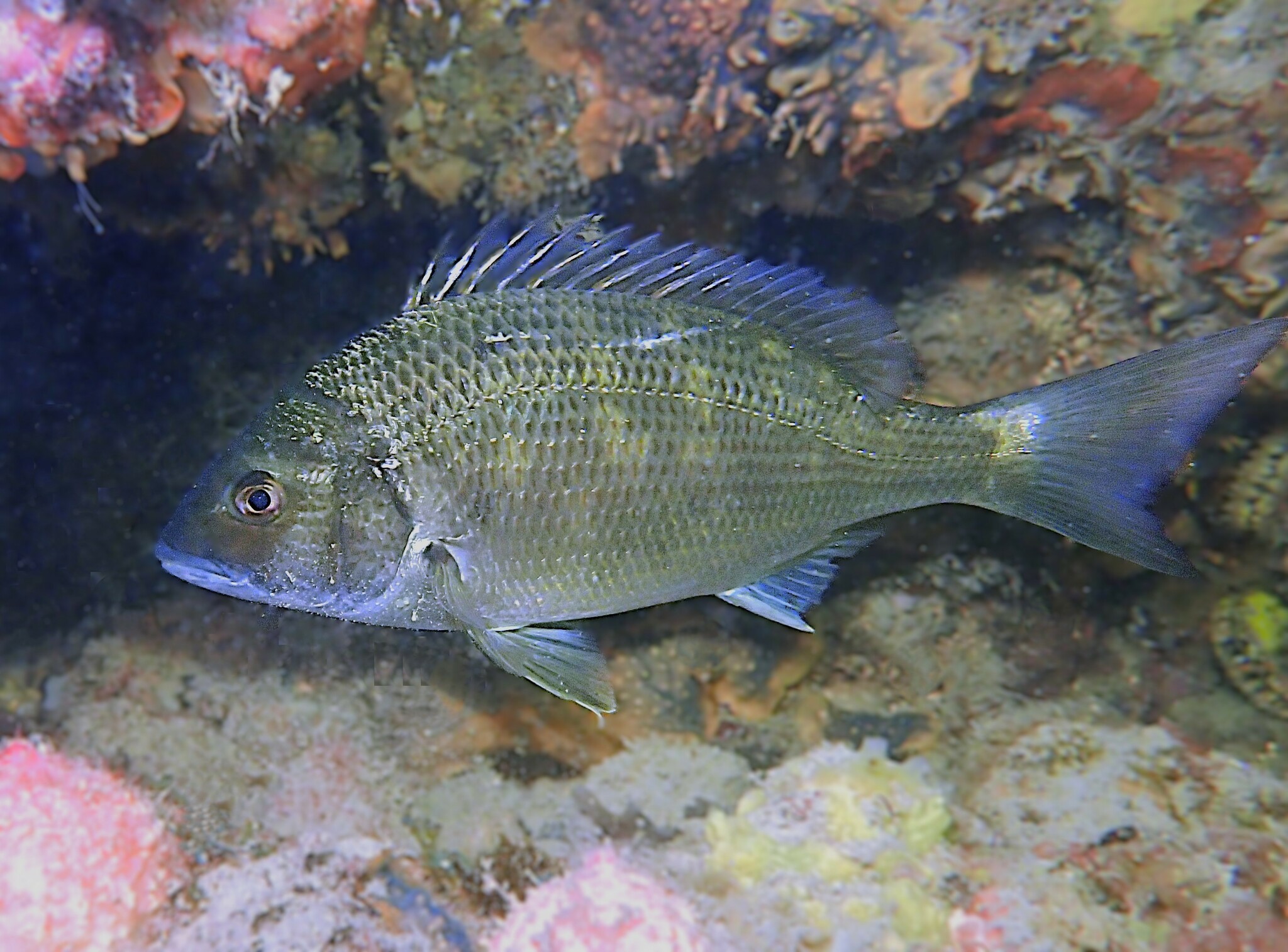
Black bream
- Family
- Sparidae
- Season
- Jan, Feb, Jul, Aug, Sep, Oct, Nov, Dec
Guides for this water
Technique, gear and safety guides that fit Faskar.