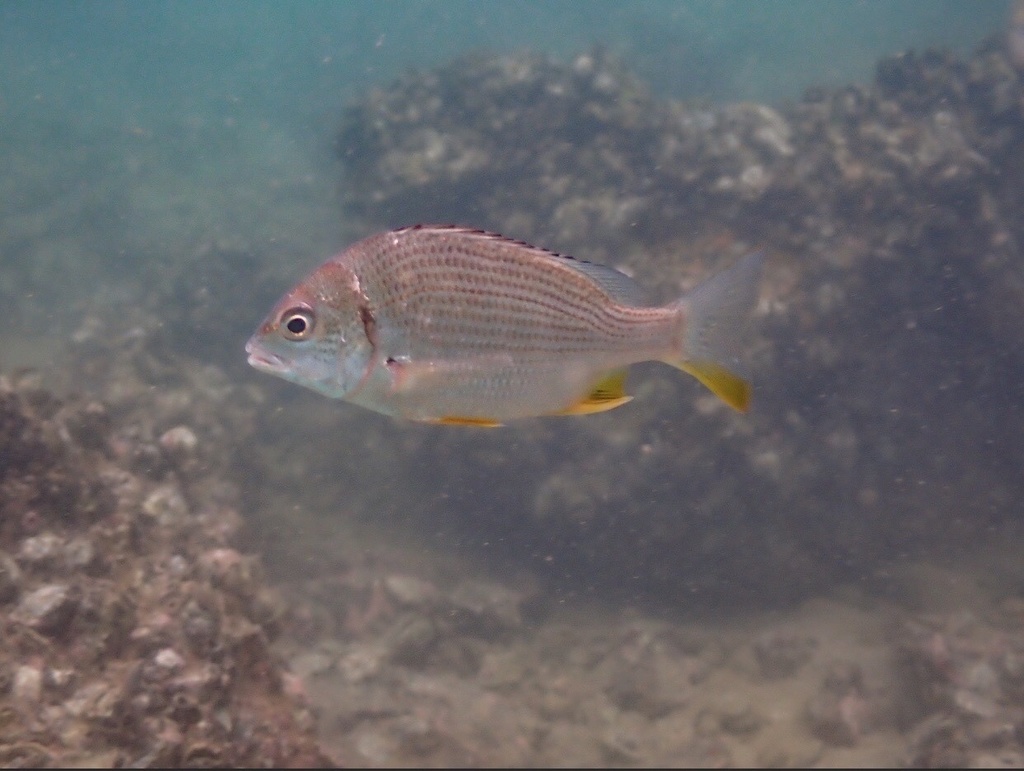
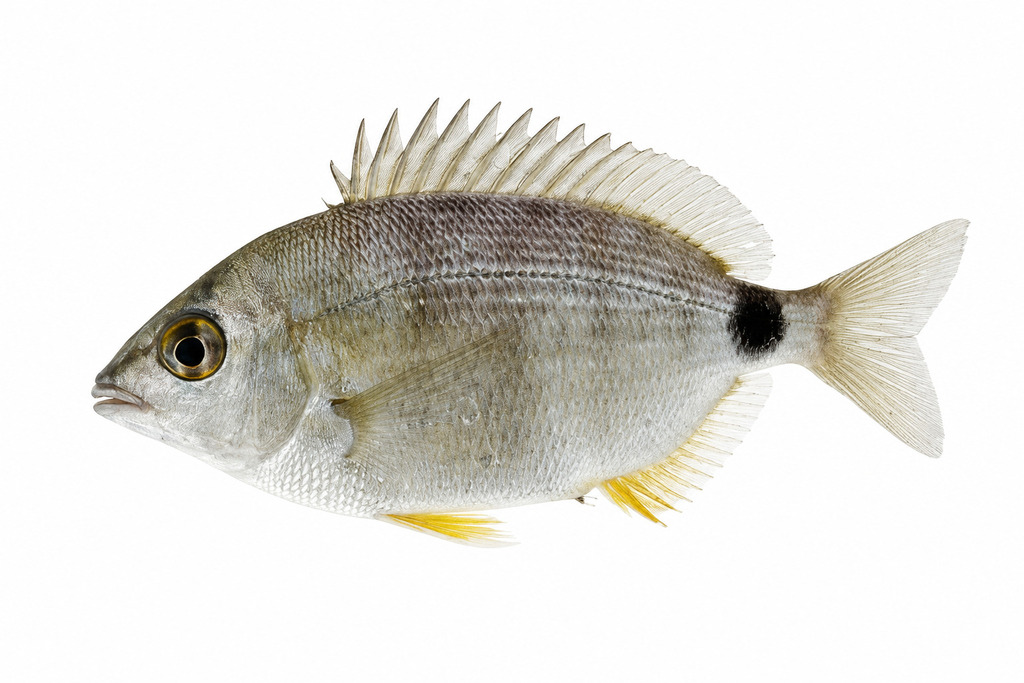
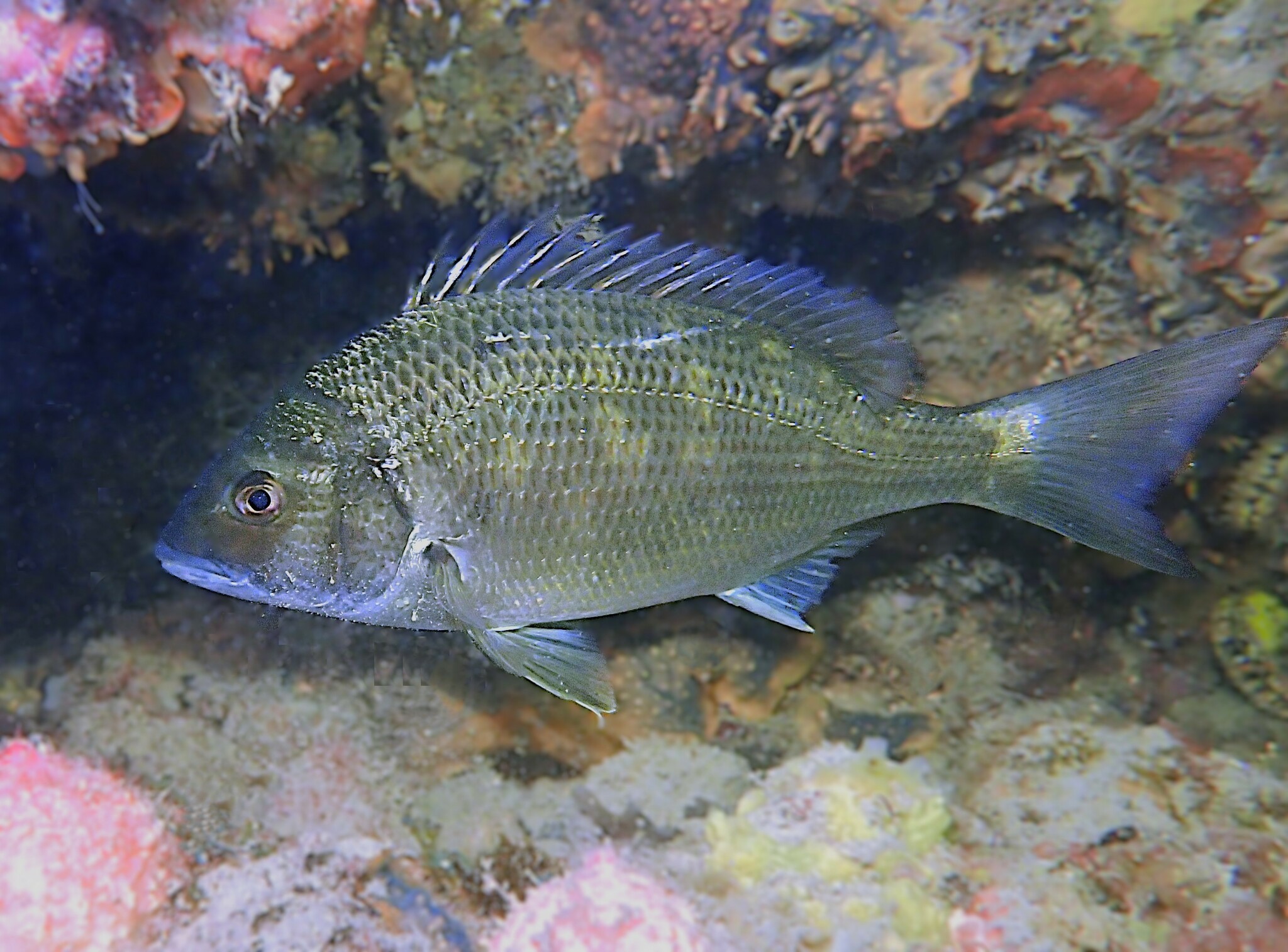
Yellowfin seabream (Acanthopagrus latus) is a fish of the family Sparidae. FishBase gives its range as: Northwest Pacific: limited to the east Asia Shelf, recorded only from the coasts of Honshu (including Seto Inland Sea), Shikoku and Kyushu Is., Japan (not Ryukyu and Ogasawara Is. or Sea of Japan), southern Korea, Taiwan, China (from around Shanghai to southern China) and northern Vietnam (south to Hué). It is recorded in subtropical water. The recorded maxima are 40 cm FL, 1.5 kg. IUCN status: Data Deficient (DD). Chinese name: .
Reading the spines
The identification characters are precise: 11 dorsal spines with 10–11 soft rays (XI,11 is the usual formula, rarely XI,10), 8–9 anal spines and 24 vertebrae. The body is deep in young fish and becomes slender in adults, 2.14–2.70 times in standard length, with 3.5–4.5 scale rows between the fifth dorsal-fin spine and the lateral line. Those proportions matter because the species was split out of a wider Indo-Pacific complex; older records from outside the east Asia shelf are treated by FishBase as misidentifications of related species. The record's ceiling is 40 cm fork length and 1.5 kg, with maturity at 24.4 cm.
An estuary fish with a saltwater address
FishBase calls it marine, freshwater and brackish, demersal, and places it in warm shallow coastal waters that often enter river mouths and estuaries. The range is narrow and specific: the east Asia shelf, from Honshu (including the Seto Inland Sea), Shikoku and Kyushu, but not the Ryukyu or Ogasawara islands or the Sea of Japan, then southern Korea, Taiwan region, the Chinese coast from around Shanghai south, and northern Vietnam to Hué. GBIF's 1,593 preserved records follow that shape: Japan 823, Taiwan region 217, China 212, Hong Kong SAR 86, Vietnam 18. iNaturalist holds 289 observations. A fish recorded from river mouths and rocky coasts in the same breath is not a contradiction; it is an animal that uses the transition.
The blanks are information
There is no depth range in the source, no spawning table and no temperature window. The honest response is to leave those fields empty rather than invent a number. On the water, the blank becomes a method: sound the ground until you find the first hard edge, the first channel, the first place where the estuary smell gives way to clean salt, and treat that as the working band. A mark that produces at 3 m tells you more about this species than a guessed 0–50 m ever could.
Where to start looking
The country and territory counts put the centre of gravity in Japan, and the Japanese records include the Seto Inland Sea, a shallow, island-dense basin with strong tidal exchange. Taiwan region and the Chinese coast from Shanghai south add estuary and breakwater ground; Hong Kong SAR's 86 records sit in the same pattern. For a visiting angler, the practical translation is to look for structure a demersal bream can hold against: a river-mouth bar, a rock wall at the edge of a channel, a jetty with tide running past it. The record supplies no coordinates, and neither does this page.
Tide, light and the first cast
The source does not name a best time of day; what follows is inference from the habitat. A fish that enters river mouths and estuaries lives in water that moves, and moving water carries food. Fish the tide rather than the clock: the first hours of a push and the last of a drop are the windows when a demersal fish can feed without working against the full flow. On a rocky shore that often means casting along the wall rather than into the open; in an estuary it means reading the seam where the outflow meets the incoming tide. Dawn and dusk are sensible starting points, not rules.
Small tackle, sharp mouth
At 40 cm and 1.5 kg, this is not a fish that needs heavy gear. The mouth is a bream's mouth — capable of crushing shellfish — so a light leader and a small, sharp hook will out-fish a heavy rig, and a lure that imitates a small fish or shrimp can be worked on the same rod you would use for seabass. The 24.4 cm maturity length is the number to remember when deciding what to keep: a 25 cm fish is an adult, but it is also the smallest adult the record describes. Check local size limits before applying that number.
Parasites, medicine and the market
FishBase notes two human-facing facts that are easy to skip: the species is used in Chinese medicine, and it is parasitised by the monogenean Anoplodiscus australis on the fins and body surface. The second is the one an angler will actually see. A few white or opaque patches on a fin are not automatically a reason to discard the fish, but they are a reason to look closely, photograph the affected area and check local advice. The first explains why the fish has a market beyond the dinner plate, and why a data-deficient species can still be commercially important.
What the record leaves open
IUCN lists the species as Data Deficient, assessed 3 December 2009; FishBase records commercial fisheries, commercial aquaculture and gamefish use. Data Deficient does not mean rare, and it does not mean abundant; it means the assessment could not resolve the question. The source also contains no verified regulation text. For an angler, that adds up to a short checklist: confirm the local size and bag rules, confirm whether the estuary is closed, and confirm that the fish in front of you is A. latus rather than another member of the complex. The rest of the page is a starting point, not a verdict.
How to catch it
Shore casting
Cast from shore or a breakwater, within reach of the recorded inshore range.
Rock fishing
Float or bait fishing from rocky shore marks.
Regulations before you keep it
These are the published regulations for this fish. Read the number first. The notice below it is the actual regulation.
Minimum size1
Fork length ≥150 mm
China — Fujian · CN-FJ
Fujian commercial catch standard (Fujian Fisheries Notice 2018 No. 114): the minimum catch size for yellowfin seabream is fork length ≥ 150 mm; smaller individuals count as juveniles. The notice does not address recreational angling, so whether an angler must release an undersized fish depends on the local fisheries authority.
Season / closure1
From 12:00 on May 1 to 12:00 on September 1, September 16 or August 16, depending on the area
China — national · CN-NATIONAL
All Chinese coastal waters (MAR Notice 2023 No. 1): the summer moratorium starts at 12:00 on 1 May and ends at 12:00 on 1 September, 16 September or 16 August depending on the sea area, and applies to capture operations. All gear types except hook-and-line are closed; rod-and-line fishing is outside the moratorium gear list, but hook-and-line vessels must still report port entry and exit, and coastal provinces may adopt stricter measures.
The closure has three area-based windows, all starting at 12:00 on May 1 and ending at 12:00 on September 1, September 16 or August 16.
Every record above names its source and the date it was retrieved. See the regulation register for the full list, or how to read these regulations.
Where these facts come from
Check these pages before you rely on a size, range or protection status.
-
FishBase — Acanthopagrus latus
— FishBase · T2
-
GBIF — Acanthopagrus latus occurrence records
— GBIF · T2
-
IUCN Red List — Acanthopagrus latus
— IUCN · T1
-
Photo record — iNaturalist
— iNaturalist · T3