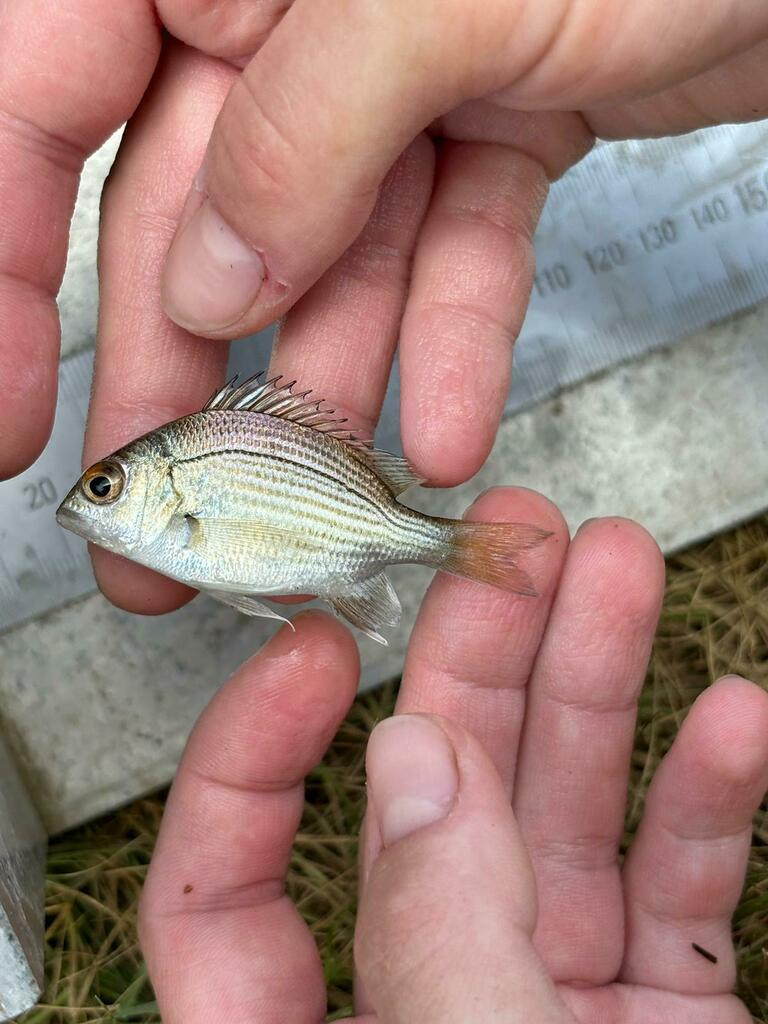
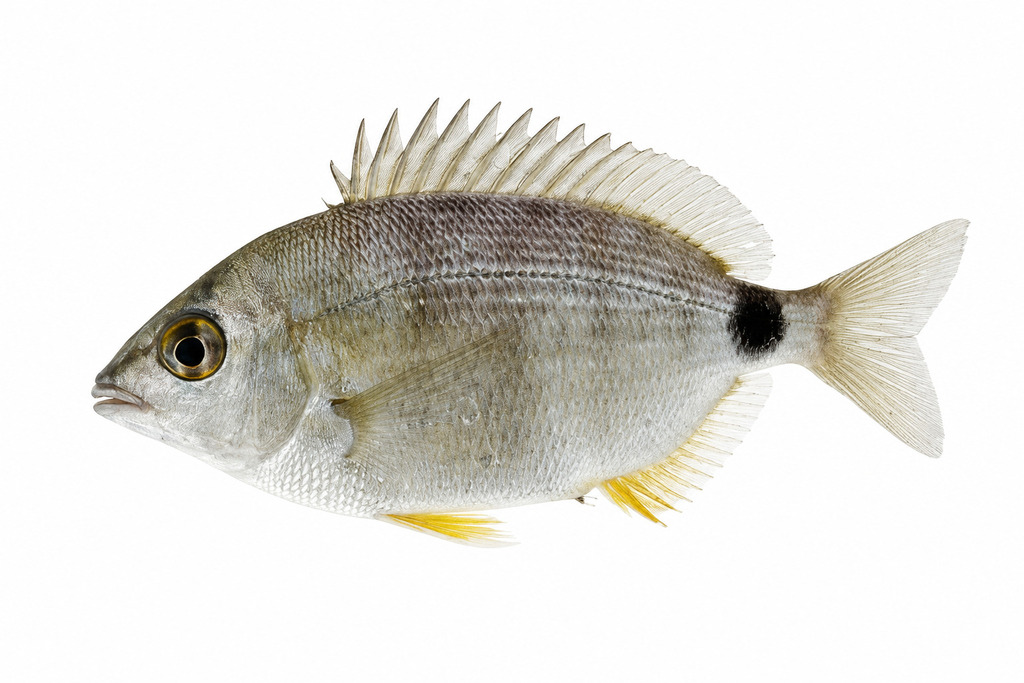
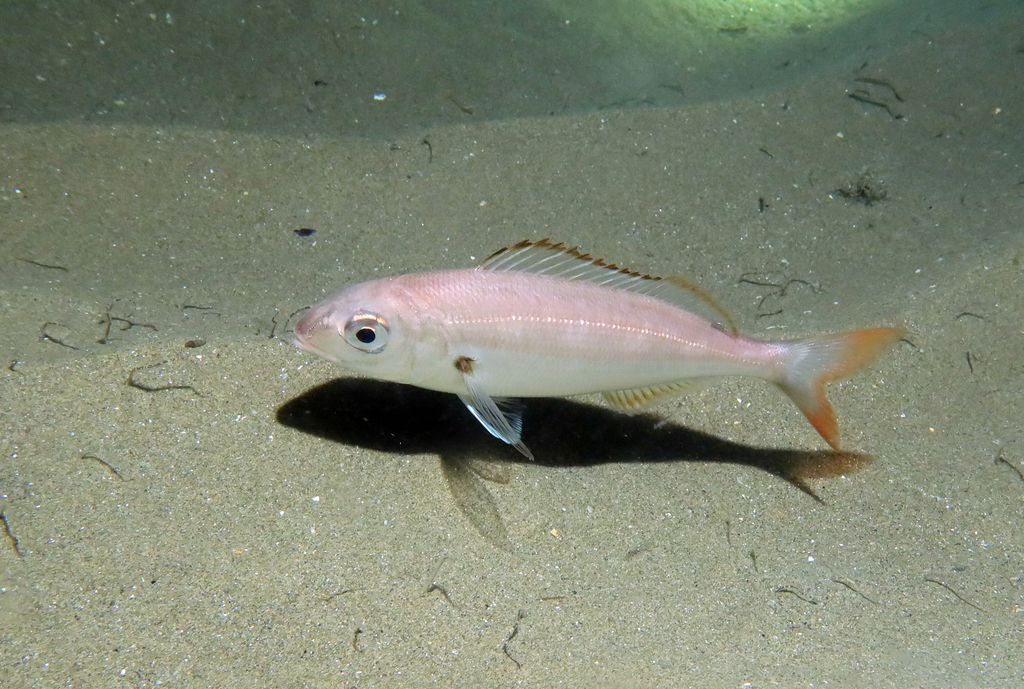
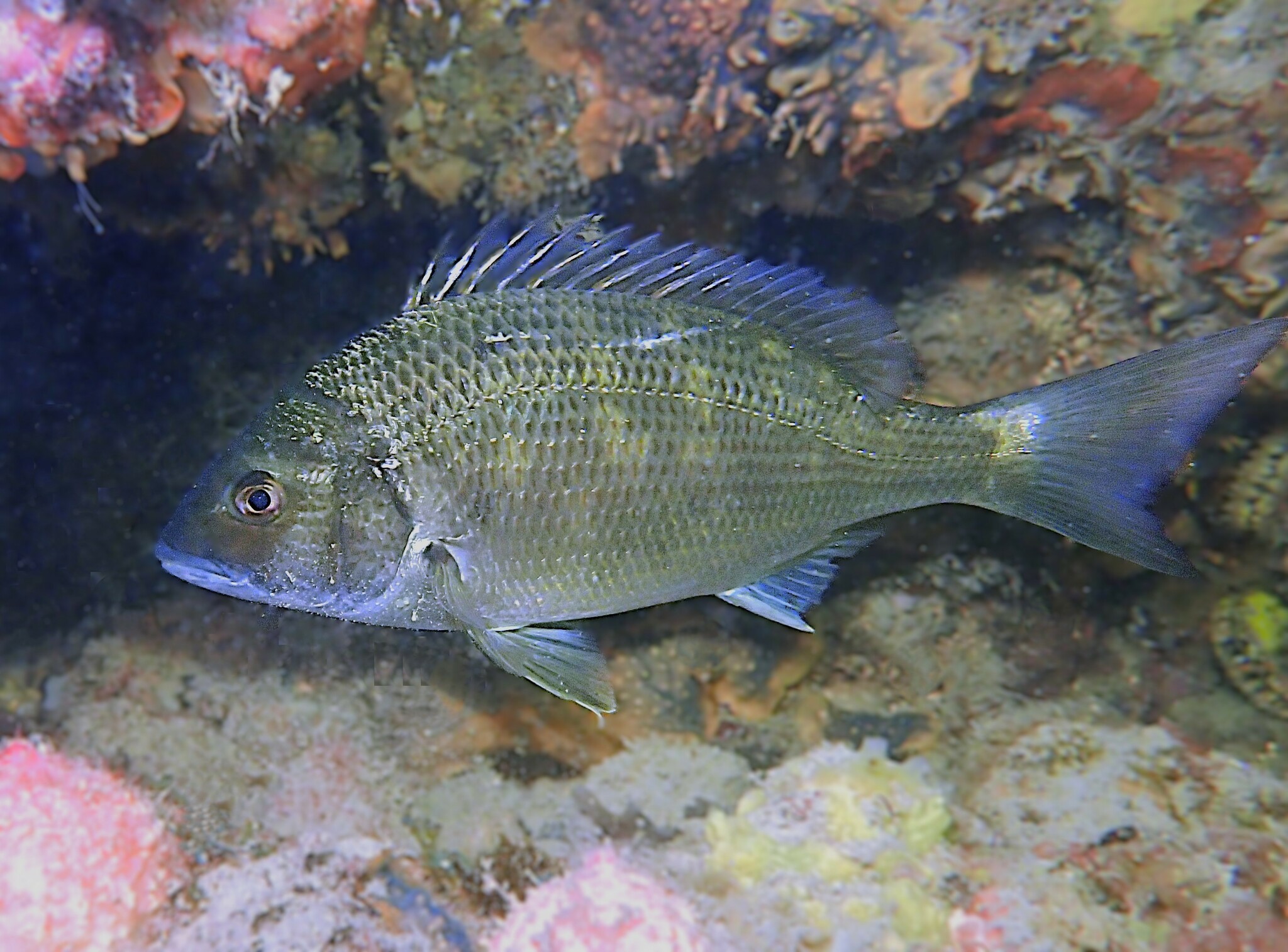
Pacific seabream is an estuarine and inshore sparid of the western Pacific, recorded from southern Japan south to Australia and east through the western Pacific islands. It enters river mouths, tidal creeks and sheltered bays, and also works rocky shorelines, which is why shore casters, rock anglers and small-boat fishermen all meet it. FishBase gives a maximum of 50 cm standard length and 34.8 cm for females, with maturity from about 21 cm. IUCN lists it as Least Concern, assessed in 2014.
Reading the spines
The fin formula is XI,11 dorsals and III,8–9 anals, usually III,8. The diagnostic set is more useful than the silver-grey colour: 3.5 scale rows between the fifth dorsal-fin spine base and the lateral line; the ventral edge of the first two infraorbitals straight below about 30 cm SL but visibly concave above the rear of the upper jaw at about 35 cm; the front edge of the dorsal scaly area on the head slightly convex and without small scales; 15–19 total gill rakers, modally 17; a deep body 45–48% SL, mean 47%; a small orbit 2.9–4.9 times in head length, mean 3.7; and a second anal-fin spine clearly longer than the third. Those proportions travel better than colour, which shifts with bottom and water clarity.
Where to start looking
FishBase's range is the western Pacific from Japan to Australia. Its country list runs Australia, China, Hong Kong, Indonesia, Japan, Macao, Malaysia, Papua New Guinea, the Philippines, the Ryukyu Islands, Singapore, Taiwan region, Thailand and Vietnam. GBIF's 984 occurrence records sit mostly in Australia (314), Taiwan region (285), Indonesia (147), Japan (86), the Philippines (48), Hong Kong SAR (23), Vietnam (20) and mainland China (16). The species is mainly brackish: estuaries, inlets, coastal rivers and tidal creeks, occasionally the lower reaches of freshwater streams, with juveniles in protected bays. It is usually solitary or in small groups, sometimes schooling on migration. Look for river-mouth bars, mangrove creeks, channel walls and jetty bases, where tide concentrates food and salinity swings.
FishBase does not list a diet for the species; on genus habits, expect benthic shellfish, crustaceans and worms, which is also how the bait choice is framed.
The blanks are information
FishBase gives only an Australian spawning window, June to September. A tropical, estuarine fish is catchable all year, but spawning and estuary entry shift with latitude; in Taiwan region and southern China the warm months are the practical season, while in eastern Australia the local winter record is the reference. No temperature window is published, so the honest advice is to follow local estuary temperature and avoid the first cold snap. Tide matters more than clock: the first hours of a push and the last of a drop put food within reach on the inside of bars and flats. Dawn and dusk are sensible starting points, not rules.
The GBIF cluster in Australia and Taiwan region is a reminder that this is a warm-temperate to tropical fish, not a cold-water bream. In Hong Kong SAR and southern China, the same animal uses harbour walls, typhoon shelters and rocky points. The species is a popular angling target and is often caught on hook and line. A visiting angler should read the venue as an estuary first: find the salt wedge, the channel edge and the first hard structure, then fish the seam rather than the open water.
Small tackle, sharp mouth
At 50 cm and a maturity length of 21 cm, this is light-tackle work: a 2.7–3.6 m rock rod or a 7–8 ft lure rod, a 2000–3000 size reel and an 8–12 lb fluorocarbon leader. The mouth can crush shellfish, so small, sharp hooks and compact baits out-fish heavy rigs. Prawn, crab meat and sandworm are the staples; bread and shrimp paste work in estuaries. Small minnows, soft plastics and vibration baits can be slow-rolled along walls. In strong flow, pack the berley so it reaches the bottom before it disperses, and in dirty estuary water use scent and sound.
Tide, light and the first cast
The source does not name a best hour, so the following is inference from habitat. A fish that lives where water moves feeds when the movement brings food; fish the tide rather than the clock. On a rock wall, cast along the structure, not into the open. In an estuary, read the seam where outflow meets the push. The first hours of the flood and the last of the ebb are the windows a demersal bream can use without fighting the full current. Dawn and dusk are convenient, not mandatory.
Eating, handling and the rules
FishBase records commercial fisheries, commercial aquaculture and public-aquarium use. The flesh is fine-grained and well regarded. Bleed and ice the fish, remove gills and guts, and keep estuary fish cool; a muddy note is handling, not species. Ciguatera is mainly a risk in large reef predators, so this estuarine sparid is lower risk, but large individuals and organs are still not a daily food. Rules differ by jurisdiction: Taiwan region has no nationwide recreational sea-angling licence but the Fisheries Agency and local governments can close areas and seasons and set minimum sizes, with additional no-take rules in protected areas such as Kenting; Hong Kong SAR has no recreational sea-angling licence, but the Fisheries Protection Ordinance regulates fishing methods and marine parks and marine reserves prohibit angling and collecting; Southeast Asian states set sizes, closed seasons and marine protected areas through their fisheries departments, with very uneven enforcement. Check the current local notice.
What the record leaves open
The page is built from FishBase's taxonomy, morphology, distribution, biology, human-use and IUCN entries, with the FishBase country table for range and GBIF/iNaturalist for occurrence. Water temperature, local spawning months in Taiwan region and local size limits are not standardised, so the text stays conservative. IUCN Least Concern is not a stock assessment. Confirm the local size and bag rules, confirm whether the estuary is closed, and confirm that the fish is A. pacificus rather than another member of the complex.
How to catch it
Bottom fishing
Fished with the listed approach, matched to the recorded depth and size.
Lure fishing
Fished with the listed approach, matched to the recorded depth and size.
Regulations before you keep it
These are the published regulations for this fish. Read the number first. The notice below it is the actual regulation.
Minimum size1
≥25 cm
Australia — Queensland · AU-QLD
Queensland sets a 25 cm minimum size for pikey bream.
Queensland's 30-fish possession limit for pikey bream is shared with tarwhine and yellowfin bream.
Pikey bream | Min: 25cm | Combined limit: 30 in total of pikey bream, tarwhine and yellowfin bream
Every record above names its source and the date it was retrieved. See the regulation register for the full list, or how to read these regulations.
Where these facts come from
Check these pages before you rely on a size, range or protection status.
-
FishBase — Acanthopagrus pacificus
— FishBase · T2
-
GBIF — Acanthopagrus pacificus occurrence records
— GBIF · T2
-
IUCN Red List — Acanthopagrus pacificus
— IUCN · T1
-
Photo record — iNaturalist
— iNaturalist · T3