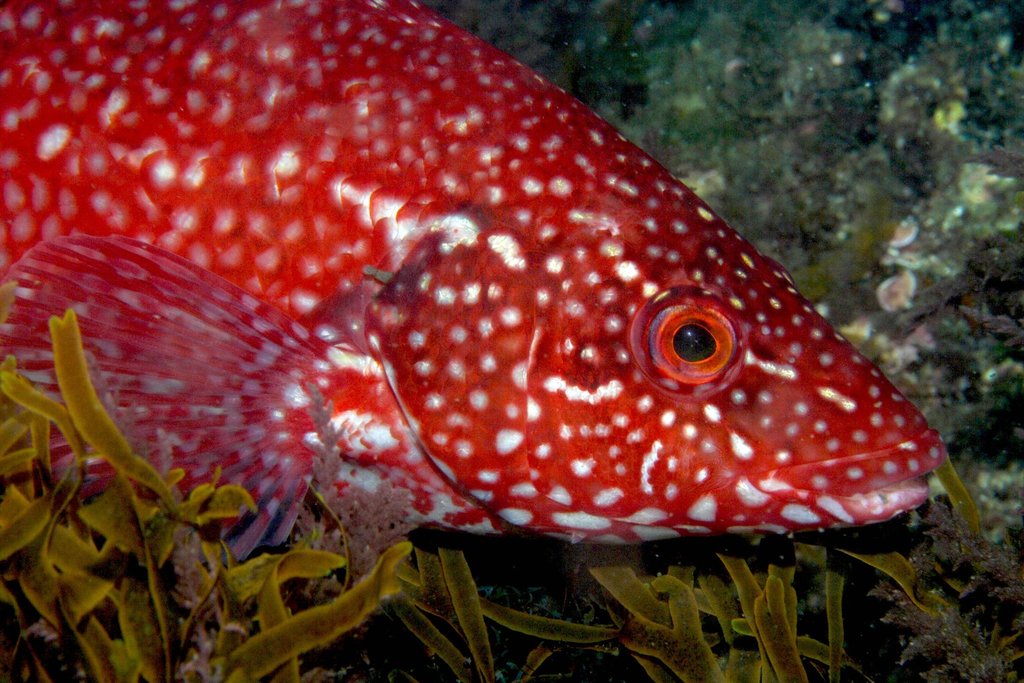
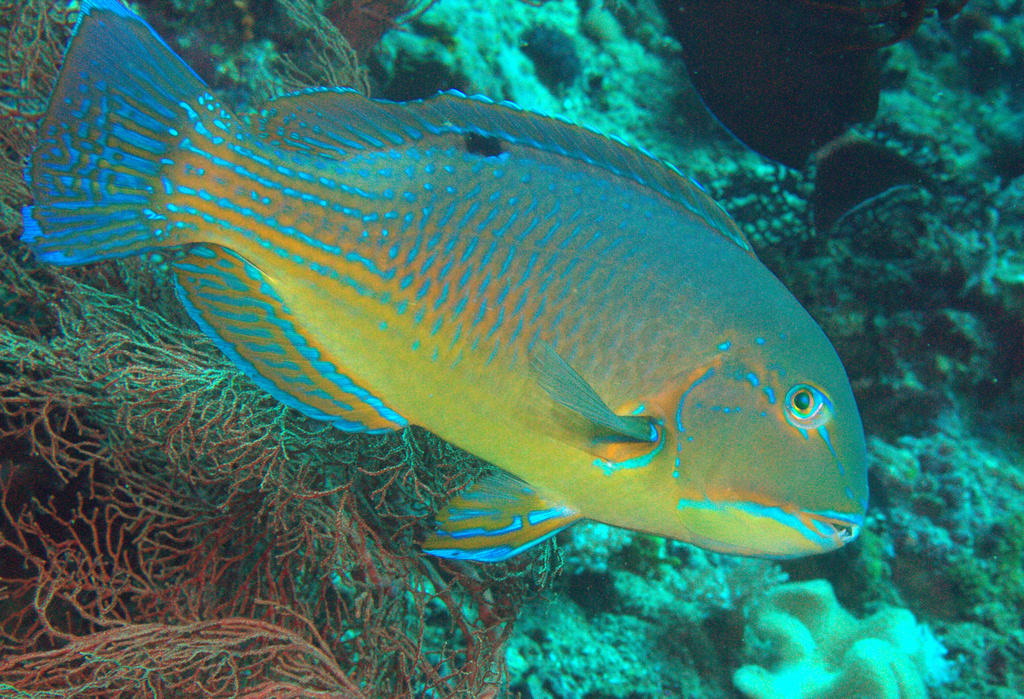
A single fish carries at least five English handles and two Chinese ones. The page title says Western blue groper; the common-name table lists Blue groper, Gould's wrasse, Parrotfish and Western blue wrasse in the same column. Chinese sources split between and . All of them point at an animal that reaches 175 cm and lives for decades. The names are not the problem to solve first; the problem is that each name leads to a different set of records.
Five English names, one animal
FishBase collects Blue groper, Gould's wrasse, Parrotfish, Western blue groper and Western blue wrasse as English vernaculars. iNaturalist prefers the capitalized Western Blue Groper. The five are not translations of one another. "Gould's" points at a person, "western" points at a coastline, "blue" points at a colour, and "parrotfish" is a handle borrowed from a different family of reef fishes.
A borrowed name is not an error to correct in public. Fishing communities rename what they catch, and a name can survive for generations after its original owner has moved on. What matters for a reader is that the record keeps all five without ranking them. A search for "blue groper" will return this species in some places and a different reef fish in others; only the two-part scientific name stays fixed.
Two Chinese names, two descriptions
FishBase's Chinese column gives in both character sets, and that is the name the field bundle uses. The expansion list that placed this fish on the site wrote instead. One name commemorates a naturalist; the other describes a western blue wrasse. Both are reasonable, and neither is an official standard name in the sense of a national fish catalogue.
The practical consequence is small but real: a Chinese reader searching will not find this page under that string, and a reader searching will. The slug is the stable address; the two Chinese strings are search keys. Keeping both visible costs nothing and prevents the false impression that there are two species.
The 175 cm record and the missing common length
The size block gives 175 cm total length, 39 kg as its top published weight, and 70 years as the greatest reported age. It gives no common length at all. Wikipedia repeats the 175 cm figure and puts the top weight at about 40 kg.
That 39 versus 40 is not worth a paragraph of reconciliation. They were published in separate references, and FishBase labels its own figure as the maximum published weight rather than a measured average. The missing common length is the more consequential gap: without a typical size, there is no source-backed "usual fish" to plan around, only a maximum and a maturity length. This entry will not invent the missing middle.
Maturity at 65.3 cm, age at 70 years
First maturity is recorded at 65.3 cm, with no range given. Against a 175 cm maximum, that places the spawning threshold at a bit over a third of the record length. The arithmetic is simple; the implication is not. A fish can be large, legally catchable in some jurisdictions, and still immature by this standard.
The other figure that reshapes any reading of the size structure is the 70-year maximum age. A species that can live seven decades does not rebuild a depleted size class in a few seasons. The record does not connect age to length for this species, and this entry will not draw that curve for it. What the two figures do support is a cautious reading of any unusually large fish: longevity and bulk are separate traits here, and one cannot substitute for the other.
Rock, continental shelf, 5 to 65 metres
Depth is recorded as a band from 5 to 65 m, the climate as subtropical, and the milieu as reef-associated. Its habitat keywords name rock and continental shelf; its diet keywords name fishes and echinoderms. Wikipedia adds rocky substrates and a diet that includes small crabs, molluscs and starfish.
Rock and shelf are not the same address. A 5 m mark and a 60 m mark can both be rocky, but the first is reachable from a shore ledge on a calm day and the second is a boat mark. The band does not say where inside it the fish concentrates, because the record supplies no usual-depth figure. Treating 5–65 m as "anywhere inshore" is the mistake this line invites.
Two southern coastlines
FishBase places the species in southern Australia, from southern Western Australia to South Australia. Wikipedia extends the eastern end to west of Melbourne, in Victoria, and puts the western end at the Houtman Abrolhos.
The two statements agree at the western end and disagree at the eastern one. FishBase stops at South Australia; Wikipedia continues into Victoria. Neither page explains the difference, and this entry will not pick a winner. A third source, the GBIF distributions endpoint, adds no geography at all: its single record is a "Global" presence entry attributed to the IUCN Red List, with no country-level rows. For a trip, the conservative reading is that the South Australian range is the part both records support, while the Victorian coast is a claim that should be checked against a local record before it is treated as established.
VU, minor commercial, and an empty gamefish field
The IUCN assessment is Vulnerable, dated 12 March 2008. CITES and CMS are both Not Evaluated on the same page. Under human uses, the fisheries line reads "minor commercial"; the gamefish field is absent rather than filled with a no.
An absent field is not evidence of absence. It means the record did not carry the value, so a reader cannot conclude that anglers do not pursue this fish, nor that they do. For regulation, the commercial label carries the weight: a Vulnerable, slow-growing, long-lived reef fish is the kind of species that jurisdictions manage with size limits and closures, and the name used in the regulation is what to search for.
The name to carry
Take two figures to the water: 175 cm as the largest recorded size, and 65.3 cm as the point below which the source considers the fish immature. Take one name as well: Achoerodus gouldii, because "blue groper", "parrotfish" and each lead somewhere slightly different. The five English handles and the two Chinese ones are useful for finding records; they are not useful for comparing them.
Regulations before you keep it
These are the published regulations for this fish. Read the number first. The notice below it is the actual regulation.
Minimum size2
60–100 cm (outside gulf waters)
Australia — South Australia · AU-SA
South Australia sets a 60–100 cm slot limit for western blue groper outside gulf waters.
Western Blue Groper (outside gulf waters) | 60 to 100 | 1 | 3
≥500 mm
Australia — Western Australia · AU-WA
Western Australia sets a 500 mm minimum legal size for western blue groper.
"Western blue groper Achoerodus gouldii 500 mm 1 1 1"
Bag limit2
1 fish per person per day · 3 per boat
Australia — South Australia · AU-SA
South Australia allows 1 western blue groper per person per day and a boat limit of 3.
Western Blue Groper (outside gulf waters) | 60 to 100 | 1 | 3
1 fish per person per day
Australia — Western Australia · AU-WA
Western Australia allows 1 western blue groper per fisher per day.
"Western blue groper Achoerodus gouldii 500 mm 1 1 1"
Every record above names its source and the date it was retrieved. See the regulation register for the full list, or how to read these regulations.
Where these facts come from
Check these pages before you rely on a size, range or protection status.
-
FishBase — Achoerodus gouldii
— FishBase · T2
-
GBIF — Achoerodus gouldii occurrence records
— GBIF · T2
-
IUCN Red List — Achoerodus gouldii
— IUCN · T1
-
Photo record — iNaturalist
— iNaturalist · T3