
Blue tuskfish
Blue tuskfish is a labrid of the Indo-West Pacific, from Western Australia to Queensland, with reports from Sri Lanka to Papua New Guinea, north to the Ryukyus and south to New Caledonia. It lives in subtropical water and reaches 70 cm TL.

Blue tuskfish (Choerodon cyanodus) is a fish of the family Labridae. FishBase gives its range as: Indo-West Pacific: Western Australia to Queensland. Reported to range from Sri Lanka to Papua New Guinea, north to the Ryukyu Islands, south to New Caledonia. Neither cited page describes colour, so the fin count and body plan carry the identification rather than a colour plate. It is recorded in subtropical water. The recorded maximum is 70 cm TL. IUCN status: Least Concern (LC). Chinese name: .
Identification
Choerodon cyanodus has the fusiform body and oval cross-section typical of the tuskfishes, with three anal spines and ten soft anal rays. The only size figure in the record is a 70 cm total-length maximum; common length, maximum weight, age at maturity and longevity are all absent. A 70 cm ceiling with no middle value means an angler cannot place a 40 cm fish in the life cycle from the data alone. iNaturalist's taxon 97653 carries 221 observations, and Wikipedia notes a diet of molluscs, including hatchling and juvenile green turtles. Neither cited page describes colour, so the fin count and body plan carry the identification rather than a colour plate.
Habitat and distribution
The record labels it marine, reef-associated and subtropical; its habitat keywords are reef, sand and continental shelf. Depth is simply not recorded. In prose the range stretches from Western Australia to Queensland, with reports between Sri Lanka and Papua New Guinea, north to the Ryukyus and south to New Caledonia. The accompanying country list contains just Australia and Viet Nam. Both are true to their own tables: one describes a broad Indo-West Pacific presence, the other records two territories, and no source reconciles them. Wikipedia says the fish is known around Australia but has been claimed farther afield. Against 221 iNaturalist sightings, any map of this species is a scatter of points rather than a filled coastline.
Season and fishing approach
No spawning month, depth band, weight or age is given, so the first trip has to be designed around what remains. Reef meeting sand or shelf edge is the starting ground, since those three words are the only habitat clues. Molluscs and small turtles in the diet suggest hard structure where shellfish grow, not clean sand. Baits shaped like fish, crustaceans or molluscs, fished along the reef-sand seam, are a sensible opening; tackle should suit a 70 cm wrasse rather than a 70 cm record. With no dated run in the sources, treat the first session as prospecting and write down depth, bottom type and water temperature. Those notes become the local season that the database lacks.
Edibility and regulations
The uses on record are the commercial fishery and the aquarium trade. IUCN's assessment, made on 30 April 2004, places it in Least Concern, while the species is absent from both CITES and CMS listings. Wikipedia mentions the aquarium trade but gives no catch statistics. No source states a legal minimum length or a daily take. Because the country list contains only two entries, a rule from one jurisdiction cannot be transferred to another; the assessment category is the sole statement that can be repeated, and a category is not a landing permit.
Where these facts come from
Check these pages before you rely on a size, range or protection status.
- FishBase — Choerodon cyanodus — FishBase · T2
- GBIF — Choerodon cyanodus occurrence records — GBIF · T2
- IUCN Red List — Choerodon cyanodus — IUCN · T1
- Photo record — iNaturalist — iNaturalist · T3
Fish in the same water
These fish live in the same place.
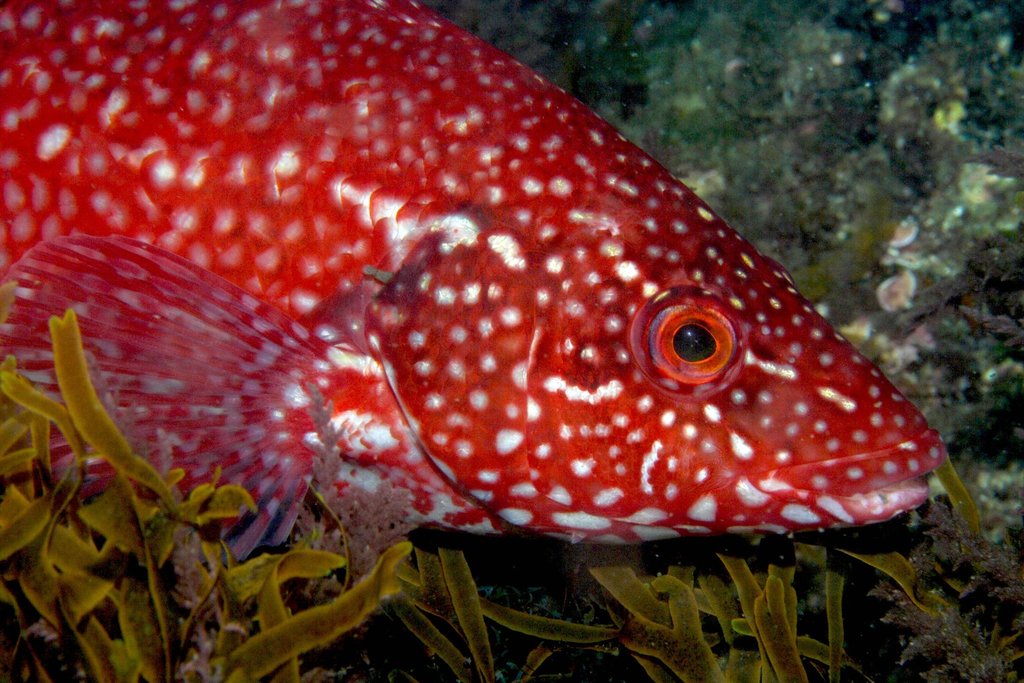
Ballan wrasse
- Family
- Labridae
- Depth
- 1–50 m
- Season
- Apr, May, Jun, Jul, Aug
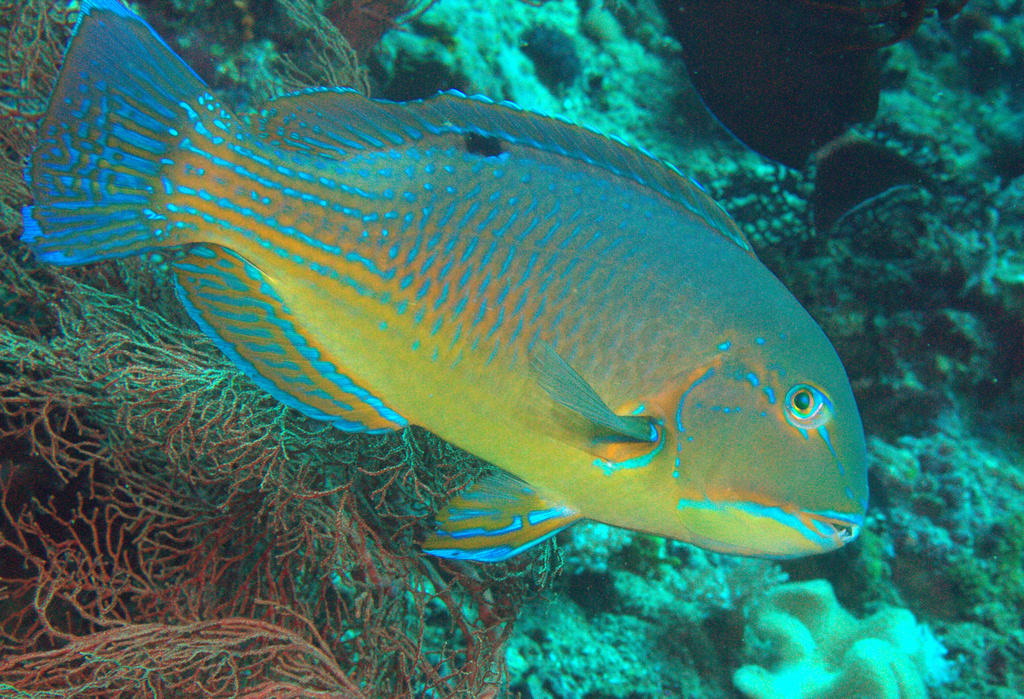
Blackspot tuskfish
- Family
- Labridae
- Depth
- 10–60 m
- Season
- Jan, Feb, Mar, Apr, May, Jun, Jul, Aug, Sep, Oct, Nov, Dec

Blue-barred parrotfish
- Family
- Labridae
- Depth
- 1–90 m
Guides for this water
Technique, gear and safety guides that fit Blue tuskfish.