
Blackspot tuskfish
Blackspot tuskfish is a labrid of the Indo-West Pacific, from the Ryukyu Islands south to Australia and Indonesia. It lives from 10 to 60 m in tropical water, reaches 100 cm TL and 15.5 kg, and feeds on crustaceans, fish and echinoderms. It is present year-round.
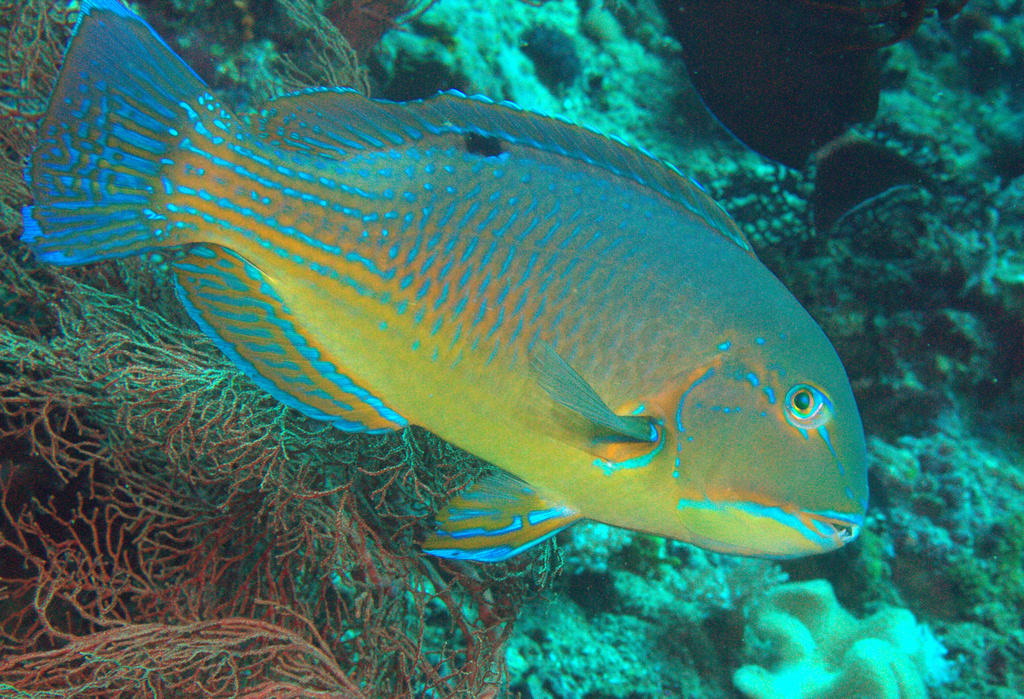
Blackspot tuskfish (Choerodon schoenleinii) is a fish of the family Labridae. FishBase gives its range as: Indo-West Pacific: Ryukyu Islands south to Australia and Indonesia. Reported from Mauritius. The blackspot tuskfish shares the fusiform, oval-sectioned build and the three-spine, ten-ray anal fin of its congeners. It is recorded from 10 to 60 m, in tropical water. The recorded maxima are 100 cm TL, 15.5 kg. Diet includes crustaceans, fishes and echinoderms. IUCN status: Near Threatened (NT). Chinese name: .
Identification
The blackspot tuskfish shares the fusiform, oval-sectioned build and the three-spine, ten-ray anal fin of its congeners. Its data set is fuller: 100 cm is the total-length maximum, 15.5 kg the heaviest published specimen, and maturity begins somewhere in a range starting at 24 cm. Typical length is unrecorded, leaving no market-size bridge between a 24 cm adult and a metre-long fish. Most records place it between 10 and 60 m, with 10–20 m the usual band; Wikipedia says it seldom occurs below 20 m. Taxon 97667 on iNaturalist has 501 observations.
Habitat and distribution
The Indo-West Pacific range runs from the Ryukyus south through Australia and Indonesia, with Mauritius also reported. The country and territory list names fourteen territories, among them China, Hong Kong SAR, Taiwan region, Thailand, Viet Nam, the Philippines and Japan. Sand and weed are preferred over clean coral in this tropical reef fish. Fish are concentrated in the shallow part of the recorded depth span; the 20–60 m tail is a secondary zone rather than the main ground.
Season and fishing approach
January to December is the spawning entry, supported by one Okinawa record from southern Japan. A year-round claim without a peak, resting on a single locality, cannot become a local closed season. Crustaceans, fish and echinoderms make up the diet, so crab, prawn and cut-fish baits over sand and weed at 10–20 m fit the feeding evidence. The species is also classed as a gamefish. Line and drag must handle a possible metre-long fish, although the average catch is far smaller. A leader heavy enough to turn a hooked fish away from reef matters more than a delicate presentation, because the usual ground is shallow and snaggy. Start on the shallow sandy band and move deeper only after evidence; that follows the usual-depth statement.
Edibility and regulations
Here the market and the wild stock point in different directions. Commercial fishing, commercial aquaculture, the aquarium trade and gamefish use are all listed, yet IUCN rated the species Near Threatened on 30 April 2004. Farming and trade do not remove the wild-stock concern, so the two entries can coexist. It has no CITES or CMS assessment. These three sources print no legal minimum or daily take. Fourteen jurisdictions sit in the country list, which means rules must be read one jurisdiction at a time rather than inferred from the volume of trade. Near Threatened is a category in this record, not a prohibition on landing.
Where these facts come from
Check these pages before you rely on a size, range or protection status.
- FishBase — Choerodon schoenleinii — FishBase · T2
- GBIF — Choerodon schoenleinii occurrence records — GBIF · T2
- IUCN Red List — Choerodon schoenleinii — IUCN · T1
- Photo record — iNaturalist — iNaturalist · T3
Fish in the same water
These fish live in the same place.


Guides for this water
Technique, gear and safety guides that fit Blackspot tuskfish.