
White sturgeon
White sturgeon can reach six metres and still be hooked within sight of a city skyline. It is neither a freshwater fish nor a saltwater one; the fishable part of its life is the boundary between the two. The catalogue files it as marine, freshwater and brackish, anadromous, 1–122 m at 0–23 °C — four points on one salinity gradient.
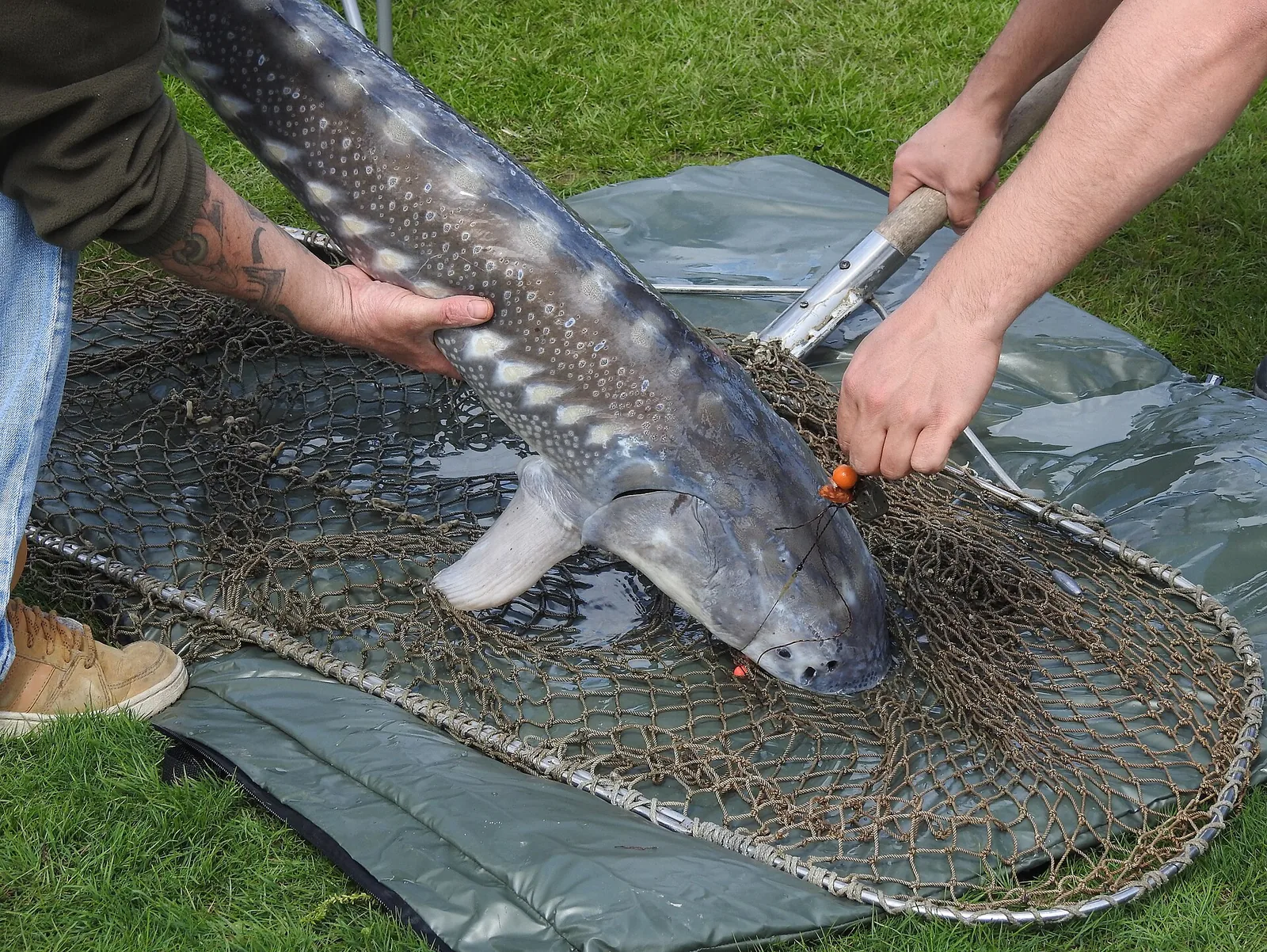
A white sturgeon can be six metres long and still be hooked within sight of a city skyline. Everything else about the fish follows from one awkward fact: it is not a freshwater species and it is not a saltwater species, and the part of its life that anglers can reach is the boundary between the two. The catalogue files it under three salinities at once — marine, freshwater, brackish — and adds anadromous, demersal, 1 to 122 m, 0 to 23 °C. Those are not four separate habitats. They are four points on a single gradient, and the fish is usually somewhere in the middle of it.
A fish defined by a salinity line
Adults spend most of their time at sea, close to shore. They enter the estuaries of large rivers, push far inland to spawn, and return. In an estuary the fresh river water rides over the denser sea water, and the boundary between them — the salt wedge — moves up and down the channel with the tide and with river flow. Sturgeon work that boundary. Wikipedia's summary of estuarine behaviour is unusually direct: the fish prefers deep, soft-bottomed areas, and its movement in the water column depends on salinity.
For a boat angler this is a map, not a fact. A deep hole inside the estuary holds fish when the wedge sits in it; the same hole can be empty on a big freshet, when the fresh layer thickens and pushes the salt water, and the fish with it, downstream. The mark is not "the deep hole". The mark is the deep hole plus the current salinity structure on that tide.
Why the "common length" is the least useful number here
FishBase gives a maximum of 610 cm total length, 816 kg, a reported age of 104 years, maturity at 160 cm, and a common length of 21 cm. That last figure is a trap. Twenty-one centimetres is a modal length from survey catches that include young-of-year; Wikipedia puts typical adult length near 2.1 m, a factor of ten higher. Use the common-length field to size a survey net, never to size a rod.
The weight figure needs the same handling. The 816 kg number is attached to an unauthenticated estimate for a 104-year-old fish. The most defensible maximum is 630 kg, and a 1995 sample of adults ran 34 to 75 kg. A fish that makes an angler's arms shake in an estuary is usually somewhere in that 10–40 kg band, with the very large animals being old females that are worth more in the water than on a deck.
Depth bands inside 122 metres
The recorded range of 1–122 m describes the whole species, not the fishing. In the tidal reach, most fishable water is 10–30 m, and the productive part of it is the bottom metre. On the sounder a sturgeon shows as a broad, soft return close to the mud, sometimes lifting a metre or two as it works upstream; it rarely produces the hard arch of a salmon.
Night matters more than dawn here. Studies summarised on Wikipedia record more active movement at night and link feeding movements to the tide, which fits the experience of anglers who fish the last of the flood into the first of the ebb and pick up fish after dark. The frozen hour before first light is not automatically the best hour.
How a sturgeon takes a bait
The mouth is underslung and protrusible, built to suck food off the bottom rather than to grab it. The take usually reads as a few taps, then steady weight, then a run. Hitting on the taps is how hooks pull; winding down until the line comes tight and letting the fish load the rod is how they stay attached. The barbels sit closer to the snout tip than to the mouth, and the sensory pits on the snout do the finding while the mouth does the lifting.
Gear follows from the fish's size and the fish's mouth. Heavy conventional tackle, a leader that will survive contact with the ventral scutes — the two rows of four to eight bony plates between the anus and the anal fin are the part that saws through light line — and a circle hook that can rotate into the corner of a mouth with no jaw to set against. A strike that works on a bass does nothing here.
The spring run follows the freshet
Spawning in the Sacramento–San Joaquin system runs from mid-February to late May, with the peak in March and April. Fish gather on gravel or rock in moderate to fast current, at 3–23 m, with bottom velocities of 0.6–2.4 m per second. They are communal broadcast spawners: one female, many males, eggs fertilised in the flow. The eggs are negatively buoyant and develop an adhesive coat on contact with water, which fixes them to the substrate; hatching takes 3–13 days depending on temperature, with 14–16 °C close to optimal. Females spawn every two to four years, males every one to two, and feeding stops shortly before spawning.
That single paragraph explains most of the season. The run is not a calendar event but a temperature and flow event: a cold spring pushes it late, a warm one early, and a dam release can change the water the fish are responding to within a day. Anglers who fish the run by date rather than by water temperature spend a lot of time looking at an empty river.
Dams, ladders and a very long memory
The distribution text sounds tidy — Alaska to Monterey, with landlocked populations in the Columbia drainage, Montana, Idaho and Lake Shasta — but the map is now a set of disconnected reaches. Dams built for hydropower blocked upstream movement across the Columbia basin, and the fish ladders were designed around salmon and steelhead, not around a fish that swims with its belly on the bottom. Downstream passage happens, through turbines, spill gates or the trash sluiceway, and nobody has identified the route.
Genetic work using microsatellites separates populations by watershed, which is another way of saying that a fish removed from one river is not replaced by fish from the next. The long lifespan cuts both ways: a 104-year-old fish is a library of good and bad years, and a population that stops producing young can look healthy for decades before the gap shows up in the catch.
What the rules are actually protecting
The IUCN assessment is Vulnerable, under criterion A2bc, dated 15 September 2020. CITES lists the species on Appendix II, which controls trade rather than fishing. NatureServe calls it globally secure but imperiled in California, and the American Fisheries Society treats it as endangered. In the Columbia basin retention is closed and catch-and-release fishing continues, busy enough that guide services advertise trips for it specifically.
That combination — a legally protected fish that people still deliberately target — is why the local rule matters more than the global status. A closed retention season with open catch-and-release is a different fishery from an open one, and the handling standard changes with it: keep the fish in the water, support the belly, skip the photograph if the fight was long.
The name on the label
In 2025 the species was moved from Acipenser to a revived genus, Sinosturio, a change that sturgeon biologists have not universally accepted. The specific epithet is built from trans, beyond, and montanus, of mountains, which is a fair description of a fish that swims inland past the Cascades. English common names accumulate along the same coastline — Pacific, Oregon, Columbia, Sacramento and Snake River sturgeon — and the Chinese name, , describes the head rather than the colour.
None of those names tells an angler where to fish. The salinity line does. Find where the fresh layer ends and the salt water begins, fish the bottom on the upstream side of that boundary, and the name on the label stops mattering.
How to catch it
Boat bottom fishing
Anchored boat over a deep hole, heavy bait fished on the bottom in current.
Shore fishing
Long rod from a pier, levee or bank, with enough weight to hold bottom.
Where these facts come from
Check these pages before you rely on a size, range or protection status.
- FishBase — Acipenser transmontanus — FishBase · T2
- GBIF — Acipenser transmontanus occurrence records — GBIF · T2
- IUCN Red List — Acipenser transmontanus — IUCN · T1
- Photo record — iNaturalist — iNaturalist · T3
Fish in the same water
These fish live in the same place.

Acoupa weakfish
- Family
- Sciaenidae
- Depth
- 1–20 m
- Season
- Jan, Feb, Mar, Apr, May, Jun, Jul, Aug, Sep, Oct, Nov, Dec

American angler
- Family
- Lophiidae
- Depth
- 0–800 m
- Season
- Mar, Apr, May, Jun

American eel
- Family
- Anguillidae
- Depth
- 0–464 m
- Season
- Jan, Feb, Mar, May, Jun, Jul
Guides for this water
Technique, gear and safety guides that fit White sturgeon.