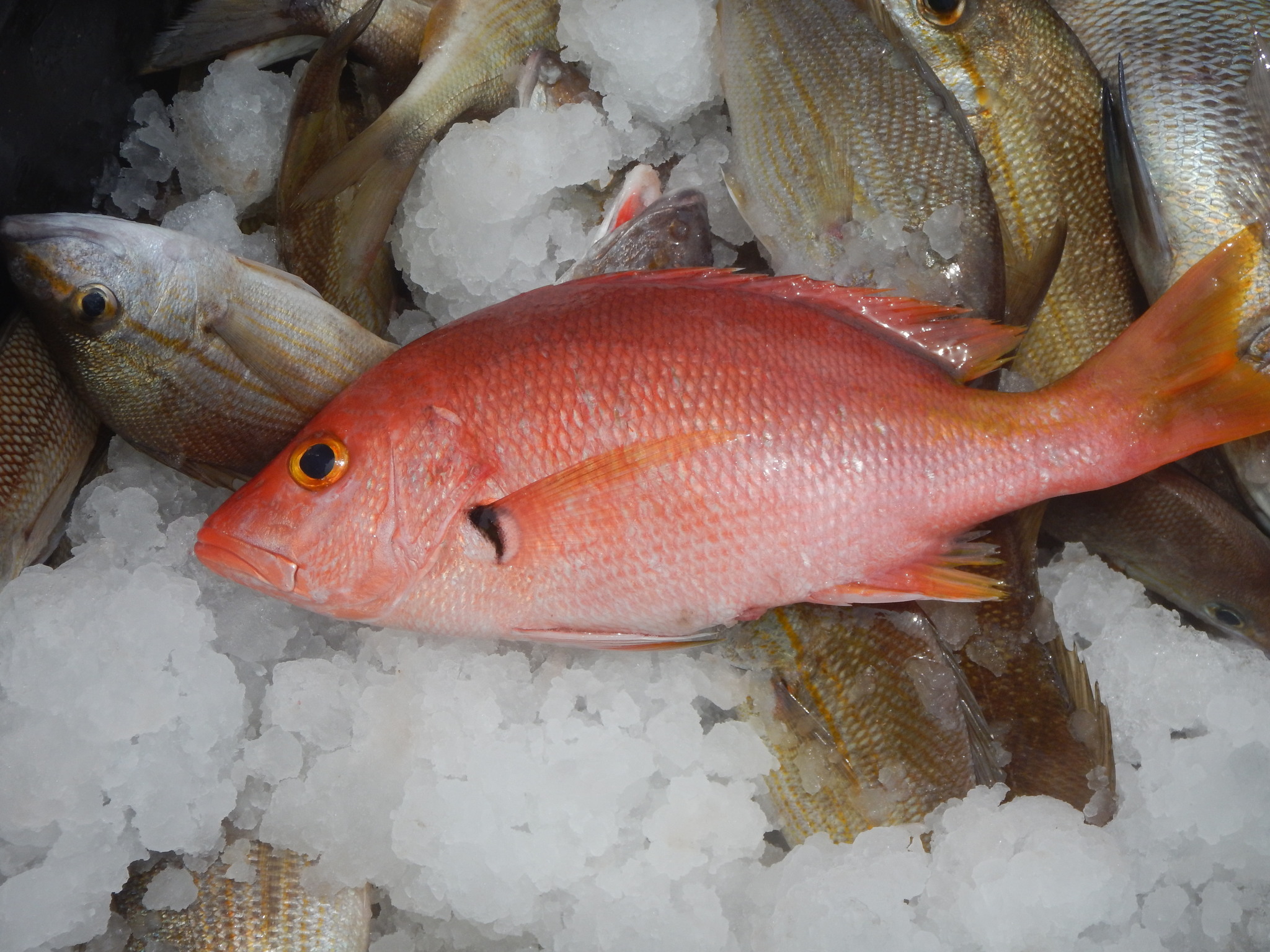
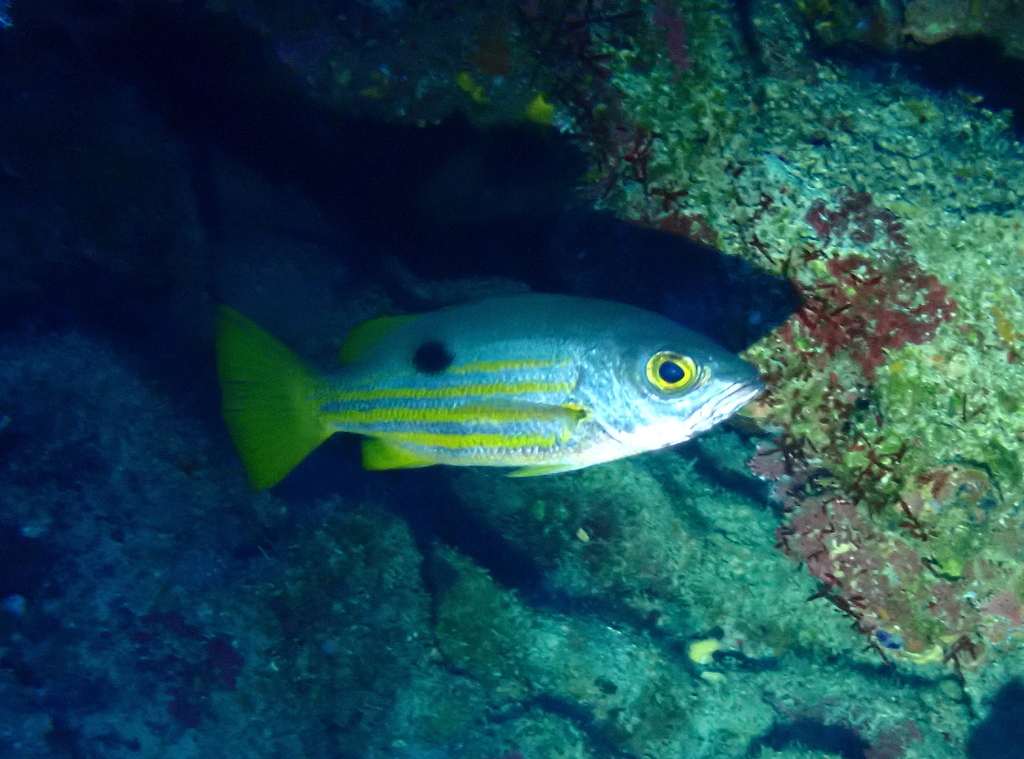
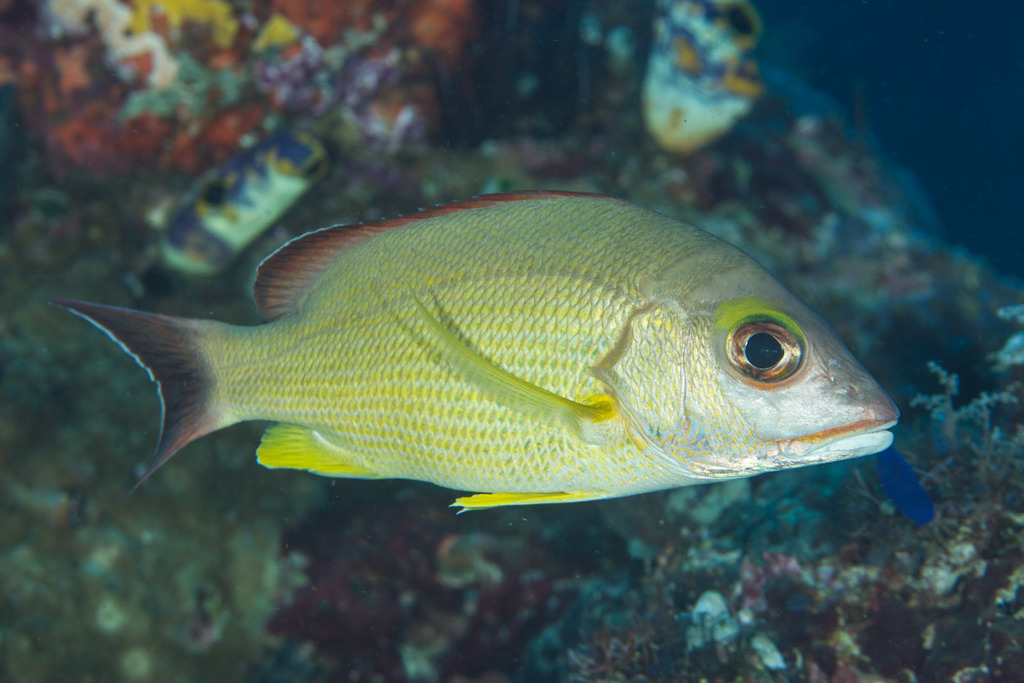
The build is elongate and laterally compressed, lighter than most snappers of the same length. Several characters together make the identification reliable. The lower jaw protrudes slightly, and the premaxillae are not protrusible, being fixed by a frenum, which is unusual among snappers. The jaw teeth are extremely small, minute in large adults, and the roof of the mouth is toothless. Gill rakers on the first arch total 49–52, the last soft ray of both dorsal and anal fins is produced, and the caudal fin is forked. Colour runs from blue-grey or mauve to overall reddish, with a black margin on the maxilla, a shining silver lining inside the mouth and gill chamber, and yellowish to reddish fins. The tubed lateral-line scales number 69–75. Taken together, these marks are safer than the word red.
East Africa to Hawaii, plus one South African record
The range is Indo-Pacific: East Africa to the Hawaiian Islands, north to the Ryukyu and Ogasawara islands, south to Australia, with a separate Southeast Atlantic record from Port Alfred, South Africa. That last line is easy to miss, because it places the species outside the ocean its main range describes. The coordinates run 35°N to 35°S and 24°E to 150°W. The country list stretches from East Africa and the Red Sea through India and Southeast Asia to Hawaii and French Polynesia.
GBIF holds 1,681 records, of which 1,116 are from Mayotte, 167 from Australia, 120 from Japan and 36 from the Philippines. The Mayotte share reflects long-term survey work there, not a population that exists only in one place.
Deep water has no season
No spawning month is recorded. Below 100 m the annual temperature swing is small, so the seasons affect boat days and sea state far more than they affect the fish's routine. That is the opposite of shallow-reef fishing, where water temperature is the first thing to check.
The latitudinal spread from 35°N to 35°S means the same month is a different proposition in Hawaii and southern Japan. Read the swell and wind forecast first, the moon second. When the bottom current is strong, the line goes down at a slant and the touch on the bottom becomes vague, so a slow drift is worth more than a heavy sinker. With no spawning window in the record, there is no month that must be avoided; treat the year as open and let the weather decide.
Dropping two hundred metres
The standard approach is deep bottom fishing. The boat holds over a steep slope in 100–250 m and a heavy handline or electric reel lowers a whole fish or a squid to near the bottom. Lehi is often deeper than ehu or gindai, which means a longer drop, so the first job is to confirm the bait has reached bottom rather than to lift it.
Slow-pitch jigging is the second method, worked along the same edge when the current eases. Baits are whole fish, squid and cut bait, matching a diet of fishes, squid and crustaceans. A whole fish survives small pickers better than a strip. When the current runs hard, resist the urge to add lead; a finer braid cuts the water and transmits the bottom better. Once the bait is down, let the current lift it and give two or three short lifts.
Gear that can read the bottom
The recorded ceiling is 110 cm and 11.3 kg, but the difficulty at this depth is line capacity and feedback, not the size of the fish. Use a metered braid so you know where each metre sits, and a reel or handline drum that carries more than 300 m. Choose the sinker for the current, heavy enough to touch bottom but not to wedge. A single hook or an assisted setup is more reliable than a treble on a hard mouth.
The retrieve is slow, and the first 30 m is where most fish are lost, so keep the drag steady instead of locked and let the fish vent as it comes up. Keep a venting needle and pliers on board, and shorten the time any released fish spends out of the water.
Five fish, one bag
FishBase records the species as both commercial and game, marketed fresh. Hawaii lists lehi in the Deep 7 bottomfish group, with a non-commercial bag of five fish per person per day across the whole group. During a declared closure, fishing, possession and sale are all prohibited; traps, trawls, bottom longlines and nets are banned; bottomfishing vessels must be registered with DLNR and marked with a BF number, and commercial landings reported within five days.
In federal waters, an EEZ bottomfish permit is required, the 2025–2027 MHI Deep 7 ACL is 493,000 lb, and the NWHI and Papahānaumokuākea are closed. A non-resident recreational angler needs an NRMFL and commercial sale needs a CML. Check the current year's announcement for size and bag terms.
Where the data thins out
The entry relies on FishBase for taxonomy, range, meristics, depth, diet and use, GBIF for national records, iNaturalist for the taxon link and 32 observations, and the DLNR-DAR and NOAA pages for Deep 7 rules. Thirty-two observations is what a 200-metre fish should look like on a photo platform, not evidence of rarity. FishBase gives no spawning month and no length at maturity, so the season section is written around sea state. The Deep 7 bag is an aggregate across seven species, not five fish of each, a distinction that is easy to get wrong when planning a trip.
How to catch it
Deep bottom fishing
Fished with the listed approach, matched to the recorded depth and size.
Jigging
Fished with the listed approach, matched to the recorded depth and size.
Regulations before you keep it
These are the published regulations for this fish. Read the number first. The notice below it is the actual regulation.
Minimum size1
≥25 cm (tropical snapper group default)
Australia — Queensland · AU-QLD
Queensland's tidal-water table does not name Lehi. Species in the tropical snapper and sea perch group default to a 25 cm minimum size and 5 per species.
Lehi is not listed by name in the Queensland table; the 25 cm and 5-per-species figures are the group defaults. Confirm placement with Queensland Fisheries before relying on them.
Tropical snappers and sea perch | Min: 25cm | Limit: 5 per species
Bag limit1
5 fish possession limit (group default)
Australia — Queensland · AU-QLD
Queensland's tidal-water table does not name Lehi. Tropical snappers and sea perch default to a possession limit of 5 per species.
Lehi is not listed by name in the Queensland table; the 25 cm and 5-per-species figures are the group defaults. Confirm placement with Queensland Fisheries before relying on them.
Tropical snappers and sea perch | Min: 25cm | Limit: 5 per species
Every record above names its source and the date it was retrieved. See the regulation register for the full list, or how to read these regulations.
Where these facts come from
Check these pages before you rely on a size, range or protection status.
-
FishBase — Aphareus rutilans
— FishBase · T2
-
GBIF — Aphareus rutilans occurrence records
— GBIF · T2
-
IUCN Red List — Aphareus rutilans
— IUCN · T1
-
Photo record — iNaturalist
— iNaturalist · T3