
Blacktail snapper
Blacktail snapper is a small, fusiform lutjanid of the Indo-Pacific, from East Africa to the Marquesas and Line Islands, north to southern Japan and south to Australia. It works shallow reef from 1 to 80 m in water of 20 to 28 degrees C and feeds on fish and molluscs. Fish reach 40 cm TL and 0.82 kg, and it can live 34 years, a long life for a snapper of that size. It is present year-round.
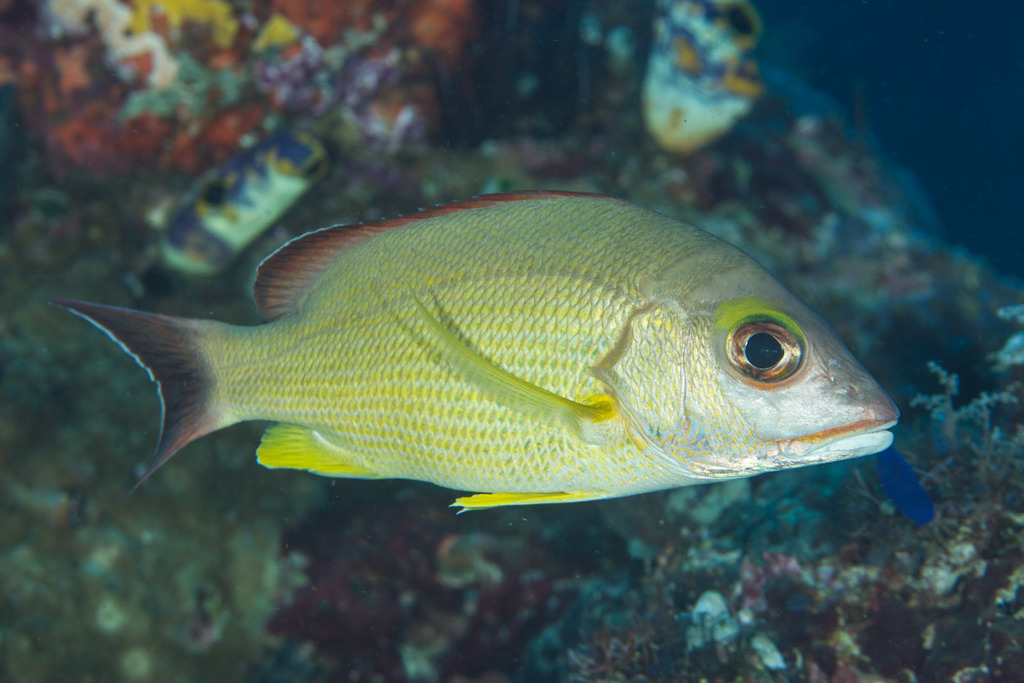
Blacktail snapper (Lutjanus fulvus) is a fish of the family Lutjanidae. FishBase gives its range as: Indo-Pacific: East Africa to the Marquesas and Line islands, north to southern Japan, south to Australia. Records from the Red Sea and Persian Gulf are outside distributional range. Three of them say blacktail, one says flametail, and four say yellow-margined; eight end in snapper, five in seaperch, and one, "Taiva", names no body part at all. It is recorded from 1 to 80 m, in tropical water at 20–28 °C. The recorded maxima are 40 cm TL, 0.82 kg, 34 years. Diet includes fishes and molluscs. IUCN status: Least Concern (LC). Chinese name: .
Identification
The FishBase common-name table carries fourteen English spellings for one species. Three of them say blacktail, one says flametail, and four say yellow-margined; eight end in snapper, five in seaperch, and one, "Taiva", names no body part at all. Wikipedia's lead repeats the same set, including flametail snapper and Waigeu snapper. The Chinese table adds a second colour vocabulary, and and , all in use for the same taxon.
The taxonomy is not contested: Lutjanus fulvus in Lutjanidae; the mismatch sits between trade names and that one accepted name. A black tail and a flame tail are opposite colour cues, and a "sea perch" is a different market category from a "snapper" even when the same fish is in the box. iNaturalist resolves to "Blacktail Snapper" and holds 2,198 observations under taxon 121459.
Size data start at 40 cm TL for the largest fish and 25 cm TL for the usual one, with 820 g as the heaviest published weight. Maturity is 20.6 cm and maximum reported age 34 years — an age record, not a size record.
Habitat and distribution
The environment line runs marine, freshwater and brackish together, reef-associated, 1–80 m, tropical at 20–28°C, spanning 34°N–34°S and 28°E–134°W. The habitat keywords are freshwater, deep and open-water. The hard numbers are the 1–80 m band and the reef association; the label set around them is wide.
The written range runs east from Africa to the Marquesas and Line Islands, north to southern Japan and south to Australia, with Red Sea and Persian Gulf records placed outside the range. The country table carries 73 territories.
OBIS holds 6,532 records in 95 datasets dated 1801 to 2026. A name-only query with no country facet in the reply gives heavy sampling but no location.
Season and fishing approach
Spawning is recorded in all twelve months at lower latitudes, while the Japan entry for the Yaeyama Islands runs April to October. Those are two different statements: one covers a latitude band, the other a single archipelago, and the second is the one to use if you are fishing southern Japan. No other month data appear on the record.
At the 1 m shallow edge, a shore session or a small boat covers the holding water, and the 25 cm common length sets the tackle class well below what the 40 cm maximum suggests. Reef-associated plus the depth band means the productive ground is the reef edge rather than open water. Because the same fish travels as flametail in Guam and Micronesia and as yellow-margined in Hawaii, the name on a local rule may not match the name on this page.
Edibility and regulations
The record carries a threat-to-humans note citing reports of ciguatera poisoning; that is a source report attached to the species, and it applies to some places and not others rather than to every fish. FishBase lists the species as commercial, as a gamefish and as a commercial aquarium species. Its Red List status, from the 4 March 2015 assessment, is Least Concern. There is no CITES appendix and no CMS one.
All 73 rows are presence records: no closed season, no minimum landing length and no daily bag, and no agency named. Where a recreational rule exists it is in the law of the landing country, written under the local name.
Where these facts come from
Check these pages before you rely on a size, range or protection status.
- FishBase — Lutjanus fulvus — FishBase · T2
- GBIF — Lutjanus fulvus occurrence records — GBIF · T2
- IUCN Red List — Lutjanus fulvus — IUCN · T1
- Photo record — iNaturalist — iNaturalist · T3
Fish in the same water
These fish live in the same place.

Guides for this water
Technique, gear and safety guides that fit Blacktail snapper.