
Blackspot snapper
The recorded depth range is 5 to 20 m. Fifteen metres of vertical room is the whole habitat, and that single fact reorganises everything else: no deep drop, no electric reel, no long run to the shelf. The species lives in the layer a shore angler can reach with a modest cast, and the question is not how deep to go but where inside that shallow band to stand.
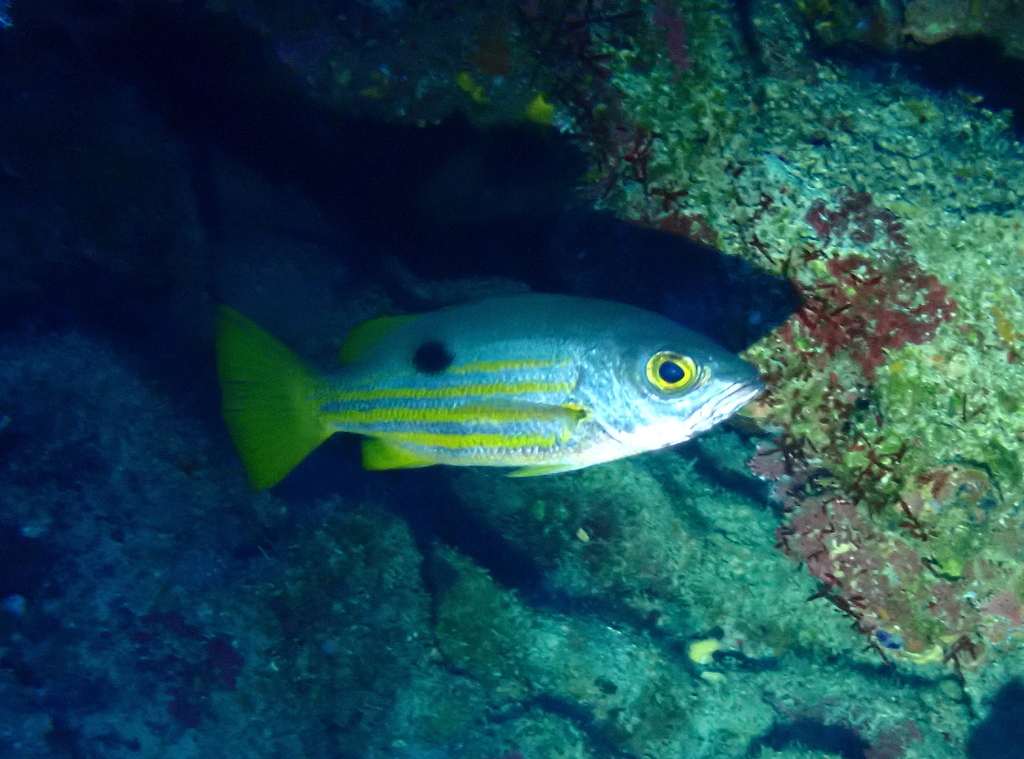
The recorded depth range is 5 to 20 m. Fifteen metres of vertical room is the whole habitat, and that single fact reorganises everything else: no deep drop, no electric reel, no long run to the shelf. The species lives in the layer a shore angler can reach with a modest cast, and the question is not how deep to go but where inside that shallow band to stand.
A band fifteen metres deep
It also explains the size, and the way the fish is used. A species that spends its life in the top twenty metres of coastal water does not grow to 90 cm, and this one does not: 35 cm maximum, 20 cm common. It is recorded as a minor commercial catch and appears in local markets mostly fresh, which is what a small, school-loving, shallow-water snapper looks like in an economy.
One black spot, four yellow lines
The back and upper sides are dark brown; the lower sides and belly are whitish with a silver sheen. Below the lateral line run four or five narrow yellow stripes, and a distinct round black spot sits on the back beneath the rear of the spinous dorsal fin. That spot is the name and the field mark at once.
Counts: ten dorsal spines with thirteen to fourteen soft rays, anal fin III, 7-9, body depth 2.5 to 3.0 in standard length, tail truncate to slightly emarginate. The preopercular notch and knob are poorly developed, and the vomerine tooth patch is triangular with a rearward middle extension; both need the fish in hand.
One more lab character is worth knowing if you keep records: the scale rows on the back run parallel to the lateral line, and the gill rakers on the first arch count 6 to 7 on the upper limb and 10 to 14 on the lower. On a boat, the black spot and the yellow lines do the job in under a second.
Fresh water is the locator
Adults sit in very shallow coastal habitat and are often found in large schools near freshwater run-offs; juveniles are frequently intertidal, over sand, silt or coral rubble, sometimes in mangrove-lined streams and estuaries, and the species may enter fresh water to feed. In a coastline that looks uniform for kilometres, that is the one feature worth navigating by.
The run-off carries food and cuts visibility, and the school uses the turbid edge rather than the fresh water itself. Fish the boundary, not the mouth. When the rain stops and the outflow thins, the school spreads out and the mark goes quiet, which is why two visits a fortnight apart can produce completely different days.
The horizontal range is wide, from the Red Sea and East Africa to the Solomon Islands and out to the Marshall Islands, between 31°E and 172°E and from 30°N to 18°S. The animal that covers that much ocean is not a specialist, and the reason it is found in so many places is the same reason it is easy to overlook: it occupies the shallow edge everywhere, and almost nobody writes about it.
Small hooks and a fast count
The recorded commercial methods are handlines, traps and gill nets, with the catch sold mostly fresh. For rod and line, that translates into small hooks, small pieces of shrimp or fish, and just enough lead to reach the bottom. Because the fish schools, the first take is usually followed by several more, and the count rises quickly.
Keep the rod tip low and move the bait slowly along the bottom. The bite reads as a series of light taps rather than a run, so strike on the first firm load instead of waiting for the rod to bend double.
The recorded use of traps and gill nets is a hint about behaviour as much as about gear: a fish that can be netted in numbers in shallow water is one that holds position in a school. A rod is simply a slower way of reaching the same group, and the group, not the individual, is what you are managing when you decide how many to keep.
Twenty centimetres is the fish
Common length 20 cm, maximum 35 cm, first maturity 20.1 cm, maximum age 12 years. Maturity and common length are the same number here, which is unusually tidy and also a warning: the everyday fish is a mature fish, so a slot that keeps only the biggest removes the breeding stock, while a slot that keeps everything removes the juveniles.
Fishing vulnerability is 19 out of 100, the lowest in this group of snappers. Light tackle is not a compromise on this species; 2000 to 3000 size reel, 0.8 to 1.0 PE braid and a 10 to 15 lb leader will land it and will also present a small bait properly. Heavy line simply shuts the bite down.
Note that age at maturity is given as 1.7 years and maximum age as 12, so this fish does the opposite of the long-lived groupers in the same water: it breeds early and dies young. That changes the release argument. A 20 cm fish is already a breeding fish, and the fish worth protecting is the cohort of young ones, not a single old giant, because there are no old giants to protect.
Two gulfs and a monsoon coast
Uses are listed as minor commercial only. IUCN lists it under Least Concern as of 30 June 2016, and it is classed as harmless to humans, with nothing on ciguatera in the record.
The United Arab Emirates manages recreational fishing and reef protection at emirate level, with federal coordination through the climate and environment ministry. Saudi Arabia runs fisheries through its environment, water and agriculture ministry, with current rules covering recreational take and reef areas. Thai authorities close the Similan and Surin parks for the monsoon window from about May to October. Sri Lanka closes the core of Bar Reef, Hikkaduwa and Pigeon Island without setting a national minimum size. The Maldives forbids the killing of reef sharks, licenses reef-fish exports and bars sales of tourist catch.
How to catch it
Boat bottom fishing
Fished with the listed approach, matched to the recorded depth and size.
Where these facts come from
Check these pages before you rely on a size, range or protection status.
- FishBase — Lutjanus ehrenbergii — FishBase · T2
- GBIF — Lutjanus ehrenbergii occurrence records — GBIF · T2
- IUCN Red List — Lutjanus ehrenbergii — IUCN · T1
- Photo record — iNaturalist — iNaturalist · T3
Fish in the same water
These fish live in the same place.
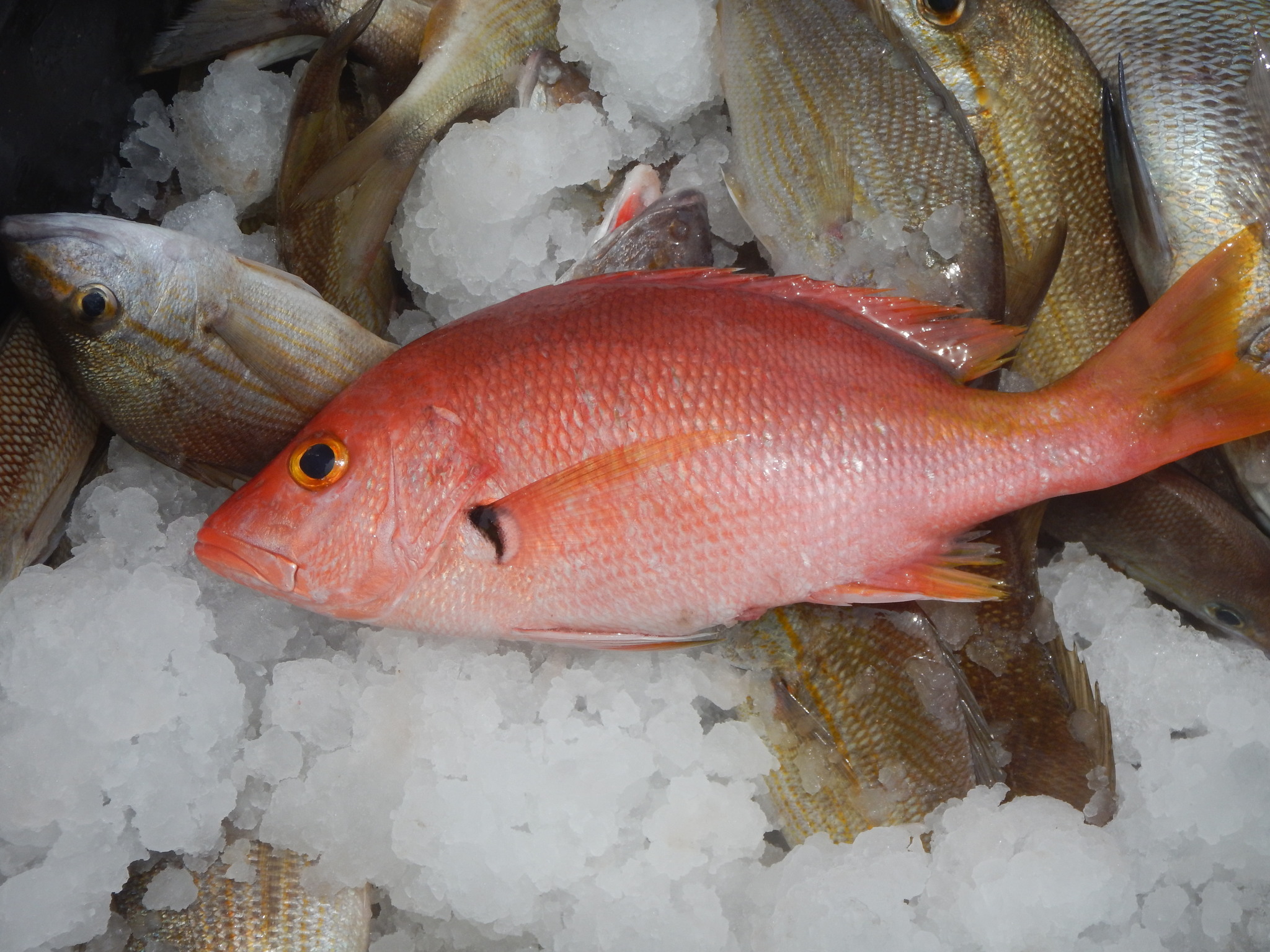
Blackfin snapper
- Family
- Lutjanidae
- Depth
- 20–200 m
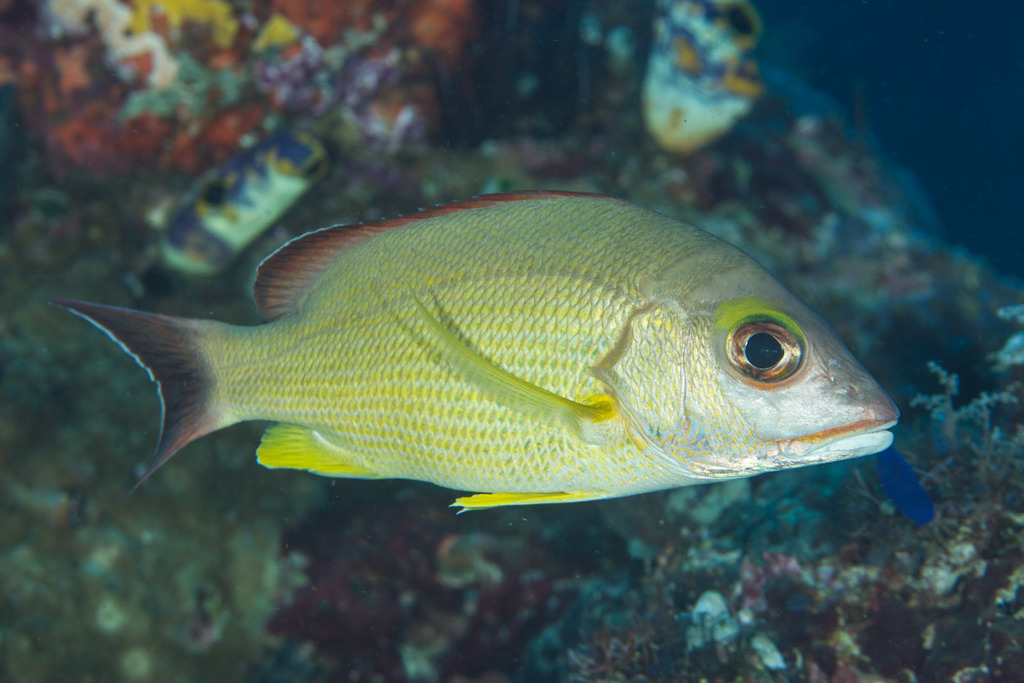
Blacktail snapper
- Family
- Lutjanidae
- Depth
- 1–80 m
- Season
- Jan, Feb, Mar, Apr, May, Jun, Jul, Aug, Sep, Oct, Nov, Dec

Blubberlip snapper
- Family
- Lutjanidae
- Depth
- 3–150 m
Guides for this water
Technique, gear and safety guides that fit Blackspot snapper.