≥38 cm
Australia — Queensland · AU-QLD
Queensland sets a 38 cm minimum size for green jobfish.
Green jobfish | Min: 38cm | Limit: 5

The most useful field mark sits on the snout: a very distinct horizontal groove runs below the nostrils, a feature the other jobfishes do not share. The body is elongate and robust, with bands of teeth in both jaws and strong canines at the front. Teeth also sit on the roof of the mouth, in a chevron or crescent patch on the vomer and in an elongate band on each palatine, which separates it from the fine-toothed lehi.
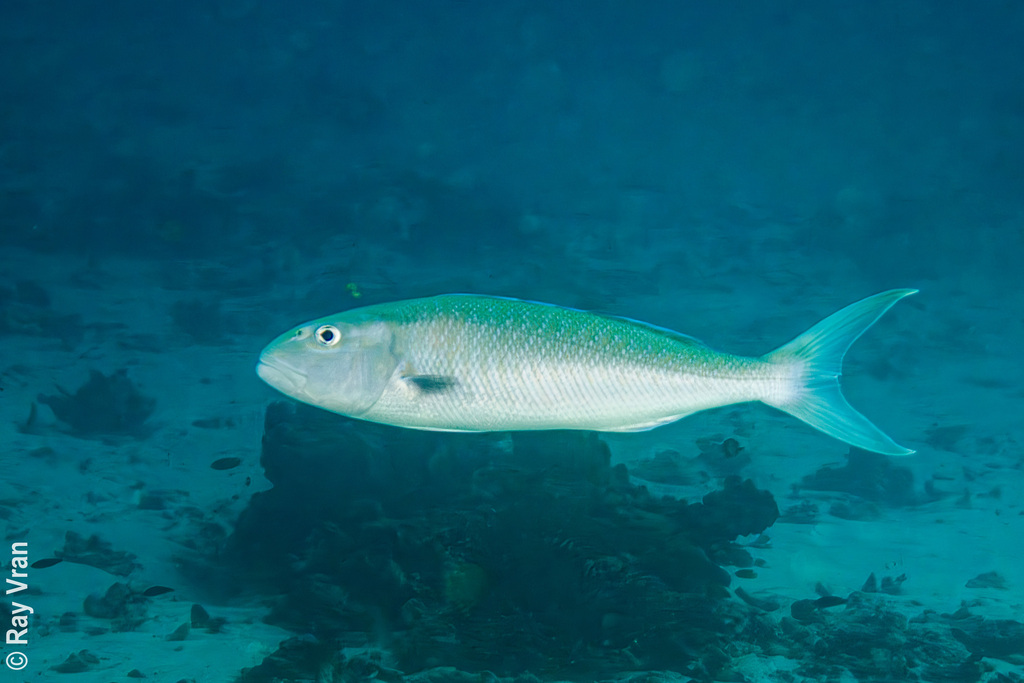
The most useful field mark sits on the snout: a very distinct horizontal groove runs below the nostrils, a feature the other jobfishes do not share. The body is elongate and robust, with bands of teeth in both jaws and strong canines at the front. Teeth also sit on the roof of the mouth, in a chevron or crescent patch on the vomer and in an elongate band on each palatine, which separates it from the fine-toothed lehi. The first gill arch carries 20–24 rakers, the dorsal fin has ten spines and eleven soft rays, and the pectoral fins are short, less than half the head length and about as long as the snout. Colour is dark green, bluish or grey-blue, and the tubed lateral-line scales number 48–50.
FishBase gives an Indo-Pacific range from East Africa to the Hawaiian Islands, north to southern Japan and south to Australia, between 35°N and 31°S and from 33°E to 134°W. The country list runs from the Red Sea and East Africa through India, Southeast Asia and the Marianas to Hawaii, the Marquesas and French Polynesia.
What makes the species unusual is the vertical range rather than the map. The record runs from 0 to 180 m, and adults are described from open water in deep lagoons, channels and seaward reefs. That is a fish that can be jigged under the boat in the morning and hooked on a bait near the bottom in the afternoon. iNaturalist holds 292 observations, a workable sample for a fish that is both common and photogenic.
There is no spawning month in the record. The maturity figure is 45 cm, with a range of 42–50 cm, which tells you that a large share of the fish an angler meets are already adults. Water temperature is the practical variable: the surface layer responds to season, the deep layer hardly does, and the fish move across that boundary.
The two reliable windows are early morning and late evening, and both are short. Fish deep on the first pass, then work the mid-water with a lighter jig once the bite thins. Current is the other clock. A slack tide over the same ledge fishes very differently from the hour when the water starts to move, and the current line is where the fish tend to be anyway.
Vertical jigging is the standard method, with a metal jig swept in slow, long strokes from mid-water down to the reef edge. Bottom bait fishing is the second option: fresh fish or squid on a single hook, held just above the drop-off rather than dropped into the coral. Trolling a small skirted lure or a deep-diving plug along the same edges covers water quickly when the fish are scattered.
Baits are fresh fish, squid and live bait, matching a diet of fishes, shrimps, crabs, cephalopods and planktonic organisms. The mouth is hard, and a single hook holds better than a treble. Let the first run go, because a fish that reaches the reef edge with a locked drag will cut the leader.
The record reaches 112 cm and 15.4 kg, with a common length of 90 cm, so the average fish is already substantial. Build around a braid main line, a fluorocarbon leader heavy enough to survive the edge, and a drag you can adjust by hand. A rod with a soft tip reads the jig better than a stiff one, and the reef edge punishes tackle that cannot turn a fish.
Keep the fight away from the coral. The first run is the one that ends badly, so give line rather than adding pressure, and pump the fish up once it slows. A long-handled gaff or a large net belongs on the boat when the fish are running large.
FishBase calls it highly commercial and a gamefish, marketed fresh, dried and salted, and rates it excellent eating. The same account warns that large individuals may be ciguatoxic, and there are reports of ciguatera poisoning from the species. That is a reason to know the local history of the ground, and to avoid putting the biggest fish on the table without advice.
Hawaii sets a 1 lb minimum for uku, but the rule applies only to spearing and to sale. A non-resident recreational angler needs an NRMFL, commercial sale needs a CML, and no take is allowed inside Marine Life Conservation Districts or Fisheries Replenishment Areas. Local advice on ciguatera is worth more than a general rule.
The entry takes taxonomy, range, meristics, depth, diet and use from FishBase, the taxon link and 292 observations from iNaturalist, and state rules from DLNR-DAR. The GBIF fields supplied for this species are not usable: the usage key is 1 and the occurrence total is far beyond any plausible figure, so the distribution section here leans on FishBase and iNaturalist instead, and GBIF is flagged rather than quoted. The record also lacks a spawning month, which is why the season section is built on light and current. Maturity at 45 cm is the one population figure solid enough to plan around.
Fished with the listed approach, matched to the recorded depth and size.
Fished with the listed approach, matched to the recorded depth and size.
Fished with the listed approach, matched to the recorded depth and size.
These are the published regulations for this fish. Read the number first. The notice below it is the actual regulation.
Queensland sets a 38 cm minimum size for green jobfish.
Green jobfish | Min: 38cm | Limit: 5
Queensland sets a possession limit of 5 Green jobfish.
A possession limit is the total number of fish you may keep at any time, including fish at home or in the freezer; it is not a daily take limit.
Green jobfish | Min: 38cm | Limit: 5
Every record above names its source and the date it was retrieved. See the regulation register for the full list, or how to read these regulations.
Check these pages before you rely on a size, range or protection status.
These fish live in the same place.
Technique, gear and safety guides that fit Green jobfish.