
Big-scale sand smelt
Big-scale sand smelt is a small silverside of the family Atherinidae, euryhaline and found across the eastern Atlantic, Mediterranean and Black Sea. Its range runs from Portugal and Madeira to Mauritania, with isolated populations on the coasts of England and the Netherlands, and it occupies estuaries and coastal water from about 1 m down. It reaches only 20 cm and lives around four years.
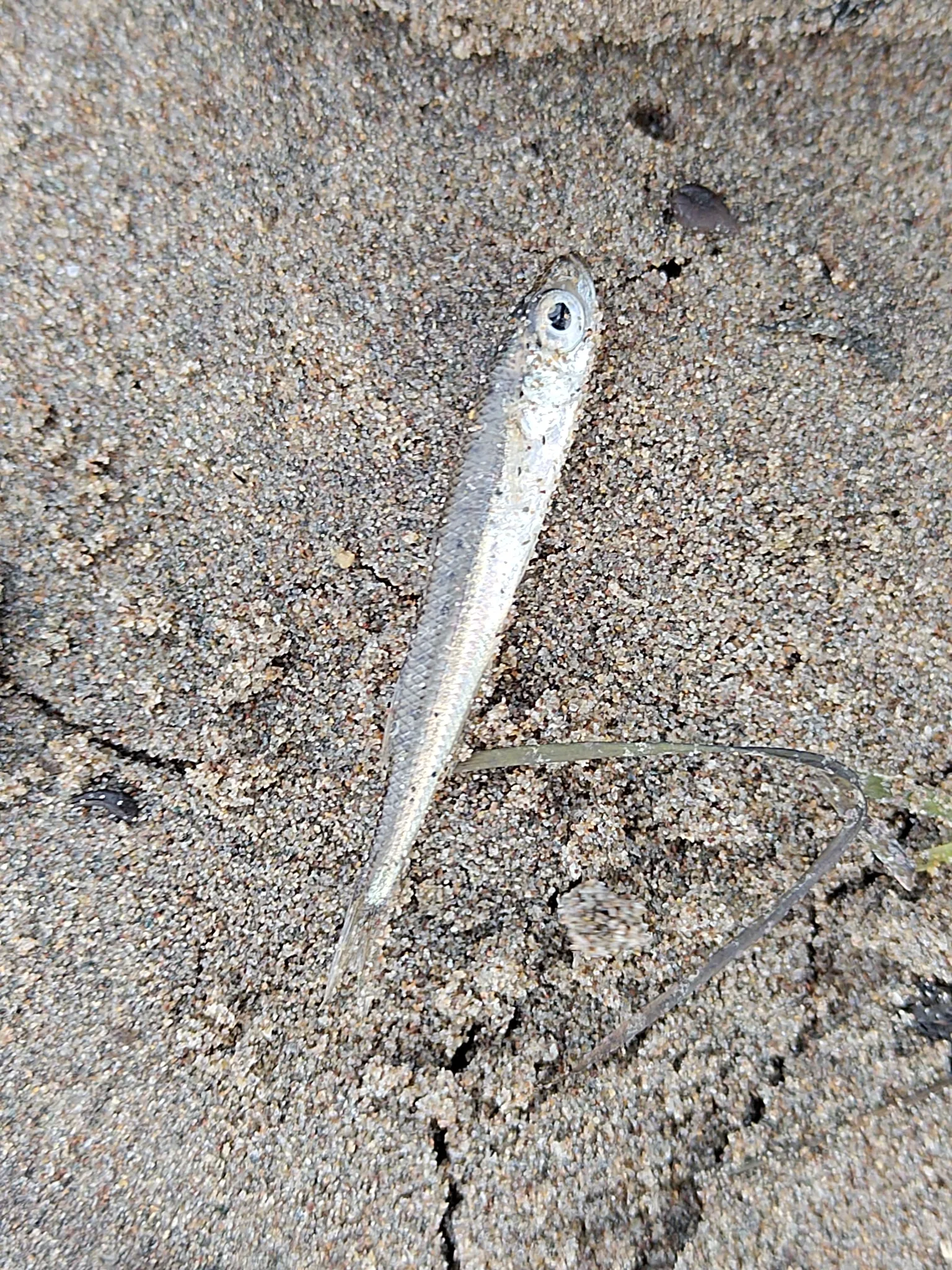
Big-scale sand smelt is a small silverside of the family Atherinidae, euryhaline and found across the eastern Atlantic, Mediterranean and Black Sea. Its range runs from Portugal and Madeira to Mauritania, with isolated populations on the coasts of England and the Netherlands, and it occupies estuaries and coastal water from about 1 m down. It reaches only 20 cm and lives around four years. The species is caught commercially but has no gamefish flag, and its IUCN category is Least Concern; it is not a usual recreational target.
Identification
The record puts this fish in salt water, fresh water and brackish lagoons at once. FishBase's environment line lists all three, and Wikipedia calls it euryhaline and amphidromous, a fish that tolerates a wide salinity range and moves between sea and fresh water during its life.
Big-scale sand smelt is the FishBase principal and the FAO form; Boyer's sand smelt and Black sea silverside are recorded alternatives. Chinese gives in the FAO list, with and among the variants.
The fin formula is the fullest part of the capture: dorsal spines 7–10, dorsal soft rays 8–16, anal spines 2 and anal soft rays 10–18. No vertebral count is carried, and body shape and cross-section are blank as well; no diagnostic sentence accompanies the ranges.
Size is 20.0 cm TL maximum, with first maturity at 5.8 cm and a range opening at 5 cm. Maximum age is four years, and no common length or weight is carried. A fish maturing at 5.8 cm spends most of its adult life below the 20 cm maximum; the upper end of the maturity range is missing.
Habitat and distribution
FishBase gives an eastern Atlantic and Mediterranean range: Portugal and Spain to Nouadhibou in Mauritania and Madeira, through the Mediterranean and the Black Sea, with isolated populations on the coasts of England and the Netherlands. Two subspecies were once recognised in Russian waters: pontica in the Black Sea and Azov, caspia in the Caspian. Of 35 country rows, 33 are native and two introduced: the Netherlands and Uzbekistan.
The environment entry is marine, freshwater and brackish, demersal, amphidromous, with a depth range that starts at 1 m and records no maximum; subtropical, 53°N–20°N, 18°W–42°E. The absent upper depth is a gap in the record, not a shallow-water limit. Habitat keywords are estuary, coastal, brackish, freshwater and open water; the diet is crustaceans, fishes, algae and worms.
GBIF's 23 rows give a different status picture: three native, eleven introduced and nine with no means. The introduced flags cover all three Dutch rows and three of the four English rows. FishBase itself marks the Netherlands as introduced but keeps England and Wales native, so the sources disagree on how far the introduced range extends. iNaturalist holds 1,734 observations.
Season and fishing approach
Ten dated spawning rows exist. Most are spring and summer windows: the Bristol Channel May–July, the Caspian March–July, Spanish and Algerian lagoons April–June, French lagoons February–September. One Croatian river record runs through all twelve months, and that single row makes the combined calendar continuous. The continuity belongs to one locality, not to the species everywhere, and no temperature threshold is given.
FishBase's fisheries field says commercial, with no gamefish flag and no aquarium use. No method, bait or regulation is recorded. The depth line starts at 1 m, and the habitat keywords include estuary and coastal; these place the fish close to shore, yet the record does not say how it is caught.
Edibility and regulations
The IUCN category is Least Concern, from an assessment dated 1 June 2022. No food-use text accompanies the commercial flag, and Wikipedia adds no culinary or market detail.
The capture contains neither size, season nor bag limit. Because the species is landed across the Mediterranean, the Black Sea and the eastern Atlantic, the applicable rule depends on the country, and the page cannot name one. A keeper should look up the local rule at the landing point rather than treat the commercial flag as an angling permission.
Where these facts come from
Check these pages before you rely on a size, range or protection status.
- FishBase — Atherina boyeri — FishBase · T2
- GBIF — Atherina boyeri occurrence records — GBIF · T2
- IUCN Red List — Atherina boyeri — IUCN · T1
- Photo record — iNaturalist — iNaturalist · T3
Fish in the same water
These fish live in the same place.

Acoupa weakfish
- Family
- Sciaenidae
- Depth
- 1–20 m
- Season
- Jan, Feb, Mar, Apr, May, Jun, Jul, Aug, Sep, Oct, Nov, Dec

American angler
- Family
- Lophiidae
- Depth
- 0–800 m
- Season
- Mar, Apr, May, Jun

American eel
- Family
- Anguillidae
- Depth
- 0–464 m
- Season
- Jan, Feb, Mar, May, Jun, Jul
Guides for this water
Technique, gear and safety guides that fit Big-scale sand smelt.