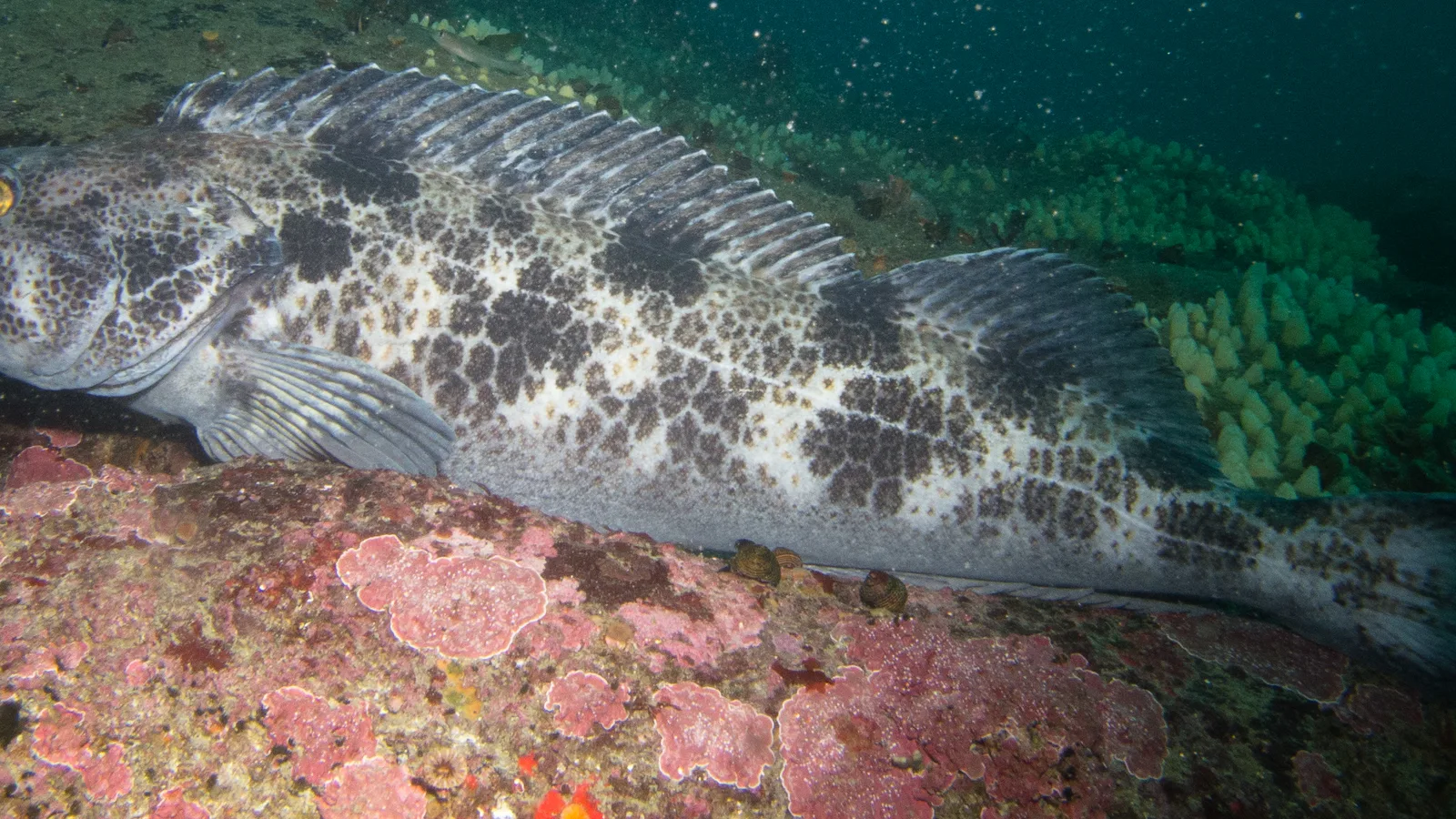
Lingcod is neither a cod nor a ling, and the catalogue is unusually blunt about it: the species sits in the greenling family Hexagrammidae, in a genus of its own, and its English aliases include buffalo cod, cultus cod and buckethead. The record gives 152 cm total length, 59.1 kg, a 25-year maximum age, maturity at 70.5 cm, and a depth range of 0–475 m. What it does not say, because no catalogue can, is that almost every lingcod is caught within a few metres of rock.
Not a cod, not a ling, and not always on the bottom
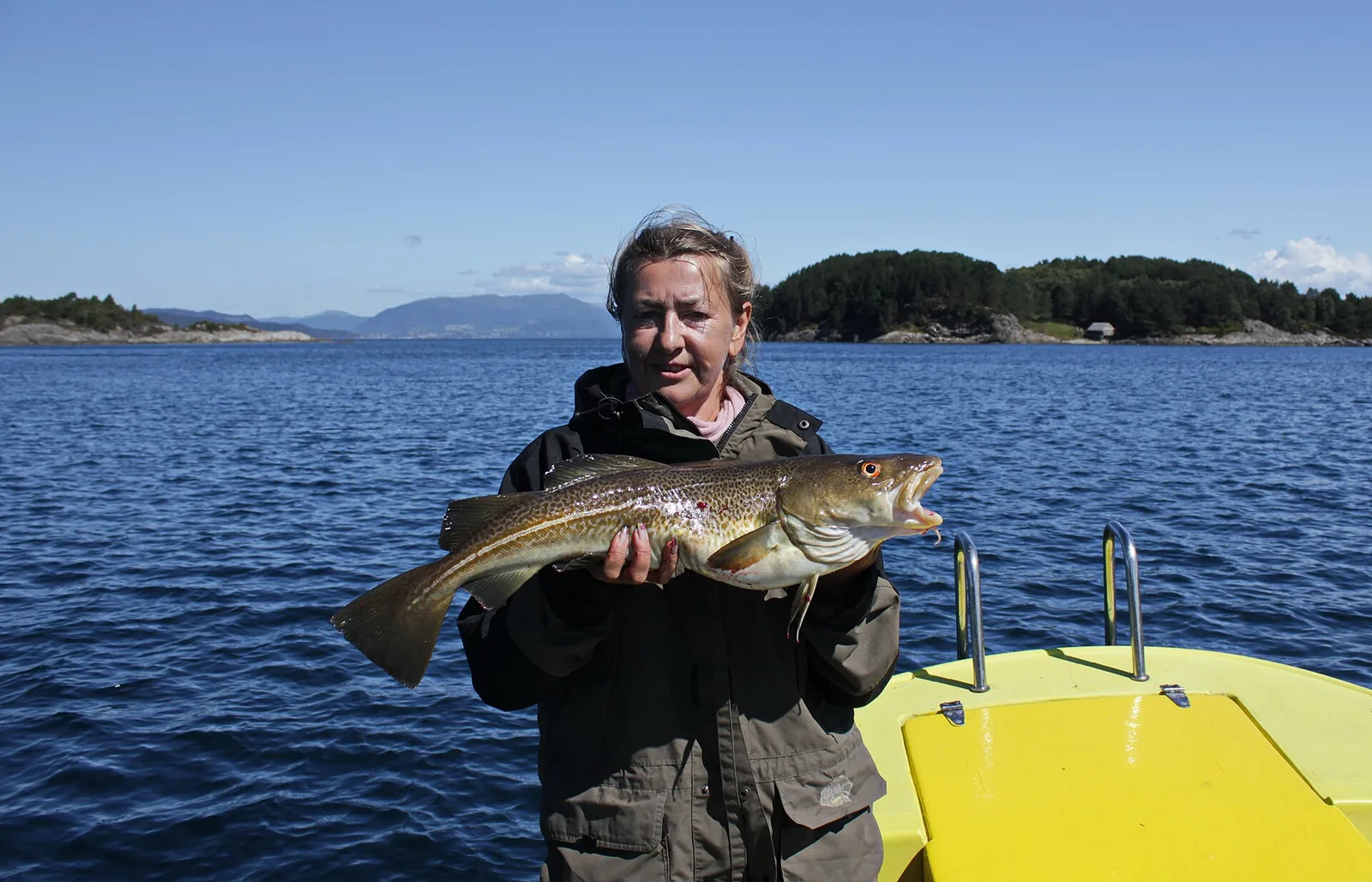
The body is elongate, with 24–27 dorsal spines followed by 21–24 soft rays, three anal spines and 21–24 soft rays, and 55–59 vertebrae. The head is large, the mouth is wide, and the teeth are the reason anglers use heavy leaders. None of that is cod anatomy; a cod has three dorsal fins and a barbel, and lingcod has neither.
The species is classed as demersal and oceano-estuarine, and the habitat keywords are rocky, sandy, muddy and coastal. In practice lingcod is a rock fish in the literal sense: it holds on pinnacles, ledges, boulder fields and wreck structure, and it uses the bottom as cover rather than as a surface to lie flat on. It will rise several metres to take a jig, which is why the strike often comes well off the bottom.
The 0–475 m field and the rock it sits on
The recorded depth range is 0–475 m, but the distribution of fishing effort is much narrower: most lingcod are caught between 10 and 120 m, on hard structure. The 475 m figure is an outer limit, not a target.
That is why a lingcod mark is described by its bottom, not by its depth. A flat sand plain at 60 m holds few fish; a boulder field at 60 m holds many. On the sounder, look for a hard, broken return with vertical relief, then fish the up-current face of it.
The estuary keyword in the record refers to juveniles in bays and inlets, not to adult fish in muddy channels. An adult lingcod in an estuary is an exception, and a mark built around mud is usually a mark built around the wrong species.
152 cm, 59.1 kg, 25 years, maturity at 70.5 cm
A 152 cm lingcod is a large female; males rarely reach that size. Maturity is given at 70.5 cm with a range of 61–76 cm, and the maximum age is 25 years, which means a big fish is old and slow-growing rather than fast and young.
For an angler the size structure matters because lingcod are territorial. A good rock can hold one large fish, and catching it does not immediately open the spot for another; the next fish to take up the territory may be smaller and may take weeks to arrive. That is a reason to release big females, and a reason not to treat a single rock as a renewable resource.
Why a lingcod strikes a jig
The diet keywords are crustaceans and fishes, and lingcod are ambush predators that use their rock as a launch point. A jig that falls past a ledge gets hit on the drop, often within a metre of the structure, and the strike is a hard thump rather than a nibble.
That behaviour sets the retrieve. Fish vertically over structure, keep the jig in contact with the bottom on the fall, and expect the bite in the first two lifts. A lure retrieved fast through open water gets ignored; a lure that hangs and flutters at the rock face gets eaten.
Nesting in December to March
The spawning table gives December to March, with records from California and an unspecified locality. Lingcod are nest spawners: males guard egg masses on rock, and the nests are vulnerable to disturbance in a way that pelagic spawners' eggs are not.
That is the basis of seasonal closures in several areas. Where a closure exists, it is usually timed to the nesting window and applies to both sexes even though the males are the ones on the nests. The local rule, not the global table, tells you which weeks are closed.
Jigs, swimbaits and the vertical presentation
The standard lingcod outfit is a 1.8–2.1 m rod rated 50–150 g, a reel with 300 m of 0.25–0.30 mm braid, and a 40–60 lb leader. The leader is short — 1–1.5 m — because lingcod are caught close to structure and a long leader only adds stretch and snag risk.
A 150–300 g jig with a large single hook or a heavy swimbait on a 60–100 g head covers most situations. Add a strip of bait to the jig when the fish are tentative; the combination of scent and profile out-fishes either alone. The hook needs to be strong: a 20 kg lingcod can straighten a light jig hook on the first run back into the rocks.
Not Evaluated, and the state rules that fill the gap
The catalogue records IUCN status as Not Evaluated, with no assessment date. That is not a statement that the species is fine; it is a statement that no global assessment exists under the current Red List process, and that management depends entirely on national and state rules.
Those rules are detailed. In US waters lingcod have minimum sizes, bag limits, depth restrictions and seasonal closures that vary by state and by area, and several jurisdictions require the release of fish above a certain size to protect females. Read the rule for the specific area, because neighbouring states differ.
106,254 records: a two-country survey map
The GBIF index holds 106,254 lingcod records: the United States at 78,205, Canada at 27,896, Mexico at 57, New Zealand at 2 and one unassigned. The two-country split is a survey map — US and Canadian groundfish surveys on the same coast — rather than a statement about the species' range, which runs from the Shumagin Islands in the Gulf of Alaska to Ensenada in Baja California.
iNaturalist's 4,029 observations are concentrated in the Pacific Northwest and California, where recreational diving and fishing effort is highest. Neither dataset narrows down a rock. They confirm the northern shelf distribution, and then the search becomes local: hard bottom, relief, current, and a jig falling along the face.
Where and when it feeds
Tide. Fish the slower stages of tide for better jig control around rock.
Weather. Calm seas are essential for reef fishing. Wind against current makes the drift dangerous.
How to catch it
Boat bottom fishing
Anchored or drifting boat, bait or lure worked near the recorded bottom.
Slow pitch jigging
Slow-pitch jigging with a controlled fall and short lifts.
Bait and lures
Whole herringSquidSwimbaitHeavy jig
Regulations before you keep it
These are the published regulations for this fish. Read the number first. The notice below it is the actual regulation.
Minimum size2
≥22 in total length · 2 fish per person · closed January 1 – March 31
United States — California · US-CA
California recreational rule: lingcod must be at least 22 inches total length, with a daily bag limit of 2; fishing is closed in all waters from January 1 to March 31, and possession is prohibited during that period.
The page is marked Updated June 23, 2026; it also requires a minimum 14 in fillet with the skin left on.
Lingcod | 2 fish per person | 22" total length / Jan 1 - Mar 31: Closed - unlawful to possess in all waters
≥22 in · open to all depths year round
United States — Oregon · US-OR
Oregon's minimum size for lingcod is 22 inches, and the lingcod fishery is open to all depths year round.
LINGCOD Open to all depths year round ... Min. size = 22 inches
Bag limit2
1 fish per person per day · residents no size limit · nonresidents annual limit of one 30–35 in fish and one fish over 55 in
United States — Alaska · US-AK
In Southeast Alaska, residents may keep one lingcod per day with no size limit, while nonresidents may keep one per day under an annual limit of one fish between 30 and 35 inches and one fish over 55 inches.
Nonresidents must immediately record the species, date and location on their harvest record; the season closes December 1.
The resident daily bag limit is one fish with no size limit;
- Season closes December 1;
- The nonresident daily bag limit is one fish with an annual harvest limit of one fish fish between 30 and 35 inches and one fish over 55 inches;
2 fish per person · 22 in total length
United States — California · US-CA
California allows 2 lingcod per person per day, with a 22-inch total-length minimum.
Fillets must be at least 14 inches long with the entire skin attached.
Lingcod | 2 fish per person | 22" total length
Season / closure1
Closed January 1 – March 31 in all waters
United States — California · US-CA
Lingcod is closed to possession in all California waters from January 1 through March 31.
Some management areas add depth restrictions from October through December.
Jan 1 - Mar 31: Closed - unlawful to possess in all waters
Every record above names its source and the date it was retrieved. See the regulation register for the full list, or how to read these regulations.
Where these facts come from
Check these pages before you rely on a size, range or protection status.
-
FishBase — Ophiodon elongatus
— FishBase · T2
-
GBIF — Ophiodon elongatus occurrence records
— GBIF · T2
-
IUCN Red List — Ophiodon elongatus
— IUCN · T1
-
Photo record — iNaturalist
— iNaturalist · T3