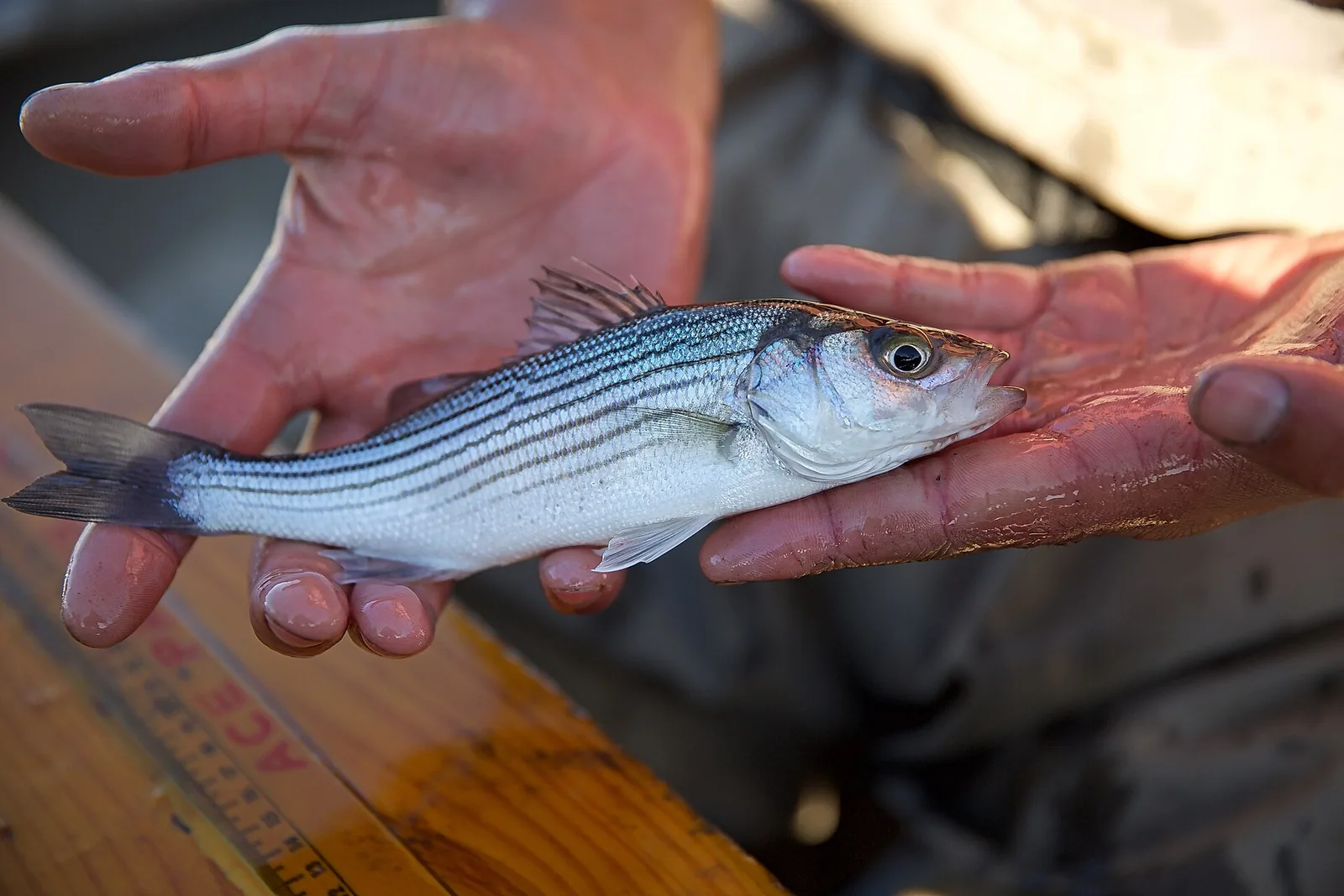
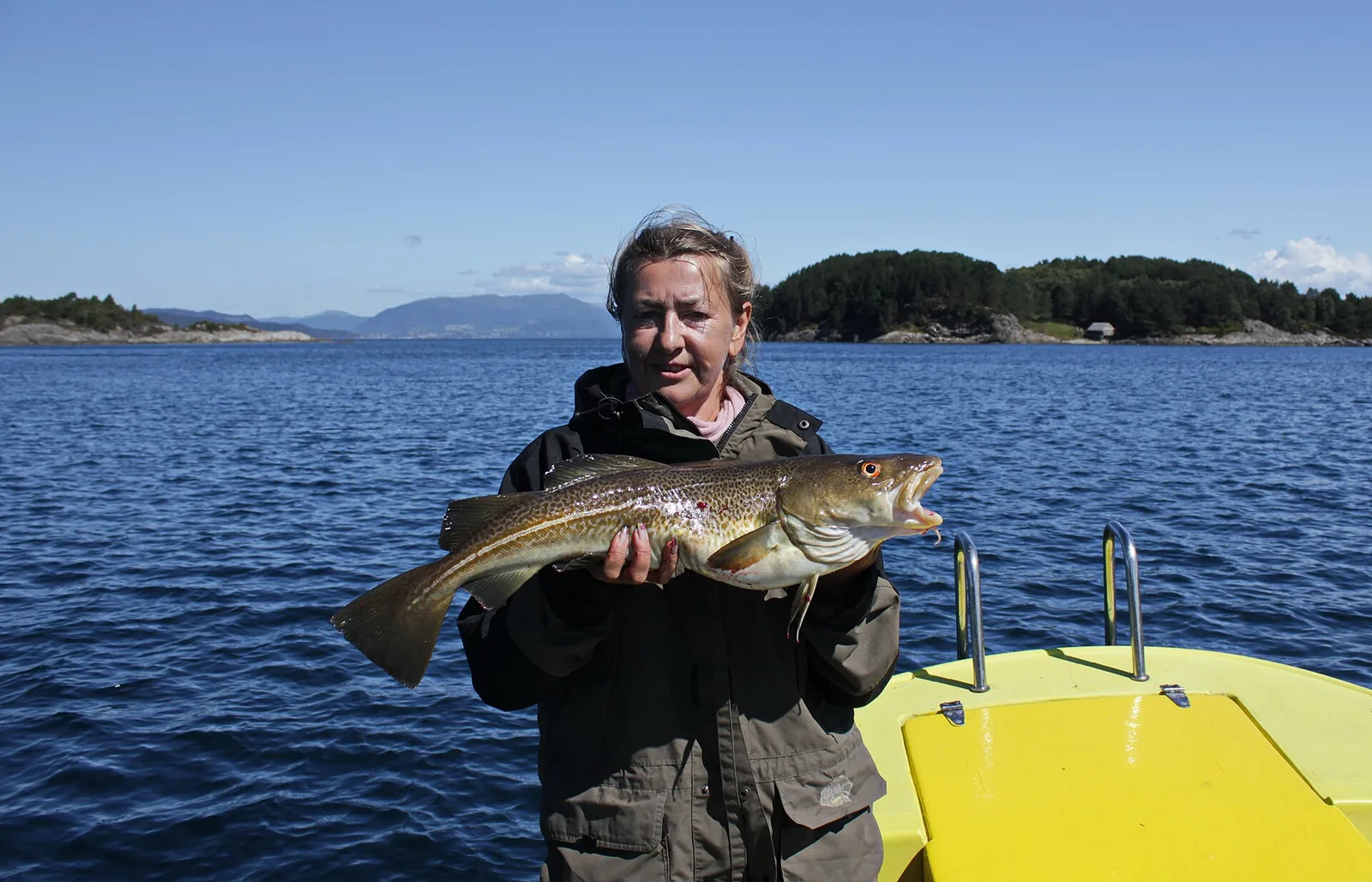
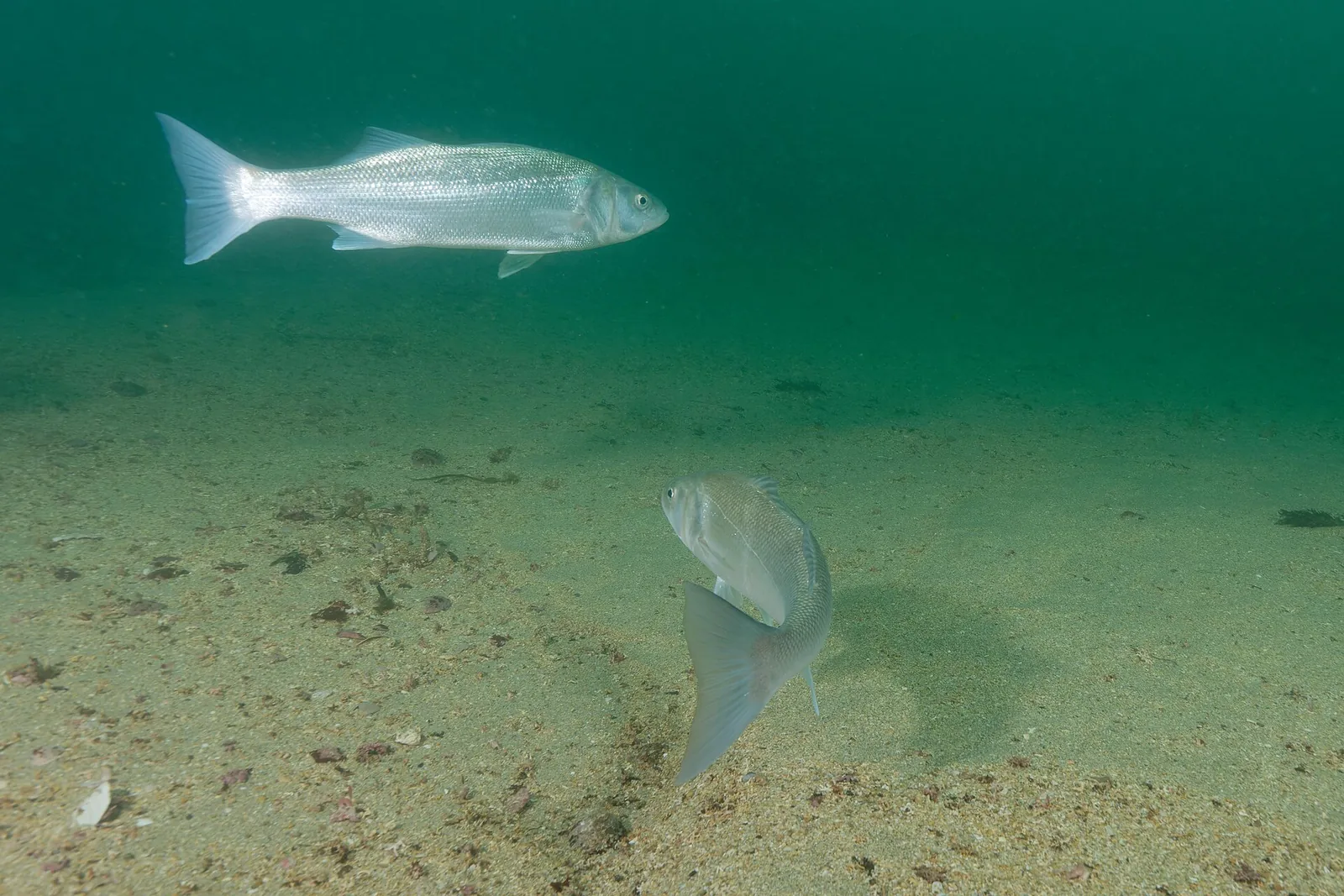
Striped bass carries more names than most fish on this site, and one of them causes real confusion. FishBase's English common-name table lists striped bass, linesider, rock, rockfish and striper, all for the same species. On the Atlantic coast those names are used interchangeably. On the Pacific coast, "rockfish" means something else entirely: the dozens of *Sebastes* species that are managed under a completely different set of rules. Getting the name right is not pedantry — it decides which regulation you read and which fish you are allowed to keep.
One fish, five names, and a name it should not have
The approved English name is striped bass, and the approved Chinese name is . The other four names are regional. "Striper" is the everyday term from New Jersey to Maine. "Linesider" refers to the seven or eight dark lateral lines that give the fish its English name. "Rock" and "rockfish" come from the Chesapeake and Carolinas, where the fish is associated with rocky structure and, historically, with the spring run.
The problem with "rockfish" is geographic. On the West Coast, rockfish are Sebastes — copper, vermilion, canary, yelloweye — and the recreational rules for them include depth limits, descending devices and closed areas that have nothing to do with striped bass. A visiting angler who asks for "rockfish" in California and in Maryland will be pointed at two different fisheries.
Why the name split happened
The two coasts named their fish independently. Atlantic colonists used "rockfish" for any fish taken around rocks, and striped bass was the main one. Pacific settlers applied the same word to the much more numerous Sebastes assemblage, which is why the name stuck there and not here.
FishBase's taxonomy resolves the species as Morone saxatilis in the family Moronidae, with no synonym confusion: the species has been stable in the literature. The name problem is vernacular, not taxonomic. That distinction matters because taxonomic stability is what allows the regulations to be written against a single entity, while the common names keep drifting.
The native range and the introduced range
FishBase's native distribution runs from the St. Lawrence River in Quebec to Lake Pontchartrain in Louisiana, and south in Florida to the St. Johns and Suwannee drainages. The introduced list is longer: Argentina, Ecuador, Hawaii, Iran, Latvia, Mexico, Russia, South Africa and Turkey. Most of those introductions were for recreational fisheries or for aquaculture, and several produced self-sustaining populations.
For trip planning the distinction is straightforward. In the native range, a striped bass is a native fish with a native-ecosystem management regime. Outside it, the fish is an introduced species, often managed as a put-and-take fishery, and sometimes subject to rules designed to protect the receiving water rather than the bass.
An anadromous fish that spawns in fresh water
FishBase classes the species as anadromous, with records from marine, brackish and freshwater. The spawning table runs April to June, with entries from California, Chesapeake Bay in May, Delaware Bay in April and May, the Gulf of Maine in June and North Carolina in April and May.
The pattern is a spring upstream migration: adults leave the coast, enter tidal rivers and move to the fresh or slightly brackish reach where eggs will stay suspended. Water temperature and flow decide the timing. A cold spring delays the run; a warm, low-flow spring compresses it. For an angler, the run is a moving front, not a fixed date, and the front moves upstream through the season.
Depth and current: the 30 m line
FishBase records a depth range starting at 30 m and no stated maximum. That lower bound is a useful filter, because it tells you that striped bass are not a shallow-flat fish in the way that, say, a winter flounder is. They use the water column over structure, and they use current.
The classic position is a channel edge beside a flat, where the tide pushes bait against a wall. In reservoirs, the equivalent is a point or a dam face where current concentrates bait. In both cases the fish is not on the bottom; it is suspended at the depth where the light and the current meet.
Tackle and bait for a 120 cm fish
FishBase gives a maximum total length of 200 cm, a common length of 120 cm, a maximum weight of 57 kg and a maximum age of 30 years. The 120 cm figure is the one to build around. A 2.7–3.0 m rod rated 15–50 g handles plugs and live bait, and a 4000–5000 size reel with 0.16–0.20 mm braid gives enough capacity for a fish that can run 50 m in the current.
Live bait — menhaden, eel, herring — is the traditional approach and remains the most reliable in turbid water. Plugs and swimbaits work when fish are feeding on the surface; a 15–20 cm minnow plug trolled along a channel edge covers water efficiently. Circle hooks are required for bait in several states, and they also reduce gut-hooking, which matters for a fish that is often released.
The 2019 LC listing and the Gulf strain
The conservation field reads Least Concern, assessed 3 February 2019, and the record lists the species as minor commercial, commercially farmed and a gamefish. The LC listing refers to the species as a whole, which spans several stocks with very different trajectories.
The Gulf Coast strain is the clearest example. FishBase's introduced list and the taxonomic record treat Gulf fish within the same species, while state management treats them as a separate stock with its own rules. A regulation written for Atlantic migratory bass does not automatically apply in Louisiana or Texas, and the size and bag limits differ.
Reading 157,000 records
GBIF returns 157,589 striped bass records: the United States at 122,158, Canada at 34,982, Mexico at 39 and a long tail of single-digit countries. The Canadian figure is large because the St. Lawrence population is intensively surveyed; the Mexican figure is small because the species is at the edge of its range there.
iNaturalist's 5,469 observations are concentrated in the northeast United States, which is where the recreational fishery is densest. Neither dataset locates fish on a given tide. Use them to confirm that a river system holds the species, then read the run timing from water temperature and the state's migration reports. In the native range the fish is predictable in season and unpredictable in position, which is exactly what makes the spring run worth following.
Where and when it feeds
Tide. Best on the last two hours of the ebb and the first hour of the flood. Spring tides produce stronger seams and more active fish.
Weather. A steady or slowly rising barometer is better than a falling one. NW wind after a front clears usually means clean water and active fish.
How to catch it
Shore casting
Cast from shore or a breakwater, within reach of the recorded inshore range.
Boat fishing
Fished from a boat, with the approach adjusted to the recorded depth.
Fly fishing
Fly fishing; a regional or specialist approach for this species.
Bait and lures
Live eelMenhaden / bunker chunkWhite bucktail jigPencil popper
Regulations before you keep it
These are the published regulations for this fish. Read the number first. The notice below it is the actual regulation.
Minimum size2
28 to less than 31 in · 1 fish per person · April 15 – December 15
United States — New York · US-NY
New York recreational rule: in marine waters (starting at the Hudson River south of the George Washington Bridge) and the Delaware River, striped bass may be kept at 28 inches to less than 31 inches, 1 fish per person per day, from April 15 to December 15; in the Hudson River north of the bridge the slot is 23 inches to less than 28 inches, April 1 to November 30.
The George Washington Bridge divides the two size tiers for the same species; which reach you fish decides the tier.
Striped Bass: marine waters (beginning at the Hudson River south of George Washington Bridge) & Delaware River | Slot size: 28" - 31" | 1 | April 15 - Dec 15
Striped Bass: Hudson River (north of George Washington Bridge) | Slot size: 23" - 28" | 1 | April 1 - Nov 30
28–31 in · 1 fish per person · January 1 – March 31 and May 16 – December 31
United States — Virginia · US-VA
Virginia recreational rule (VMRC): on the Atlantic coast striped bass may be kept at 28 to 31 inches, 1 fish per person per day, in seasons from January 1 to March 31 and from May 16 to December 31; the Chesapeake Bay spring season runs May 16 to June 15 with a 19 to 24 inch slot, also 1 fish per person.
The page is marked Recreational Fishing Regulations Sheet (Updated April 2026).
Virginia Coastal Seasons / January 1 through March 31 / May 16 through December 31 / Minimum Size Limit: 28 inches / Maximum Size Limit: 31 inches / Possession Limit: 1 per person
Chesapeake Bay Spring Season / Season: May 16 through June 15 / Minimum Size Limit: 19 inches / Maximum Size Limit: 24 inches
Bag limit3
28 in to less than 31 in · 1 fish per person per day
United States — Massachusetts · US-MA
Massachusetts recreational rule: striped bass may be kept at 28 inches to less than 31 inches, 1 fish per person per day, year round; inline circle hooks are required when fishing with whole or cut natural baits.
Measure from the tip of the snout to the end of the tail (tail compressed); gaffs are prohibited.
Striped Bass (8) | 28" to less than 31" | Year Round | 1 fish
28–31 in total length · 1 fish per person per day · January 1 – December 31
United States — Maine · US-ME
Maine allows one striped bass per person per day, and only fish from 28 to 31 inches total length may be harvested in statewide waters.
The same page states that special catch-and-release and closed-season rules apply in the Kennebec, Sheepscot and Androscoggin Rivers.
BAG LIMITS A person may take and possess 1 striped bass per day.
SIZE LIMITS Fish can be harvested between 28 inches and 31 inches inclusive total length.
28 in to less than 31 in · 1 fish per person per day · year round
United States — Rhode Island · US-RI
Rhode Island allows one striped bass per person per day in a 28-to-under-31-inch slot, year round.
3.8Striped Bass
3.8.1Recreational
A.Minimum size: Twenty-eight inches (28").
B.Maximum size: Less than thirty-one inches (< 31”).
C.Season: January 1 through December 31.
D.Possession limit: One (1) fish per person per day.
Closed area1
No recreational fishing in federal waters
United States — federal (Atlantic) · US-FED-ATL
Recreational fishing for striped bass is closed in federal waters; transit with striped bass is permitted in some areas around Block Island, Rhode Island.
Transit with striped bass is permitted in some areas around Block Island, Rhode Island.
No recreational fishing allowed in federal waters.
Every record above names its source and the date it was retrieved. See the regulation register for the full list, or how to read these regulations.
Where these facts come from
Check these pages before you rely on a size, range or protection status.
-
FishBase — Morone saxatilis
— FishBase · T2
-
GBIF — Morone saxatilis occurrence records
— GBIF · T2
-
IUCN Red List — Morone saxatilis
— IUCN · T1
-
Photo record — iNaturalist
— iNaturalist · T3