
Grey triggerfish
The depth row carries two bands, not one: 0–100 m for the species and 0–55 m for the usual fish. This article hangs off the distance between them. Forty-five metres separate the top of the everyday range from the deepest record, and the useful question is what a triggerfish is doing inside that gap.
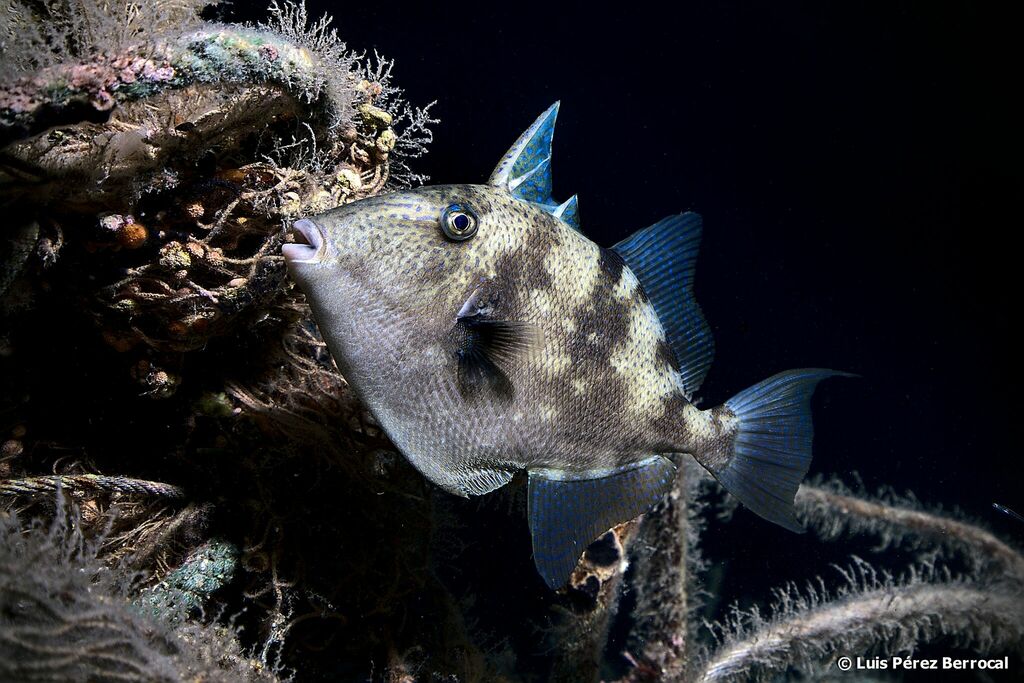
The depth row carries two bands, not one: 0–100 m for the species and 0–55 m for the usual fish. This article hangs off the distance between them. Forty-five metres separate the top of the everyday range from the deepest record, and the useful question is what a triggerfish is doing inside that gap.
Zero to a hundred
The full range begins at the surface. A zero minimum does not exclude the top metre of the water column, but it does not say the fish feeds there either. All it establishes is that the record found the species somewhere between the surface and 100 m, and that the upper limit is not a reef-crest figure.
One hundred metres is the other end, and it is a single published number rather than a band. The row cites two references, 7348 for the full range and 55172 for the usual band, so the two figures are not derived from one survey. Nothing in the row says how often the fish is taken near the maximum.
The fifty-five metre line
The usual range ends at 55 m. That is the planning line for most of the range's coasts: 55 m is a normal bottom drop from a small boat, while 100 m needs a deeper trip and more lead. The record does not explain why 55 m should be the edge, and this page will not supply a reason.
What it does support is a deck decision. A day planned inside 0–55 m is inside the described norm. A day planned at 80 m is outside it, and should be treated as an experiment rather than a routine.
The forty-five metres above it
Only the maximum crosses 55 m. The row prints no second "usually" figure and no percentage, so there is no way to say how much of the population lives above the line. All that can be said is that the ordinary fish is described as shallower and the exceptional record is deeper.
That asymmetry is worth keeping. A mark at 90 m is not disqualified by the source, but it is not endorsed by it either.
Surface is inside the record
Wikipedia describes the species as native to shallow parts of the western Atlantic, from Nova Scotia to Argentina, and also present in the eastern Atlantic, the Mediterranean and off Angola. "Shallow" there matches the top of the depth row without narrowing it.
iNaturalist carries 2,373 observations. A count that large is a documentation figure, not a density measurement, and it sits on the shallow side of the range where most people dive and fish.
Twelve months, no depth
Three spawning entries cover the calendar completely: Ghana in October–December, drawn from coastal trawl surveys run from January to December 1980; the US Gulf in April–May; and the US with all twelve months. The all-month entry alone would fill the calendar, so the other two add locality rather than months. Combined, every month appears.
Not one of the entries carries a depth or a temperature. The months therefore say when spawning has been recorded, not where in the 0–100 m band it happens.
Seventeen and sixty-six
Length at first maturity is 17 cm, with a printed range of 13–29.7 cm. Maximum length is 66 cm TL, and the common length is 44 cm TL. Maturity therefore arrives at roughly a quarter of the maximum, and the common fish is about two and a half times the maturity length. On those numbers the ordinary fish is 26 cm past first maturity, and the maturity length is 26 per cent of the maximum.
That spacing changes the release decision. A 17 cm triggerfish is a juvenile; a 44 cm one is the ordinary adult the record describes. The page cannot say how old either fish is at that size, because no growth curve accompanies the 15-year maximum age.
Six point two kilos, fifteen years
Maximum weight is 6.2 kg, and maximum reported age is 15 years. No length is attached to the weight, so the two maxima cannot be combined into a single specimen. The age figure is a ceiling, not a schedule.
Human use is stacked: commercial landings, a gamefish tick, and public aquariums. The alias list runs to ten English names, including turbot and leatherjacket, both borrowed from unrelated fishes. Ciguatera poisoning is recorded as a threat to people who eat the fish. The IUCN category is Vulnerable, assessed on 6 June 2011.
Fishing a band with no bottom note
The habitat keyword row is empty. That leaves the depth band as the only vertical fact on the page, and it is enough for a plan: start shallow, work down through 0–55 m, and treat anything past 55 m as a separate attempt.
Crustaceans are the recorded diet, so bait and small jigs that imitate hard-shelled prey fit the record. The species is a strong swimmer that takes a bait on the drop as readily as on the bottom, and the 45 m tail is where a deep drop replaces the shallow drift. A 55 m drop plus that 45 m tail needs about twice the line out of the shallow case, and a lead that still holds in current at the deeper end.
GBIF's 139 distribution assertions spread across 96 countries and territories, but only 24 carry the status PRESENT; Brazil alone accounts for 17 assertions, Belgium for 5, and 114 assertions have no status at all. The file carries no depth field and therefore cannot narrow the band. It confirms a wide Atlantic and Mediterranean record, not a fishing depth.
Where these facts come from
Check these pages before you rely on a size, range or protection status.
- FishBase — Balistes capriscus — FishBase · T2
- GBIF — Balistes capriscus occurrence records — GBIF · T2
- IUCN Red List — Balistes capriscus — IUCN · T1
- Photo record — iNaturalist — iNaturalist · T3
Fish in the same water
These fish live in the same place.


Guides for this water
Technique, gear and safety guides that fit Grey triggerfish.