≥60 cm
Australia — Queensland · AU-QLD
Queensland sets a 60 cm minimum size for yellowtail kingfish.
Yellowtail kingfish | Min: 60cm | Limit: 2

Yellowtail kingfish is two fish in one record: a 250 cm, 96.8 kg maximum and an 80 cm common length that weighs only 6–8 kg. The catalogue also gives 12 years and 3–825 m. Plan around the size class your gear can handle, because the tackle for a 6–8 kg fish and a 100 kg fish has almost nothing in common.
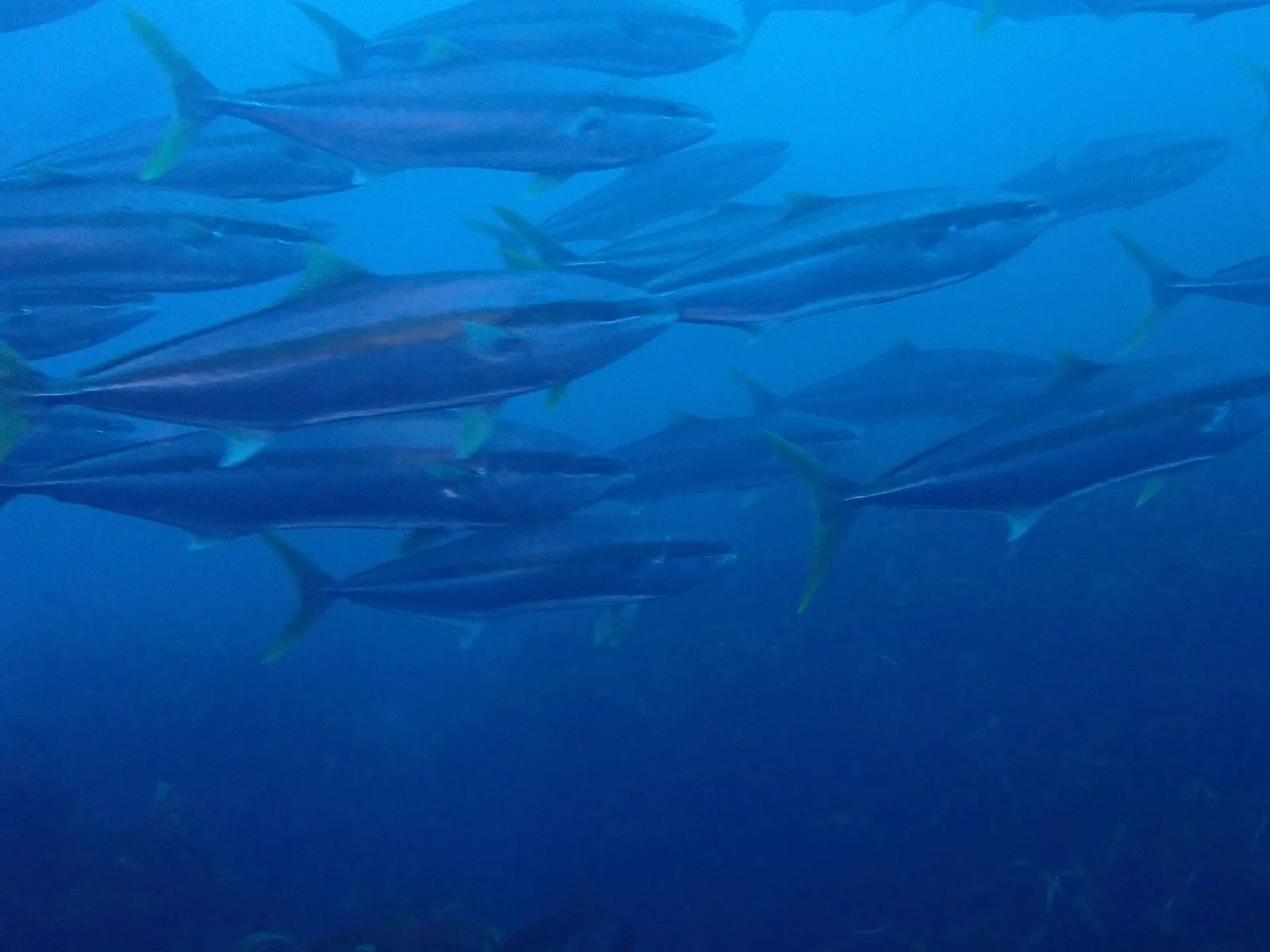
Yellowtail kingfish is a record with two fish inside it. The catalogue gives a maximum of 250 cm total length and 96.8 kg, a common length of 80 cm, a maximum age of 12 years, and a depth range of 3–825 m. An 80 cm fish weighs around 6–8 kg. A 250 cm fish weighs more than ten times that. The same species, the same page, and two entirely different tackle problems depending on which number you plan around.
The 80 cm common length is what a charter boat sees on a normal day: school fish over reef and kelp, 5–10 kg, caught on 30–50 lb gear. The 250 cm maximum is a once-in-a-decade fish, usually from a deep reef or a major structure, and usually landed on heavy tackle with a live bait.
The gap is not a data error; it is the shape of the population. Yellowtail kingfish school by size, and the big fish are solitary or in small groups on deeper structure. A trip planned for school fish and a trip planned for a 40 kg fish are different trips, with different baits, different depths and different leaders.
A 96.8 kg fish at a maximum age of 12 years is a fast grower. Yellowtail kingfish put on weight quickly in their first years, and a large adult is not necessarily old — it is a fish that found enough food and survived the years when it was small enough to be eaten.
The 12-year ceiling has a management consequence. A stock that replaces itself in about a decade responds quickly to a good recruitment year and collapses quickly under sustained heavy fishing. It also means that a 250 cm fish is a rare survivor rather than the top of a long-lived pyramid.
The depth range runs from 3 m to 825 m, and the habitat keywords are rocky, estuary, coastal, kelp, open-water and continental shelf. The 825 m figure comes from deep-set gear and stray fish; it is not a depth anyone fishes for yellowtail.
The usable range is the top 60 m, and mostly the top 30. Fish hold around rocky headlands, kelp beds, wharf structure, channel markers and offshore pinnacles. The estuary keyword is real in the sense that juveniles enter estuaries, but a 20 kg fish is not an estuary animal.
The reason the deep number matters is that it misleads trip planning. A chart that shows a 200 m drop-off next to a headland does not mean the fish are at 200 m; it means there is structure, and the fish are on the upper edge of it.
Three situations cover most yellowtail kingfish fishing. The first is a rocky headland with current: fish sit on the up-current side and move out to take a bait that drifts past the point. The second is a kelp bed: fish work the outer edge and the gaps, and a slow-trolled live bait along the edge is the classic method. The third is a wharf or channel marker in an estuary mouth, where small fish and school fish hold in the shadow line.
The common factor is current against structure. Yellowtail are not ambush predators in the way a cod is; they are fast cruisers that use structure as a reference and a funnel. Find the edge where current accelerates, and fish the down-current side of it.
The spawning table has entries from New South Wales in February, March, July, October and November, and from South Africa in January, February and March. The record's circumglobal distribution is a series of disjunct populations rather than one continuous stock: South Africa, Walter Shoals, Amsterdam Island, Japan, Australia, New Zealand, New Caledonia, Hawaii, Rapa, Pitcairn and Easter Island, plus the eastern Pacific from British Columbia to Chile.
That disjunction is why the spawning months look scattered. Each population spawns on its own schedule, tied to local temperature. For a trip, only the local window matters, and it is usually reported by local charter operators rather than by a global table.
For school fish, a 2.1–2.4 m rod rated 20–60 g with 0.20–0.25 mm braid and a 40 lb leader is the working setup. For big fish, a 1.8–2.1 m rod rated 80–150 g, 0.30–0.40 mm braid and an 80–100 lb leader is the minimum, and a live bait or a large stickbait is the usual offering.
The failure mode is the same in both cases: a fish that turns its head and runs for structure. Yellowtail are notorious for cutting anglers off on reef and wharf piles, and a leader that is one size too light is the usual cause. Set drag heavy enough to turn the first run, and accept that a light outfit will lose the big fish.
The catalogue records Least Concern, assessed 9 March 2015, and lists the species as minor commercial, experimentally farmed and a gamefish. The assessment predates the genetic work that split the old cosmopolitan Seriola lalandi into separate species, and the record still carries the old, broad concept.
That matters for reading any yellowtail kingfish data. Fish in Japan, in the eastern Pacific and in the southern hemisphere are now treated as different species by many authors, and regulations written for "kingfish" in one country may refer to a different animal from the one in another. On the water it changes nothing; on paper it changes which assessment applies.
The GBIF index holds 90,145 records for the matched taxon, with the United States at 71,836, New Zealand at 8,972, Australia at 6,727, Mexico at 573 and Japan at 185. An American total that large for a species described as southern hemisphere is a strong hint that the record set mixes taxa: the eastern Pacific and Japanese populations have been split off, and museum and survey records have not all been reidentified.
iNaturalist's 1,023 observations are weighted toward Australia, New Zealand and South Africa, which fits the current species concept better than the GBIF totals do. Treat the GBIF figure as a measure of how much material exists under the name, not as a distribution. For finding fish, the useful map is the coastline: rock, kelp, current, and a headland that puts all three in one place.
Tide. Fish the current-washed side of a bommie. A strong tide with a clean colour change is the best setup.
Weather. Light wind and a long swell are ideal. Big southerly swell can make reef edges unsafe.
Vertical jigging over the recorded depth range.
Trolled from a moving boat; suits roaming or pelagic species.
These are the published regulations for this fish. Read the number first. The notice below it is the actual regulation.
Queensland sets a 60 cm minimum size for yellowtail kingfish.
Yellowtail kingfish | Min: 60cm | Limit: 2
South Australia sets a 60 cm minimum legal length for yellowtail kingfish.
Yellowtail Kingfish | 60 | 1 | 3
Tasmania sets a 45 cm minimum size for yellowtail kingfish.
Kingfish, Yellowtail | 5 | 10 | - | 45 cm
Western Australia sets a 600 mm minimum legal size for yellowtail kingfish.
"Yellowtail kingfish Seriola lalandi 600 mm"
New South Wales, Australia: Yellowtail Kingfish has a minimum size of 65 cm and a daily bag limit of 5.
Yellowtail Kingfish | Yellowtail Kingfish | 65 cm | 5
Queensland sets a possession limit of 2 Yellowtail kingfish.
A possession limit is the total number of fish you may keep at any time, including fish at home or in the freezer; it is not a daily take limit.
Yellowtail kingfish | Min: 60cm | Limit: 2
South Australia allows 1 yellowtail kingfish per person per day and a boat limit of 3.
Yellowtail Kingfish | 60 | 1 | 3
Tasmania allows 5 yellowtail kingfish per day and 10 in possession.
Kingfish, Yellowtail | 5 | 10 | - | 45 cm
Victoria's yellowtail kingfish limit is a 60 cm minimum size and 2 fish per person per day.
The 2026 Victorian guide reduced the bag limit from 5 to 2.
Minimum legal size: 60cm | Bag limit: 2
New Zealand South-East: Kingfish has a minimum length of 75 cm; the combined daily limit with groper/bass is 5, of which no more than 3 may be kingfish.
The 100 in the table is the minimum set-net mesh size (mm), not a maximum length.
Groper (Hapuku) / Bass | Daily limit of 5 with no more than 3 kingfish | — | 160 Kingfish | | 75 | 100
South Africa's recreational rules for yellowtail (Seriola lalandi) set no minimum size and a bag limit of ten fish per person per day.
Seriola lalandi is the yellowtail amberjack; the species file lists it as yellowtail kingfish.
Yellowtail Seriola lalandi None 10
Every record above names its source and the date it was retrieved. See the regulation register for the full list, or how to read these regulations.
Check these pages before you rely on a size, range or protection status.
These fish live in the same place.
Technique, gear and safety guides that fit Yellowtail kingfish.