
Horsehead tilefish
Horsehead tilefish is recorded across the Western Pacific, from Central Honshu to the South China Sea, within the family Latilidae. It is caught from 30 to 200 m, in tropical water. Fish reach 46 cm TL and 1.3 kg.
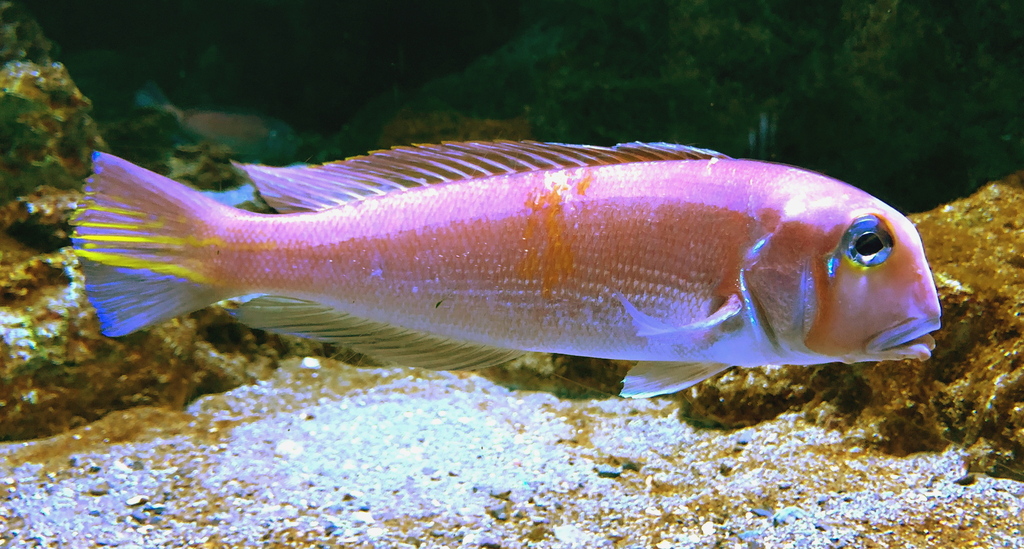
Horsehead tilefish (Branchiostegus japonicus) is a fish of the family Latilidae. FishBase gives its range as: Western Pacific: Central Honshu to the South China Sea. Also reported as far south as the Arafura Sea. In the hand, the check is the profile of the head plus the red upper body; a red tilefish with a rounded brow is a different animal. It is recorded from 30 to 200 m, in tropical water. The recorded maxima are 46 cm TL, 1.3 kg, 12 years. IUCN status: Least Concern (LC). Chinese name: .
Identification
A red tilefish with a steep, almost square forehead; the English names — horsehead, red horsehead, red tilefish — describe the head and the colour rather than any fin count. Length reaches 46 cm total, the ordinary size is 35 cm, the published maximum weight is 1.3 kg, and the oldest reported age is 12 years. First maturity is placed at 21 cm and above. In the hand, the check is the profile of the head plus the red upper body; a red tilefish with a rounded brow is a different animal. A 46 cm fish carrying 1.3 kg is not a heavy animal, and the top end of the range is a rare fish rather than the one a boat expects.
Habitat and distribution
Western Pacific from central Honshu to the South China Sea, with a report as far south as the Arafura Sea. China, Hong Kong SAR, Japan, South Korea, the Philippines, the Ryukyu Islands, Taiwan region and Vietnam all appear as range states. Depth is 30–200 m over sand and mud, in tropical water between 40°N and 15°N. This is a slope fish rather than a reef fish, and the two bottom types describe the soft outer shelf where tilefish dig and shelter. Sand and mud both mean soft ground, so the fish is sitting on the bottom rather than holding over rock.
Season and fishing approach
Spawning is recorded in May and June in Japan. The working method follows from the shape of the data: depth is given as one 30–200 m band, so the first job on a new mark is to find which part of that band holds fish. Start at the shallow edge with a bottom bait, write down the depth of every bite, and repeat the drift a little deeper until sounder and rod agree. A 170 m band is wide enough that two drifts a few hundred metres apart can sit in different temperature layers, and the log is what turns that into a repeatable pattern. The 35 cm common length sets the tackle, and 1.3 kg is a light fish by any measure, so a sensitive rod and a small reel read the take better than heavy gear. Tilefish feed on the bottom; the 21 cm maturity mark is the size below which a fish has not yet spawned.
Edibility and regulations
A commercial food fish and a recorded gamefish. IUCN status is Least Concern, assessed 27 January 2009. The CITES and CMS listings are both Not Evaluated. One rule sets the smallest fish that may be kept, another sets the dates on which the species may be pursued. With eight jurisdictions across the range, the number that matters is the one printed for the tilefish group in the water being fished. The 21 cm maturity figure is a biological line, not a legal one, and a 35 cm fish is comfortably above it.
Where these facts come from
Check these pages before you rely on a size, range or protection status.
- FishBase — Branchiostegus japonicus — FishBase · T2
- GBIF — Branchiostegus japonicus occurrence records — GBIF · T2
- IUCN Red List — Branchiostegus japonicus — IUCN · T1
- Photo record — iNaturalist — iNaturalist · T3
Fish in the same water
These fish live in the same place.

Golden tilefish
- Family
- Latilidae
- Depth
- 80–540 m
- Season
- Jan, Feb, Mar, Apr, May, Jun, Jul, Aug, Sep, Oct, Nov
White tilefish
- Family
- Latilidae
- Depth
- 30–100 m

Acoupa weakfish
- Family
- Sciaenidae
- Depth
- 1–20 m
- Season
- Jan, Feb, Mar, Apr, May, Jun, Jul, Aug, Sep, Oct, Nov, Dec
Guides for this water
Technique, gear and safety guides that fit Horsehead tilefish.