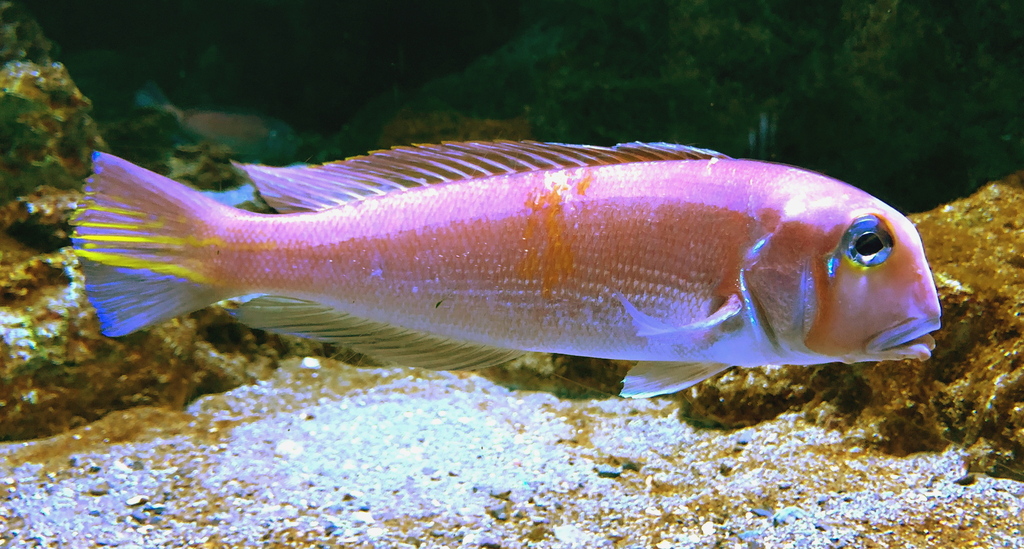
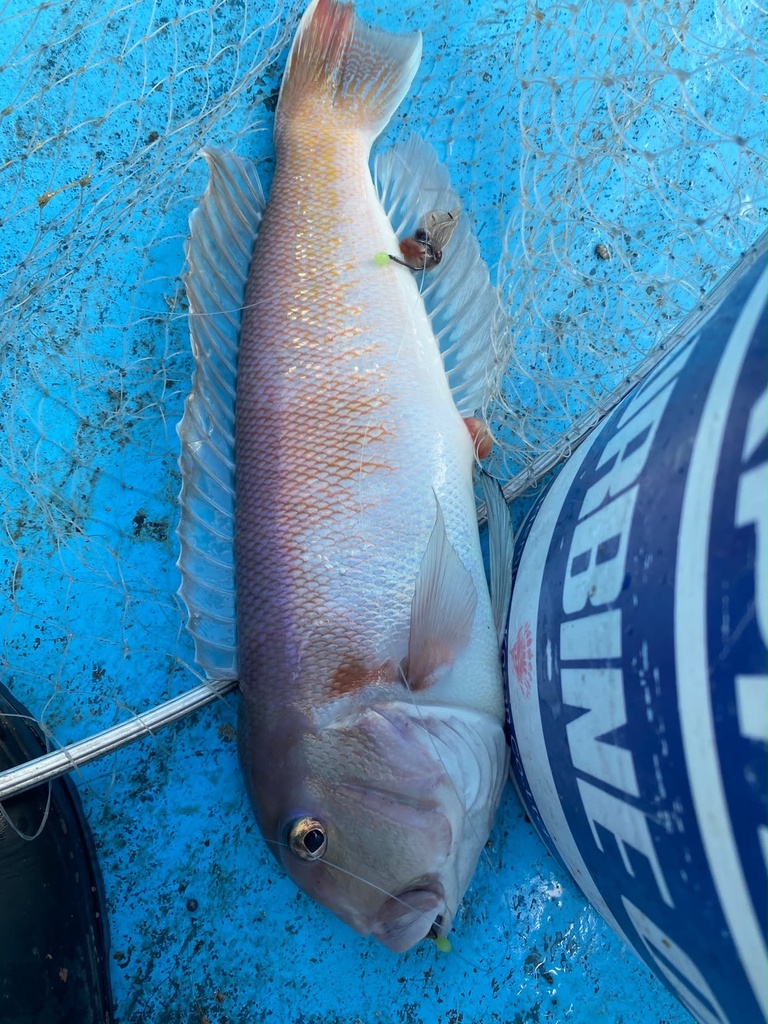
The golden tilefish is a large, deep-water tilefish of the western Atlantic. FishBase records a maximum length of 125 cm TL, a common length of 90 cm, a maximum published weight of 30 kg, a maximum reported age of 35 years and a length at first maturity of 42.2 cm. The distribution runs from Nova Scotia south along the U.S. coast, through the Gulf of Mexico from the Florida Keys to the Texas–Mexico border, and on to Tabasco and Yucatan, with a separate South American range from Venezuela to Suriname. It lives deep, mostly around 200 m, and it is slow-growing and long-lived, which makes it vulnerable to overfishing.
Identification
The body is fusiform and robust, with a blunt, heavy head. The feature that gives the genus its name is a low, fleshy ridge along the top of the head, and adults show a blue-grey to olive back, a yellow to golden belly and small yellow spots over the flank. The mouth is large and the dorsal fin runs long and low. FishBase records only the body shape and publishes no fin formula, so check the head ridge, colour and build against photographs and a regional guide before keeping a fish.
The species most likely to be confused with it on the deep-drop grounds is the blueline tilefish, which lacks the fleshy head ridge and shows a pale blue line along the base of the dorsal fin. Both are covered by the same U.S. tilefish permit, but the distinction is worth getting right.
Habitat and behaviour
FishBase gives a depth range of 80–540 m, with the species most common around 200 m over mud or sand and occasionally over rough bottom. The recorded temperature range is 9–14 °C, and the biology note gives a preferred range of 8–17 °C. Tilefish dig and maintain burrows in the sediment, and they are sensitive to cold water: a mass die-off in 1882 was followed by decades in which the species was scarce, apparently after an intrusion of unusually cold water.
The diet is mainly shrimp and crabs, with fish, squid, bivalves and sea cucumbers also taken. It lives on and in the bottom rather than chasing in mid-water, and its deep, muddy ground is a long run from most inlets.
Seasonal window
FishBase's spawning records run from January to June in the Gulf of Mexico and from March to November in the Mid-Atlantic and southern New England. The overall table covers January to November. That is a spawning record, not a promise of a bite: the fishery is open year-round, and the practical limit on trips is weather and sea state rather than a closed season.
On the deep grounds the current decides the day. Slack water is easier to fish with heavy sinkers, and a soft current lets you hold bottom with less weight. Winter trips are possible, but the run is longer and the weather window shorter.
Gear and approach
Deep dropping needs weight and line capacity. A heavy conventional reel, or an electric reel where it is legal, spooled with 65–100 lb braid, a 3–5 lb sinker and a two- or three-hook rig with circle hooks is a reasonable starting point. Glow beads help on dark ground, and a stiff rod with a fast tip lets you feel a bite 200 m down. Carry more sinkers than you think you need.
Keep the bait close to the bottom and stay in contact. Tilefish pick at a bait rather than running with it, so a slow lift and a steady wind are more effective than a hard strike. Because the fish come up from 150–250 m, release of an unwanted fish is difficult, and the recreational limit of eight fish per angler per trip is the practical ceiling. Plan to keep only what you will eat.
Edibility and regulations
FishBase describes the species as an excellent food fish, marketed fresh or frozen and suitable for steaming, pan-frying, broiling, microwaving and baking. The flesh is firm and white and holds up well in chowder or a simple pan. Bleed and ice the fish quickly.
The IUCN Red List category is EN (Endangered), assessed on 29 January 2013. FishBase records no CITES or CMS listing.
In U.S. federal waters from Maine to Virginia the recreational fishery is open year-round with no minimum size and a possession limit of eight golden tilefish per angler per trip. Private recreational boats need a valid Private Recreational Tilefish Permit to target or retain golden or blueline tilefish, and only rod and reel is allowed in the recreational fishery. Canadian rules are separate; check the current DFO requirements before fishing north of the U.S. management area.
Where to look
GBIF holds 499 occurrence records for the matched taxon, with the largest country counts in the United States (364), Canada (18) and Mexico (15). FishBase's distribution runs from Nova Scotia to the Gulf of Mexico and south to Suriname. The habitat keywords are sandy and muddy. These are distribution signals, not spot coordinates: look for mud and sand at 150–250 m, canyon edges and areas of rough bottom that hold bait, and check the forecast before committing to the run.
How to catch it
Heavy boat fishing
Fished with the listed approach, matched to the recorded depth and size.
Boat bottom fishing
Fished with the listed approach, matched to the recorded depth and size.
Regulations before you keep it
These are the published regulations for this fish. Read the number first. The notice below it is the actual regulation.
Bag limit2
No minimum size · 8 fish per angler per trip · all year
United States — federal (Atlantic) · US-FED-ATL
Federal Atlantic rules allow 8 golden tilefish per angler per trip, with no minimum size and no closed season.
A recreational tilefish permit and trip reporting are required north of the Virginia/North Carolina border.
Tilefish: Golden
Open season: All year
Minimum size: None
Possession limit: 8 per person
No minimum size · 8 fish possession limit
United States — Virginia · US-VA
Virginia sets a possession limit of 8 golden tilefish with no minimum size.
The federal EEZ rule is 8 per angler per trip, not a daily bag limit.
TILEFISH, GOLDEN
Minimum Size Limit: None
Possession Limit: 8 Golden Tilefish per person
Every record above names its source and the date it was retrieved. See the regulation register for the full list, or how to read these regulations.
Where these facts come from
Check these pages before you rely on a size, range or protection status.
-
FishBase — Lopholatilus chamaeleonticeps
— FishBase · T2
-
GBIF — Lopholatilus chamaeleonticeps occurrence records
— GBIF · T2
-
IUCN Red List — Lopholatilus chamaeleonticeps
— IUCN · T1
-
Photo record — iNaturalist
— iNaturalist · T3