
Redbelly yellowtail fusilier
The redbelly yellowtail fusilier is easy to place at a glance: a deep, compressed body, a white or pinkish lower third, and a large yellow tail with no prominent black markings on the caudal fin. The counts are 10 dorsal spines with 14–16 soft rays, and three anal spines with 10–12 soft rays. The cheek carries four or five rows of scales, the predorsal scales run 20–26, and the dorsal and anal fins are scaled.
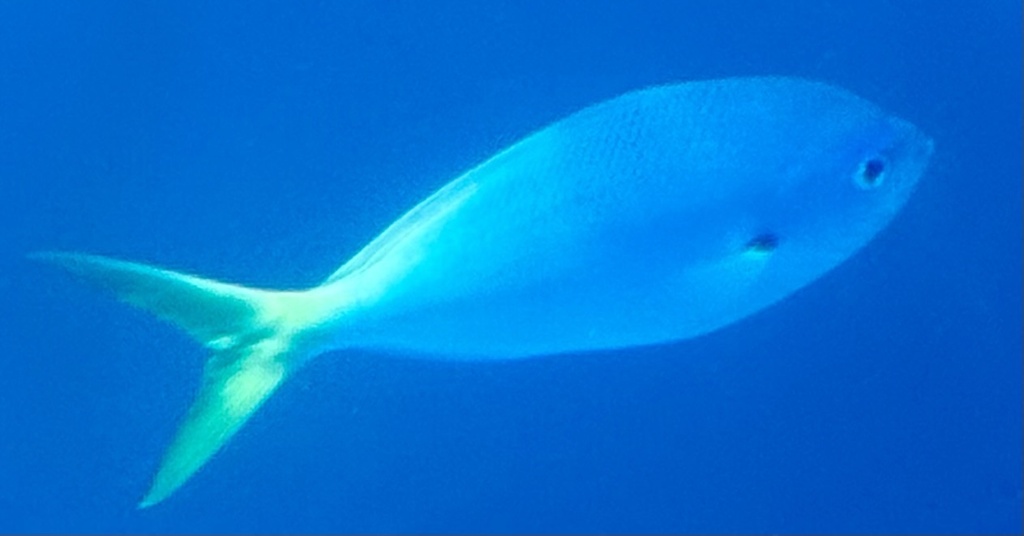
The redbelly yellowtail fusilier is easy to place at a glance: a deep, compressed body, a white or pinkish lower third, and a large yellow tail with no prominent black markings on the caudal fin. The counts are 10 dorsal spines with 14–16 soft rays, and three anal spines with 10–12 soft rays. The cheek carries four or five rows of scales, the predorsal scales run 20–26, and the dorsal and anal fins are scaled. The character that separates it from Caesio teres is a continuous band of scales across the dorsal midline behind the head. Length is usually around 35 cm; the maximum recorded is 60 cm total length.
Midwater, over a reef, in bad visibility
The range is Indo-West Pacific, from Sri Lanka to Vanuatu, southern Japan to northern Australia. The recorded depth is 1–60 m, and the useful note is 1–30 m in silty water with low visibility. This is a midwater schooler over coastal rocky and coral reefs, feeding on zooplankton. It does not migrate. That combination — non-migratory, plankton-feeding, midwater — means the school is local but not fixed. It follows current and visibility rather than a home cave. On a clear day the school may be up in the water column; after rain, it can be deeper and harder to see. Look for the current edge over the reef first, then for the fish.
A fish with two jobs
The commercial record gives three different capture methods in three places: handlines in Sri Lanka, fish traps in western Thailand and Malaysia, and trawls in the Gulf of Thailand. That is a fish that is caught because it schools, not because it is difficult. For a rod, the same schooling behaviour sets the method: small hooks, light line, a small lead, and a bait or tiny lure fished at the depth the school is holding. There is a second job, and it is the reason many reef anglers look for this fish before they look for anything else. A 35 cm fish in a tight school is exactly what a larger reef predator eats, and it is what goes into a live-bait well. That use is field practice rather than a line in the source, so treat it as an observation, not a citation. The same school can be the target or the bait, depending on the size of the rod in your hand.
Gear that matches 35 cm
Rig for the usual 35 cm fish rather than the 60 cm maximum. PE 1–1.5, a 20–30 lb leader, hooks in the 2–4 range, and a 20–40 g lead will hold a small bait or jig in the midwater layer. The mouth is small and soft; a locked drag tears it on the first run. A multi-hook rig needs the hooks spaced well apart, or the school's movement will tangle it before a fish does. Unhook in the water where possible and keep handling short — this is a fish that may be released, or may be used, and either way it should not be exhausted first.
No spawning table
The reproduction note is short: oviparous, with numerous small pelagic eggs. There is no spawning month, no spawning ground, and no maturity length in the file. There is also no weight and no age record. That is a lot of blank columns, and filling them with a plausible season would be invention. The practical consequence is simple: do not plan a trip around a spawning run that the source does not describe. Use water colour, current and the presence of the school. The species is non-migratory, so the fish are present year-round somewhere on the reef; the question is where the school is holding on the day.
Harmless, commercial, and still regulated
The uses field lists commercial fishing only — no gamefish entry and no aquarium entry. Red List status is Least Concern, assessed 6 March 2015. The threat-to-humans field says Harmless, and there are no ciguatera reports for this species. That does not make every reef fish safe; it means this one is not on the list. Thailand closes Similan and Surin national parks during the monsoon, roughly May to October, and the marine fisheries management plan sets separate closures and gear limits. Malaysia protects the core zones of the Tioman, Redang and Perhentian marine parks, and states set additional size and gear rules under the 1985 Fisheries Act framework. Indonesia zones its marine protected areas and manages reef-fish exports and sizes by ministerial regulation. The Philippines works through RA 8550 as amended by RA 10654, with closures and MPAs set nationally and locally. Confirm the current notice before keeping a catch.
Notes on names and counts
The English name in the source is redbelly yellowtail fusilier; local names in the region include ekor kuning in Indonesia and a Thai name used in the Andaman guidebooks. The Indonesian label is a colour description and is applied to more than one yellow-tailed fusilier, so it is not a species name. iNaturalist holds 1,757 observations. The scale counts above are the reliable identification route; colour alone will not separate this fish from its relatives.
How to catch it
Handline
Fished with the listed approach, matched to the recorded depth and size.
Boat bottom fishing
Fished with the listed approach, matched to the recorded depth and size.
Where these facts come from
Check these pages before you rely on a size, range or protection status.
- FishBase — Caesio cuning — FishBase · T2
- GBIF — Caesio cuning occurrence records — GBIF · T2
- IUCN Red List — Caesio cuning — IUCN · T1
- Photo record — iNaturalist — iNaturalist · T3
Fish in the same water
These fish live in the same place.


Guides for this water
Technique, gear and safety guides that fit Redbelly yellowtail fusilier.