
Dragonet
The common dragonet is a small, bottom-dwelling fish of the family Callionymidae, known for the long, sail-like dorsal fins of mature males. It is widespread in the eastern Atlantic, from southern Iceland and Norway down to Mauritania, and also occurs through the Mediterranean and Black Sea. Most fish are found on sand in 5–30 m, although trawls have recorded it as deep as 440 m.
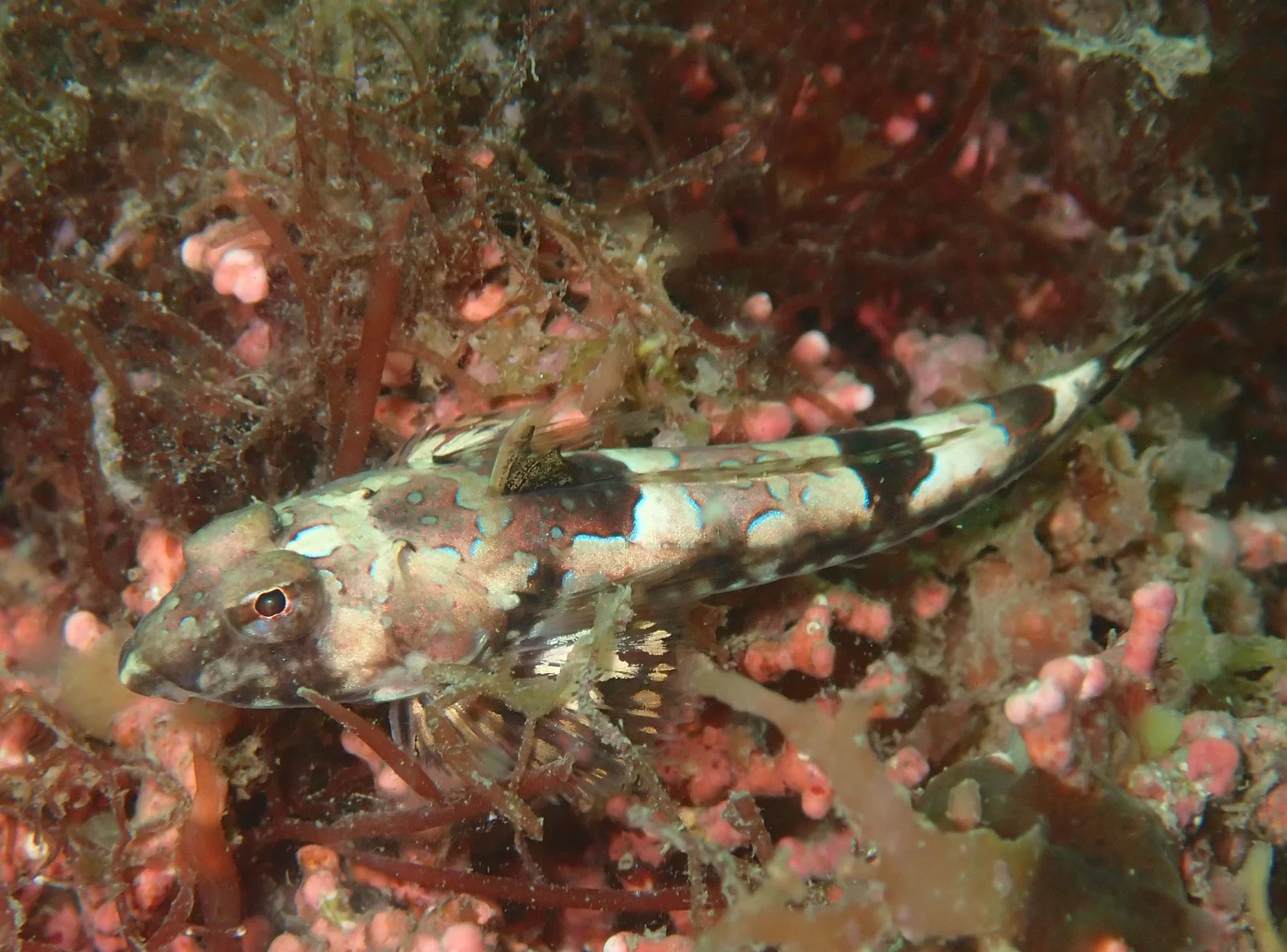
The common dragonet is a small, bottom-dwelling fish of the family Callionymidae, known for the long, sail-like dorsal fins of mature males. It is widespread in the eastern Atlantic, from southern Iceland and Norway down to Mauritania, and also occurs through the Mediterranean and Black Sea. Most fish are found on sand in 5–30 m, although trawls have recorded it as deep as 440 m. It is not a sport target: FishBase calls it a minor commercial species and notes public-aquarium use, while Wikipedia describes it as mainly bycatch. A male reaches 30.5 cm total length, and IUCN assessed the species as Least Concern in 2013.
Identification
The species epithet is lyra, but the English name is plain: Dragonet, with Common dragonet as the alternative. Chinese uses 䲗, with 䲗 and 䲗 as variants. The capture gives dorsal soft rays 8–10 and anal soft rays 9; dorsal spines, anal spines, body shape and cross-section are all blank. The counts are few but workable for a small fish with two long dorsal fins and a flat underside.
The size table gives 30.5 cm TL for a male or unsexed fish, 25.0 cm TL for a female, a common length of 15.0 cm TL, a maximum age of 7 years and a maturity length of 17.4 cm. No weight is recorded. The odd number is the relation between common length and maturity: 15 cm sits below 17.4 cm, so the typical fish in a sample may still be immature. That is a caution about sampling, not a biological rule.
Habitat and distribution
The environment line is marine, demersal, depth 1–440 m with a usual band of 5–30 m, temperate, 16–20 °C, 66°N–16°N and 42°W–42°E. The bottom is sand, and the diet is crustaceans and worms. FishBase's distribution runs from southern Iceland and Norway south to Mauritania, with the northern Mediterranean, Gibraltar, Algeria, the western Black Sea, the Aegean, the Adriatic, the Azores and the Canaries. Thirty country rows are all native.
GBIF returns 38 rows: 11 without a country code, Netherlands 8, Belgium 6, the Bahamas 3, France 2, Sweden 2, and Denmark, Spain, the United Kingdom and Greece one each. Four rows mark the taxon native, three introduced and 31 carry no means. The three introduced rows are all in the Bahamas, well outside the native range. iNaturalist holds 719 observations. Wikipedia confirms the sand bottom, the seven-year life, the bycatch and the aquarium trade.
Season and fishing approach
Two spawning rows are carried: the Mediterranean runs February to August and the North Sea runs April to August. The combined window is February to August. The temperature band, 16–20 °C, is recorded, but no spawning threshold is captured, so the two cannot be tied together.
The use line is minor commercial with public aquariums, and there is no gamefish flag. Wikipedia says the fish is caught in bycatch and used in the aquarium trade. The capture gives no method, bait or regulation. The usual depth band, 5–30 m, is within reach of shore and small-boat work, but the record does not say how to target a dragonet, and the bycatch note suggests it is not a target species.
Edibility and regulations
IUCN lists the species as Least Concern, assessed 6 May 2013. No food use or market detail is recorded. The human-use line is minor commercial plus public aquariums, with gamefish absent. Wikipedia's extract adds bycatch and the aquarium trade but no culinary or regulatory detail.
No size, season or bag limit is carried. A fish taken mainly as bycatch may still be covered by a local rule, and the page has no way to say which. Anyone keeping one should check the rule that applies at the landing point, not infer a limit from the absence of a gamefish flag.
Where these facts come from
Check these pages before you rely on a size, range or protection status.
- FishBase — Callionymus lyra — FishBase · T2
- GBIF — Callionymus lyra occurrence records — GBIF · T2
- IUCN Red List — Callionymus lyra — IUCN · T1
- Photo record — iNaturalist — iNaturalist · T3
Fish in the same water
These fish live in the same place.

Acoupa weakfish
- Family
- Sciaenidae
- Depth
- 1–20 m
- Season
- Jan, Feb, Mar, Apr, May, Jun, Jul, Aug, Sep, Oct, Nov, Dec

American angler
- Family
- Lophiidae
- Depth
- 0–800 m
- Season
- Mar, Apr, May, Jun

American eel
- Family
- Anguillidae
- Depth
- 0–464 m
- Season
- Jan, Feb, Mar, May, Jun, Jul
Guides for this water
Technique, gear and safety guides that fit Dragonet.