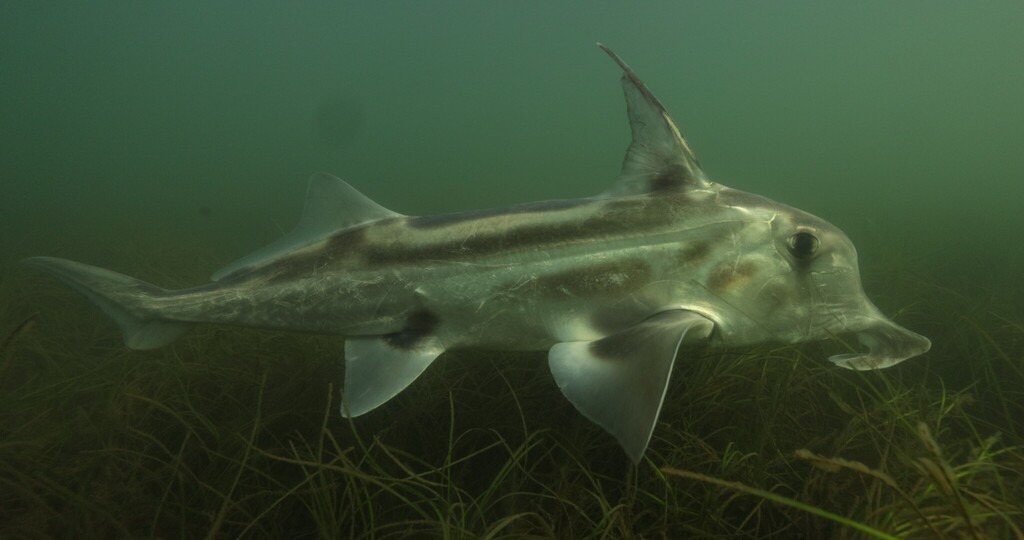
Elephant fish is a chimaera, and the names are the first thing to sort out. FishBase gives Elephant fish as the English name, with ghost shark, plownose chimaera, whitefish and silver trumpeter among the alternatives. It is a demersal fish recorded from the surface to 227 m. Wikipedia classifies it as a chimaera in the subclass Holocephali, with sharks, rays and skates in the other subclass, Elasmobranchii.
A cartilaginous fish outside the shark group
The species is a cartilaginous fish (Chondrichthyes) in the subclass Holocephali; sharks, rays and skates belong to the other subclass, Elasmobranchii. Both groups sit inside Chondrichthyes, so "cartilaginous" alone does not separate a chimaera from a shark.
That distinction is not academic. Ghost shark, elephant shark and whitefish all point at something the animal is not, and none of them is a taxonomic statement. Plownose chimaera is one of the recorded names, and reperepe is listed as an English vernacular name.
125 cm is the record, 75 cm the ordinary fish
The maximum is 125 cm TL and the common length is 75 cm TL. No maximum weight and no maximum age are published. Maturity is estimated at 71 cm, with a range that opens at 70 cm and leaves the upper bound blank.
The distance from 71 cm to 125 cm is 54 cm. That is the adult size range the page documents without describing. A 75 cm fish is the ordinary fish, four centimetres above the maturity estimate; a 125 cm fish is a record.
No fin-ray counts, no body-shape field and no colour note are published. Identification therefore rests on the classification and the recorded names, not on a meristic table.
0 to 227 metres, and a spring move into estuaries
The depth range is 0–227 m. The environment line adds marine and brackish water, a demersal habit and an oceanodromous life history. The habitat keywords are estuary and coastal.
The biology note says the fish migrates into large estuaries and inshore bays in the spring to breed. That is the only seasonal statement on the page, and it describes a movement rather than a spawning month.
Brackish water is listed alongside marine, which is consistent with the estuary keyword and with a fish recorded in estuaries. The page gives no separate depth for that estuarine phase.
The latitude span is 33°S to 50°S under a subtropical label. Wikipedia puts the New Zealand range south of East Cape and Kaipara Harbour and gives 0–200 m, a slightly shallower ceiling than the FishBase figure.
7,046 records, two centres
FishBase gives the range as the southwest Pacific: southern Australia and New Zealand. GBIF holds 7,046 records: 4,216 Australian, 2,745 New Zealand, one each from Argentina, Great Britain and Uruguay, and 82 spread across other countries.
The two centres hold 98.8 percent of the records, and the three single records are range noise rather than a second distribution. The two centres also match the FishBase sentence, and Wikipedia's New Zealand limits fit inside the larger picture.
Shellfish, and eggs in horny cases
The diet is mainly shellfish. The species is oviparous, and the eggs are encased in horny shells. Those two lines are the whole biological account: no prey species, no feeding time and no growth curve are published.
Egg-laying is recorded; the page describes no clutch size and no incubation period. The page publishes no spawning month and no nursery depth, so the spring movement into estuaries is the only reproduction-related timing a trip can be planned around.
Males carry a club on the head
Males have a small, club-like protuberance on the head and long copulation organs near the pelvic fins. That is the only sexual dimorphism the page records.
It is also a handling point: a male brought aboard carries structures a female does not, and the page gives no size at which the club appears. Sex cannot be assigned from the published length data.
Boat first, shore second
The methods list puts boat bottom fishing as mainstream and shore casting as secondary. The terrain list is sandy bottom, coastal and estuary. The two lines agree on a bottom rig in shallow coastal water or at an estuary mouth.
The 227 m figure is the deepest the page documents, and the estuary keyword places the fish in water far shallower for part of the year. A shellfish diet supports bait fished on or near the bottom, though the page names no bait.
Good flesh, one commercial use
FishBase records a commercial fishery and no other use: no gamefish entry, no aquaculture and no aquarium trade. The biology note says the flesh is of good eating quality. That is the only handling or eating statement on the page.
No weight is published, so there is no fillet yield to quote; no age is published, so there is no growth argument for a release size. The 71 cm maturity estimate is the only biological line, and it sits four centimetres below the 75 cm common length.
Least Concern in 2024, and national rules decide
The IUCN category is Least Concern, assessed on 4 May 2024. CITES and CMS are both Not Evaluated, and the species is listed as harmless to humans. The category is global; it is not a stock estimate for either national fishery.
In New Zealand, MPI sets the amateur saltwater rules: daily bag limits, minimum sizes, method restrictions and accumulation limits, applied by fishery management area (FMA). Marine reserves under the Marine Reserves Act 1971 are no-take, and Hauraki Gulf, Fiordland and Marlborough Sounds carry additional rules, as do temporary closures and rāhui.
No bag number, size limit or closure date is given here. The page also publishes no national size limit, so the 71 cm maturity estimate cannot be checked against a rule. Check the current MPI rule for the FMA and the marine reserve map before the trip.
Regulations before you keep it
These are the published regulations for this fish. Read the number first. The notice below it is the actual regulation.
Bag limit2
2 fish per day · 4 in possession
Australia — Tasmania · AU-TAS
Tasmania allows 2 elephant fish per day and 4 in possession.
Elephantfish | 2 | 4 | - | -
5 fish per fisher per day
New Zealand — South East · NZ-SE
New Zealand allows 5 elephant fish per fisher per day.
Elephant fish | 5 | — | 150
Every record above names its source and the date it was retrieved. See the regulation register for the full list, or how to read these regulations.
Where these facts come from
Check these pages before you rely on a size, range or protection status.
-
FishBase — Callorhinchus milii
— FishBase · T2
-
GBIF — Callorhinchus milii occurrence records
— GBIF · T2
-
IUCN Red List — Callorhinchus milii
— IUCN · T1
-
Photo record — iNaturalist
— iNaturalist · T3