
Armed snook
Armed snook is a small centropomid of the eastern Pacific, from Mexico down to Ecuador, and it is a fish of brackish as well as fully marine water. It reaches 46.5 cm TL with a common length of 25 cm and about a kilo. Shore casting and boat fishing are the methods listed for it. IUCN assessed it as Least Concern in 2019, and no depth band is recorded.
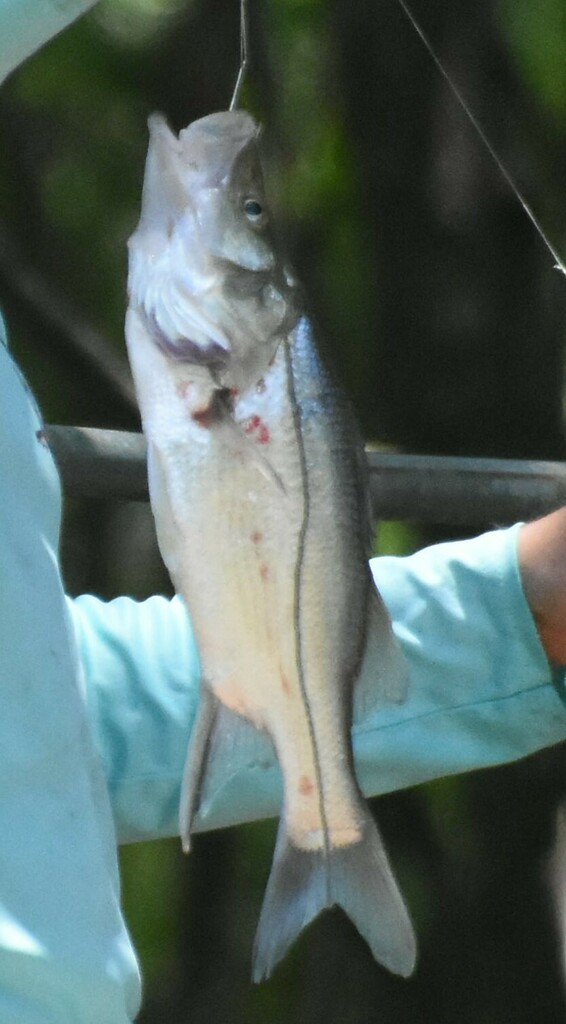
*Centropomus armatus*, the armed snook, is a small centropomid of the eastern Pacific, recorded from Mexico to Ecuador. FishBase gives 46.5 cm TL as the maximum, 25 cm TL as the common length and 1.0 kg as the maximum weight. It is a brackish-water and marine species, taken by commercial and recreational fishers, and was assessed as Least Concern in 2019. This page covers the spine that gives it its name, the empty biology file, and the Colombian permit rules that are the only species-relevant instrument located.
Identification
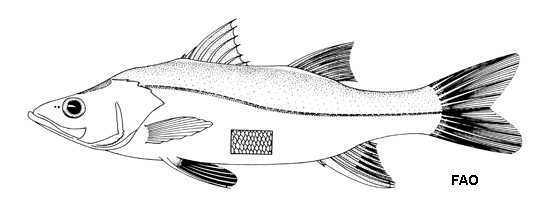
The morphology is unusually well described. The body is long and moderately deep, with a dorsal profile slightly concave behind the eyes. The lateral line runs to the posterior edge of the caudal fin. The second anal spine, folded down, reaches or passes the origin of the caudal fin, and the pectoral and pelvic fins are sub-equal in length. The first gill arch carries 20–25 gill rakers.
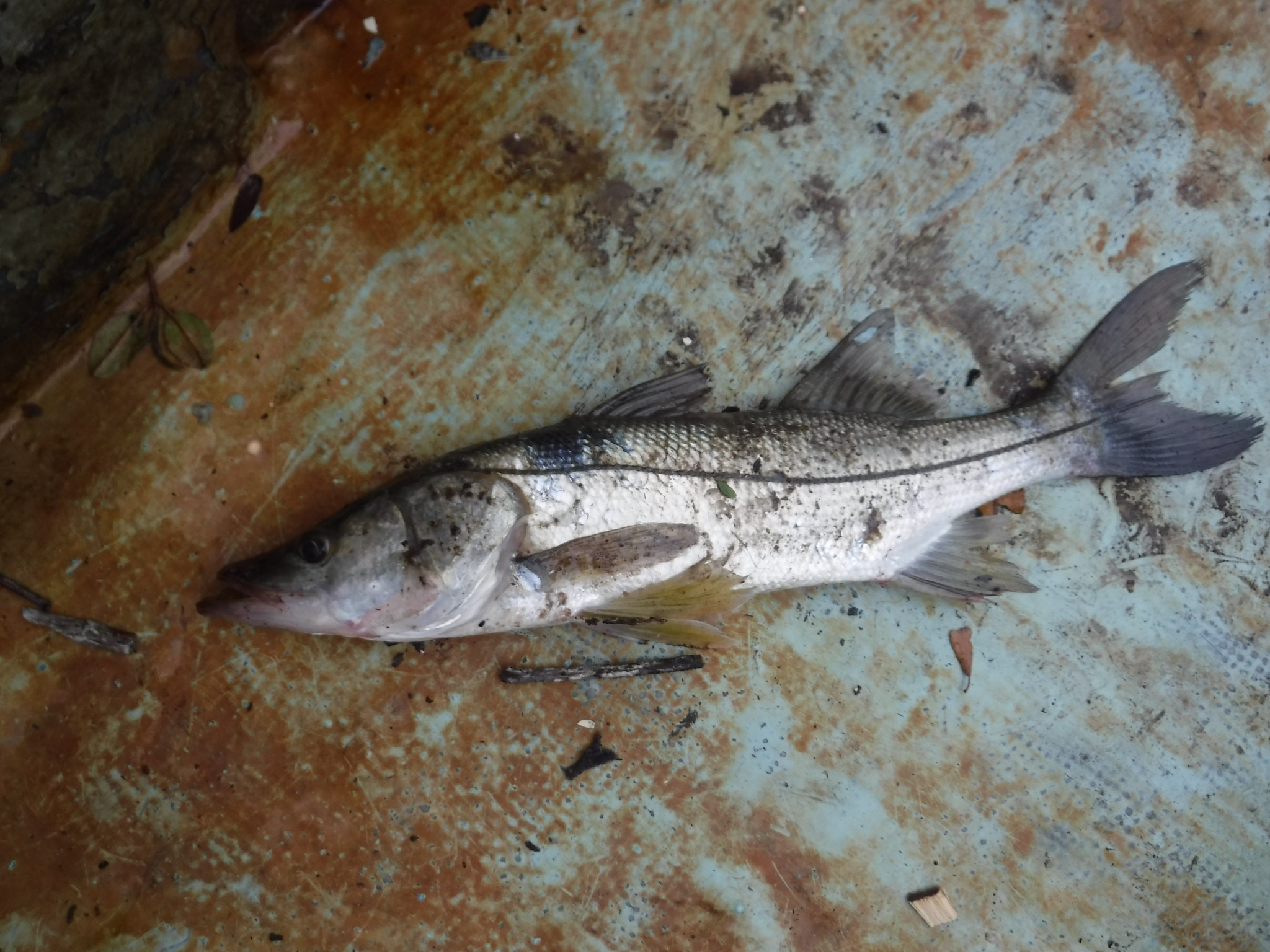
Colour is recorded: a blue-grey back, a silvery belly and a dark lateral line, with black membranes between the spines of the first dorsal fin and between the second and third anal spines. Those black membranes and the overlong anal spine are the marks to check first, and they are what the English name refers to.
Size is modest. Maximum length is 46.5 cm TL, common length 25 cm TL and maximum weight 1.0 kg. No maturity length is given. A 46.5 cm fish is therefore the top of the range, and a 25 cm fish is a routine catch whose maturity status the page cannot state.
Range and habitat
The distribution text is eastern Pacific, Mexico to Ecuador. The environment line adds marine, brackish, demersal, tropical, between 24°N and 4°S and 107°W and 76°W, with no depth figure. The word brackish is the useful one: it places the fish in estuaries and river mouths, where fresh and salt water mix, and it is the only habitat statement on the page.
GBIF returns 734 present records: 503 from Colombia, 110 from Mexico, 81 from Panama, 12 from El Salvador, 8 from Ecuador, 4 from Guatemala, 4 from Peru, 2 from Costa Rica and 2 from the United States. iNaturalist carries 6 observations. Peru and the United States are not on FishBase's country list, and the Costa Rican total of 2 is thin for a country inside the described range. Colombia holds 69 percent of the records.
No substrate, salinity range or nursery description is recorded.
Habits and diet
The biology section is empty. FishBase records no diet, no prey, no feeding time and no growth rate for this species. Reproduction is equally blank: no spawning season, no spawning ground and no maturity length.
The IUCN entry is Least Concern, assessed on 8 January 2019. The page gives no population trend and no regional breakdown.
That is the whole file. For a fish that is both commercially and recreationally taken, the absence of a diet and a maturity figure is the main limit on what this page can say. The morphology is detailed; the natural history is not.
Season and time of day
No spawning period is recorded, so no month can be recommended, and none can be called a closed season on the evidence here. The climate line says tropical, between 24°N and 4°S, which is a latitude band rather than a season.
Time of day is not recorded either. An inference, labelled as one, can be made from the body plan: a long, moderately deep fish with a large mouth, living in brackish water and recorded as demersal, fits an ambush predator that holds near structure and feeds when light is low. That is reasoning from shape and habitat, not a record, and with no diet data it should not be pushed further.
Tide is not mentioned anywhere on the page. In a brackish species that is the obvious missing variable, and it is not in the source.
Tackle and techniques
With a maximum of 46.5 cm and 1.0 kg, and a common length of 25 cm, this is light-tackle work. Gear scaled for a one-kilogram fish is enough, and heavier tackle is not supported by any figure on the page.
The habitat is brackish and demersal, with no depth given, so the presentation should be near the bottom in water where fresh and salt meet. No bait or method is recorded; a bottom or near-bottom presentation with shrimp or a small fish is inference from the habitat, not a recommendation from the source.
The one handling point the morphology supplies is the second anal spine, which reaches or passes the caudal origin when folded, and the black membranes between the first dorsal spines. A fish that small is usually held in the hand, and those spines are where the hand should not go.
Identification should be checked against the gill-raker count of 20–25 and the long anal spine, because the other snooks in the same estuaries are not described here.
Kitchen and handling
FishBase records commercial use and a gamefish entry, with no price, no quality note and no culinary description. Maximum weight is 1.0 kg and common length 25 cm; there is no common weight, so no kilogram grade can be built.
A 25 cm snook yields small fillets, and the 46.5 cm maximum is the top of the range rather than a routine landing. The page gives no data on the size composition of landings, so how often a large fish appears is unknown.
Nothing is recorded about killing, bleeding, storage or filleting. The regulatory rule is set out below: Colombia requires a permit, and no species-specific size or bag was located there.
Regulations and conservation
IUCN lists the species as Least Concern, assessed on 8 January 2019. The page gives no trend and no regional breakdown. LC is a global label; Colombia, with 503 of the 734 GBIF records, carries most of the documented occurrence and is not separately assessed on this page.
Colombia: a recreational fishing permit or registration is required. No species-specific size or bag limit for C. armatus was located in the sources checked, so the Colombian rule is deferred: verify current requirements with the competent regional authority before fishing. No Argentine or Brazilian numbers apply to this species and none are imported here.
The other range states, from Mexico to Ecuador, are not covered by the regulatory sources used for this page. Their rules must be checked locally; nothing in this article should be read as a size or bag figure for them.
The conservation picture is therefore thin in a specific way: a widely distributed, Least Concern fish with no species-specific harvest rule located in the one country whose permit system is documented here.
How to catch it
Shore casting
Fished with the listed approach, matched to the recorded depth and size.
Boat fishing
Fished with the listed approach, matched to the recorded depth and size.
Where these facts come from
Check these pages before you rely on a size, range or protection status.
- FishBase — Centropomus armatus — FishBase · T2
- GBIF — Centropomus armatus occurrence records — GBIF · T2
- IUCN Red List — Centropomus armatus — IUCN · T1
- Photo record — iNaturalist — iNaturalist · T3
Fish in the same water
These fish live in the same place.

Guides for this water
Technique, gear and safety guides that fit Armed snook.