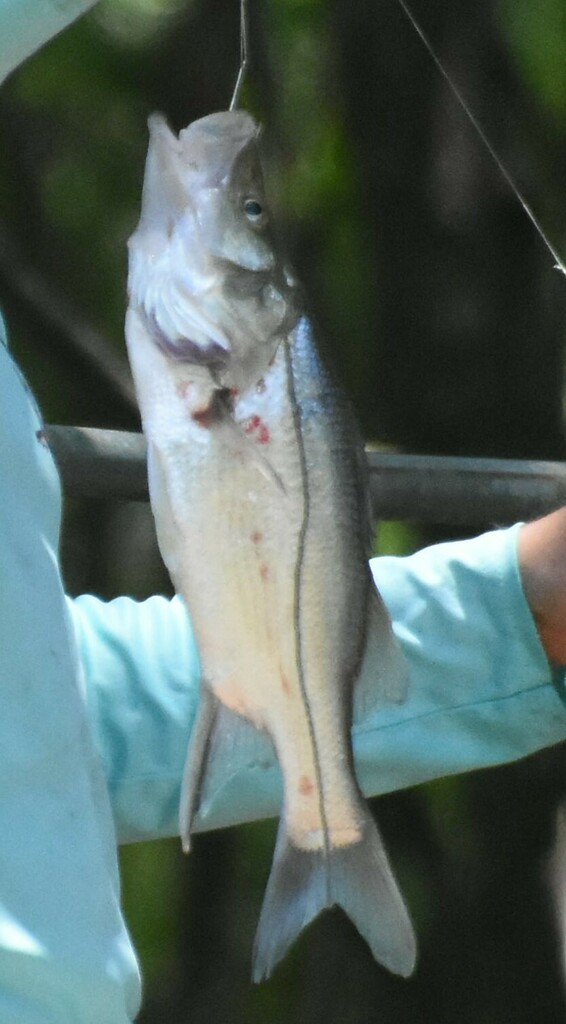
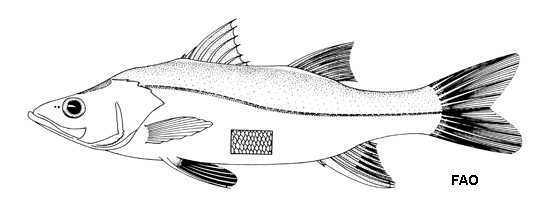
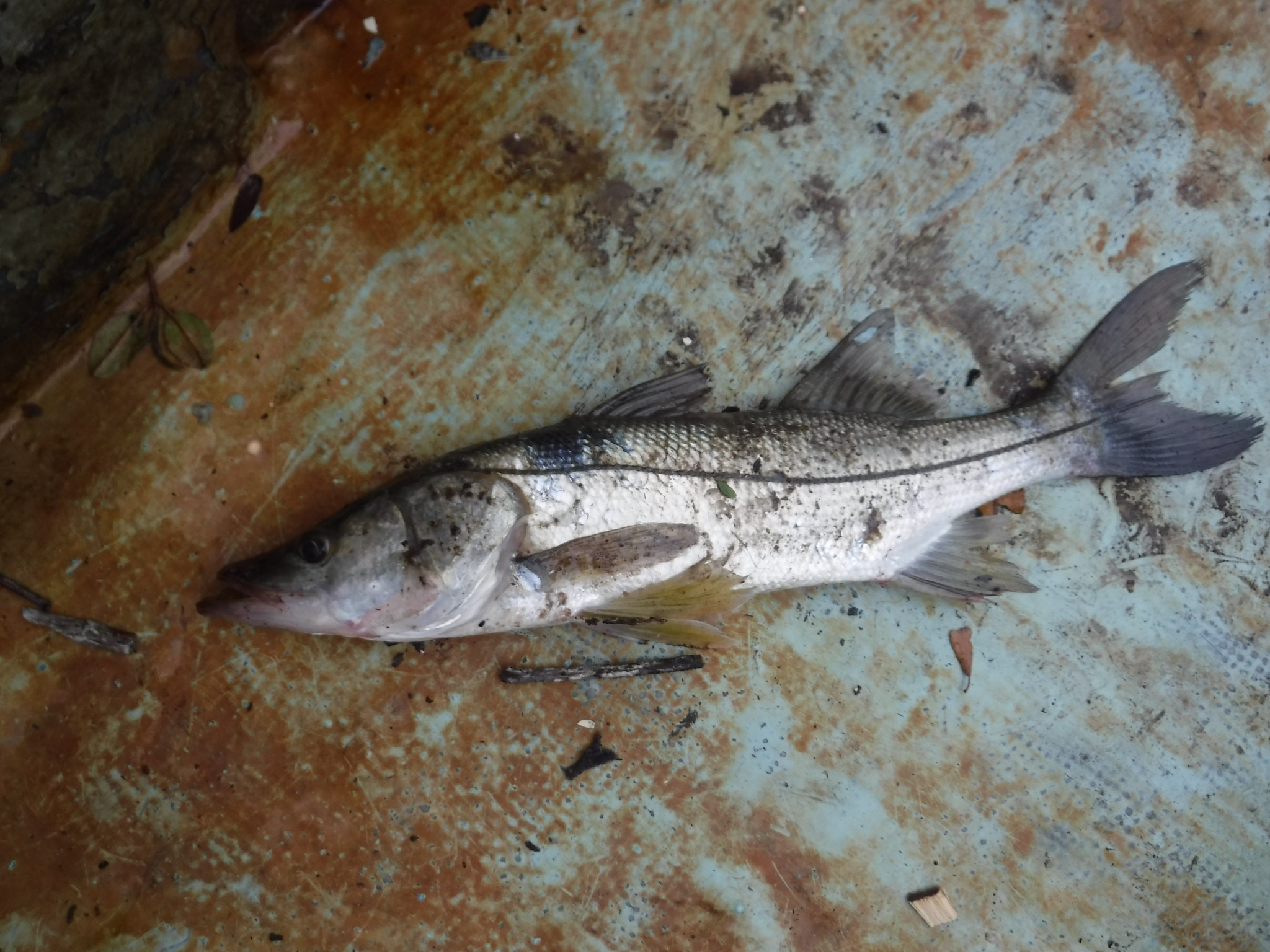
Common snook is a fish described by the water it moves through. The page carries five environment words at once — marine, freshwater, brackish, reef-associated and amphidromous — and not one salinity figure. That mismatch between labels and measurements is the useful thing to work with.
Five words for water
The environment line lists marine, freshwater and brackish, adds reef-associated, and then adds amphidromous as the movement term. Read together, those words describe an animal that can be found across the whole salinity range, from river water to full-strength sea water, without saying where in that range it spends most of its time.
The same line gives a reef-associated milieu, which sits awkwardly beside the freshwater and brackish entries. It is not a contradiction in the database; it is a set of habitat tags collected from different descriptions. Treat the list as a vocabulary, not as a map.
One practical reading follows. If the tags were collected from different descriptions, then each one was probably true where it was written and no single tag summarises the whole animal. A fish tagged reef-associated was recorded over reef; a fish tagged freshwater was recorded upriver. Both statements can be accurate, and neither locates the fish on a given morning.
Amphidromous is a direction, not a number
Amphidromous means the fish moves between fresh and salt water during its life, but the term does not say when, how far, or at what salinity. The page adds no salinity value, no distance, and no timing.
That leaves the most important practical question unanswered. Want to fish the transition? The source confirms it exists and stops short of locating it. The gradient has to be found on the ground, or in local knowledge, not in this record.
The depth field starts at nothing
The depth range is printed as a blank minimum and a maximum of 22 m. When the lower bound is empty, what remains is a single known ceiling, not a range. The page cannot say how shallow the species goes, which is exactly the end of the range that matters in an estuary.
Its habitat keywords name estuary and coastal; the diet tags list crustaceans and fishes. Those are consistent with a shallow, structured environment, but they are words, not depths.
140 cm record, 50 cm common, 7 years
The table's maximum-length entry is 140 cm TL, the common length 50 cm, the maximum weight 24.3 kg and the maximum age 7 years. The distance between 50 and 140 is the difference between a good fish and a record fish.
Seven years is a short lifespan for a fish that reaches 24 kg. No age-at-weight figure is given, so the growth curve cannot be read from this record. What you have is a ceiling on age and a ceiling on size, not a schedule. A seven-year cap also limits how many spawning seasons one fish can contribute, a question the page raises and leaves open.
Maturity at 42 cm, with a blank range
The maturity field gives Lm 42.0 cm, with both ends of the range left blank. So there is a single maturity figure and no bracket around it.
On the gradient, that matters in a specific way. A 42 cm fish can come from fresh, brackish or salt water, and the page never says whether maturity arrives at one size across all three. That figure is the sole maturity fact here; do not stretch it across salinity zones the source never compared.
25–31°C and the spawning rows
The temperature window is 25–31°C. The spawning table marks January and May through December, with regional rows for Cuba in January and August through December, and French Guiana in May through September.
Nothing ties the spawning rows to a salinity value. Assuming spawning occurs at the salty end is easy; supporting it from this record is not. The regional months are useful for trip planning; the salinity of the spawning ground is not in this source.
The country table overshoots the range text
The distribution text runs from southern Florida and the southeastern Gulf of Mexico through the Antilles and the Caribbean coast to Rio de Janeiro, with additional records from North Carolina and Texas. Uruguay is also listed, and it lies south of the stated Rio limit.
The country table is a list of places with a record, not a boundary. An isolated capture, a mislabelled record or a real range extension could all explain Uruguay; the page chooses none. The GBIF distribution table lists 46 rows, 32 of them sourced from a Brazilian fauna checklist, and 35 rows with no locality name at all. iNaturalist, by contrast, carries 2,552 observations; the distribution table remains thin and catalogue-shaped behind a broad range statement.
Fishing the gradient
Pick the water you can read. In an estuary, note the salinity or at least the distance from the inlet, because the species record gives you no salinity value to compare against. Note its total length and weight, the date, and whether the fish came from fresh, brackish or salt water.
Work from 50 cm, treat 140 cm as the record, and remember that 42 cm is the only maturity figure on offer. Wikipedia mentions the local name robalo and the obsolete synonym Centropomus undecimradiatus: names have changed while the salinity gradient has not.
Regulations before you keep it
These are the published regulations for this fish. Read the number first. The notice below it is the actual regulation.
Minimum size1
22–38 in (558–965 mm) fork length slot
Puerto Rico · PR
Puerto Rico prohibits taking or possessing common snook (róbalo) smaller than 22 inches (558 mm) or larger than 38 inches (965 mm) fork length.
Regulation 7949 (2010) supersedes Regulation 6768 (2004). No closed season for róbalo is listed in the regulation; emergency closures are possible under Article 28.
Pesque, posea, venda u ofrezca en venta róbalos (Centropomus undecimalis) menores de 22 pulgadas (558 mm) de largo horquilla (LH), ni mayores de 38 pulgadas (965 mm) de largo horquilla (LH).
Every record above names its source and the date it was retrieved. See the regulation register for the full list, or how to read these regulations.
Where these facts come from
Check these pages before you rely on a size, range or protection status.
-
FishBase — Centropomus undecimalis
— FishBase · T2
-
GBIF — Centropomus undecimalis occurrence records
— GBIF · T2
-
IUCN Red List — Centropomus undecimalis
— IUCN · T1
-
Photo record — iNaturalist
— iNaturalist · T3