
Mexican snook
Mexican snook is a centropomid of Mexican inshore and coastal waters, including estuaries, brackish reaches and fresh water. It reaches 90 cm TL and 9 kg, and is a minor commercial catch and a gamefish. Its season runs June to August.
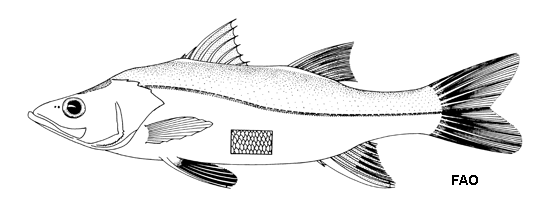
Two entries sit in one human-use row: fisheries "minor commercial", gamefish "yes". On most species pages those two lines describe two different fleets. Here they describe a single fish that barely registers in landings and still carries a sport label. The rest of the record is thin in the same way — three countries, six public observations, one spawning window. This page works with the thinness instead of padding it.
Two labels on one line
"Minor commercial" is a category, not a number. It says the species is landed, and it says the landings are small enough that FishBase does not treat them as a fishery of their own. "Gamefish: yes" is a different kind of claim, and it is the only line in the row that points at a person holding a rod.
Neither line comes with tonnage, price, or a landing table. That is the whole market picture, and adding to it would be inventing. What the row does establish is an order: the fish became a target before it became a commodity.
A species described in 1961
The World Register of Marine Species enters Centropomus poeyi as an accepted species described by Chávez in 1961, under AphiaID 280066. The same record flags it as marine, brackish and freshwater at once, which is rare for one taxon and agrees with the four habitat words in FishBase.
A 1961 description is recent in ichthyology. That helps explain the uneven common names: FishBase carries Mexican snook and Robalo prieto, and the first of those names the authority's country rather than a local trade.
Ninety against forty-five
The size row gives 90 cm total length as the maximum, 45 cm TL as the common length, and 9 kg as the maximum weight, all from reference 3713. The ordinary fish is half the length of the largest — a two-fold spread, not the order-of-magnitude gap that a record-fish page has to manage. In the same unit, the common fish is 45 cm shorter than the maximum.
No maturity length and no maximum age are printed. So the page cannot say at what size the stock begins to reproduce, and the 9 kg figure stands alone with no paired length. On board, 45 cm is the planning number; 90 cm is the fish that ends the session.
The depth row is empty
The depth field carries nothing at all. Not a range, not a usual band, not one figure. This is not a gap to be filled with a number borrowed from another snook; it is a gap that decides what the habitat words are for.
Those four words — estuary, coastal, brackish, freshwater — place the fish horizontally. Without a depth they support only a plan along the water: river mouths, channel edges, the reach where fresh meets salt. The vertical position has to be found on the day.
June, July, August
One spawning record exists: Mexico, June through August. One country, three months, and no depth or salinity attached to the entry. Three months is a quarter of the year; the other nine carry no spawning record. The record does not say whether those fish spawned inside the river or beyond its mouth.
That leaves the window usable as a date and useless as a location. A trip planned for late summer is defensible; a claim that the fish will sit in a particular channel because it is spawning is not supported by the record.
Three countries, five assertions
The FishBase country table names Belize, Mexico and Trinidad and Tobago. The distribution text draws a shorter line, from Tampico in Mexico to Belize, and Trinidad sits outside it. Both statements are in the record and neither is reconciled there.
GBIF's five distribution assertions are just as sparse: one carries a country code (Mexico), and the other four are regional labels — Western Atlantic Ocean, Neotropical, Global, Gulf of Mexico. Five assertions do not make a range map. They confirm that the record exists at three scales and that only one of them is national. Three scales, three counts: three countries in the FishBase table, two in the distribution sentence, one country code in the GBIF file.
Six observations
iNaturalist holds six observations for the species. Six is not an abundance estimate, and this page will not use it as one. It is a measure of public documentation, and beside a fish that reaches 90 cm it suggests that most encounters are never uploaded.
The IUCN category is Least Concern; the assessment date is 1 November 2018. That assessment and the six observations describe different things: a stock judgement and a photo count. Neither is a local density figure.
Fishing a fish the market hardly sees
Work the horizontal habitat first, because it is the only habitat the sources describe: the river mouth, the brackish reach, and the channel edges where the four keywords overlap. Crustaceans and fishes are the two diet groups, so a live crustacean and a fish bait both fall inside the record's expectations.
Rig for 45 cm and be ready for 90. A medium spinning outfit covers the common fish; the upper end needs heavier leader and a net that can take a metre of snook. Neither source prints a size limit or a bag limit, so the 45 cm common length is the only reference on board until a local rule has been checked.
The sport label is the reason this page exists. A fish landed in small commercial numbers but named as a gamefish is a fish whose information comes from anglers. Six observations is what that looks like in public data.
Where these facts come from
Check these pages before you rely on a size, range or protection status.
- FishBase — Centropomus poeyi — FishBase · T2
- GBIF — Centropomus poeyi occurrence records — GBIF · T2
- IUCN Red List — Centropomus poeyi — IUCN · T1
- Photo record — iNaturalist — iNaturalist · T3
Fish in the same water
These fish live in the same place.

Guides for this water
Technique, gear and safety guides that fit Mexican snook.