
White snook
FishBase records the body as fusiform with a normal cross-section, and stops there. Within Centropomidae that description fits almost every member, so it does little to separate one snook from another. Two other lines do more work. The first is geography: in this stretch of the eastern tropical Pacific, a large snook can usually be narrowed by range alone.
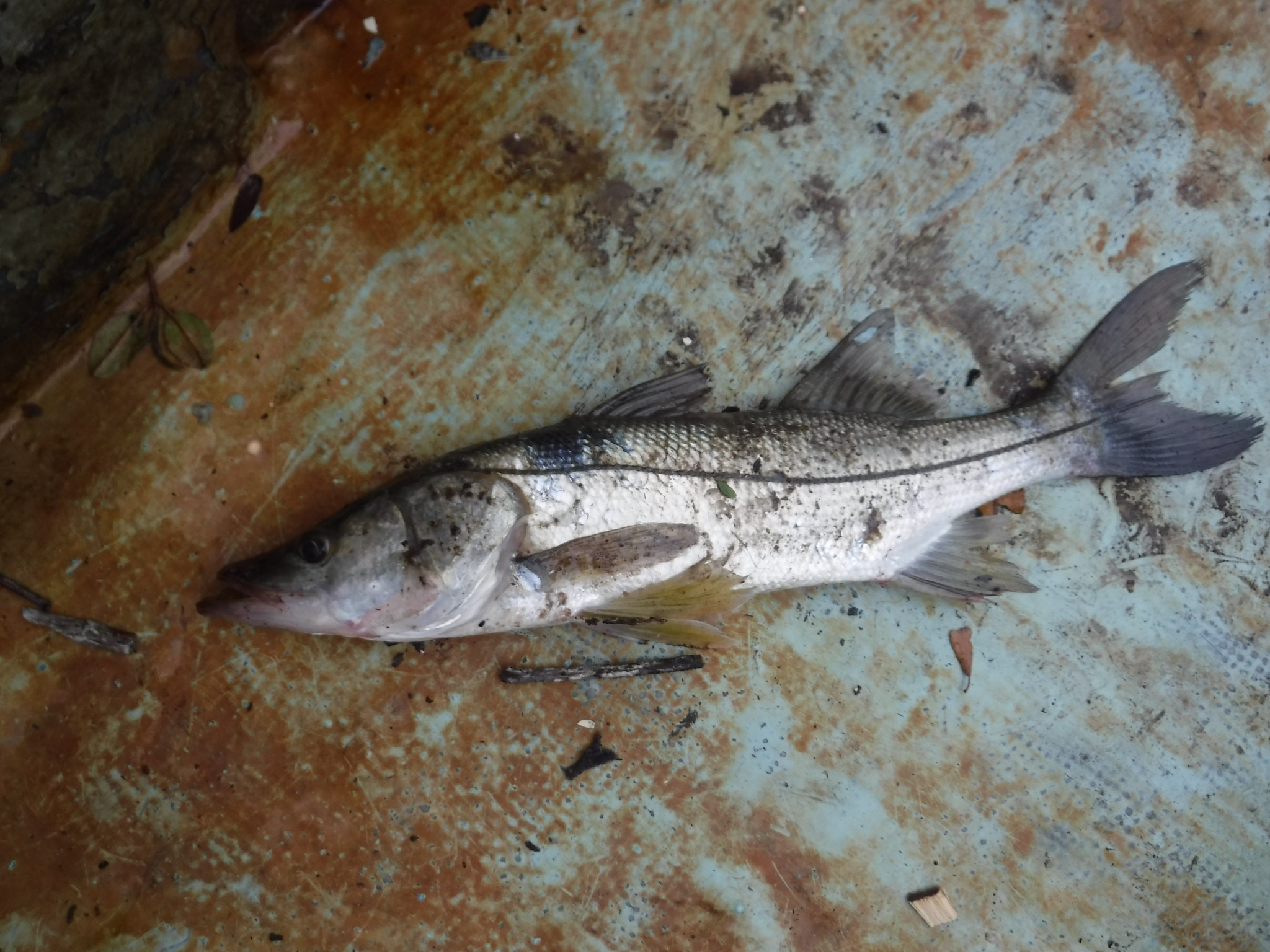
FishBase records the body as fusiform with a normal cross-section, and stops there. Within Centropomidae that description fits almost every member, so it does little to separate one snook from another. Two other lines do more work. The first is geography: in this stretch of the eastern tropical Pacific, a large snook can usually be narrowed by range alone. The second is scale — 130 cm maximum length and 21.5 kg maximum weight, alongside a literature note that the fish may reach 117 cm. Those two figures disagree, which is itself information: the length record for this species has version drift. Measure and photograph an exceptional fish rather than assuming a ceiling. The Chinese working name follows the project list; FishBase's own Chinese names are and , kept here as aliases.
One gulf and a very long coast
The range sentence is short: eastern Central Pacific, from Baja California and the Gulf of California to Peru, including the Galapagos. The country table runs through Mexico, Guatemala, El Salvador, Honduras, Nicaragua, Costa Rica, Panama, Colombia, Ecuador, Peru and the Galapagos. Latitude spans 33°N to 5°S, a narrow band pinned to the American Pacific shore rather than an ocean-wide claim. The environment is marine and demersal, and the depth fields are empty. That emptiness has a practical consequence: without a depth band there is no way to describe the water column, so fishing has to be organised around terrain instead. The terrain words are mangrove edge, river mouth and channel, all of them places where fresh and salt water meet, none of them offshore reef.
Heat, fresh water, and no spawning date
The record classes the fish as tropical between 33°N and 5°S. It gives no temperature figures and no spawning months, so no calendar is offered here. What can be said is that an estuarine fish lives with river flow. The same mouth can carry two different water colours and two different salinities in the dry and wet seasons, and a fish will track the band it tolerates. That is inference from habitat type, not a finding in the source, and it is the reason to ask locally about recent rainfall before planning a trip. Being demersal, the fish does not make large vertical moves, so the useful clock is water level and current rather than light.
Fishing the mangrove line
Start from the bank: mangrove edge, river mouth, bridge piling and dock post are the recurring positions. Live bait comes first, with live fish, cut fish and shrimp all on the list. The method is to place bait beside structure and let it sink naturally, not to cast into the middle of the river and wait. On lures, a suspending minnow or a soft plastic worked slowly along cover suits a fish that ambushes from the edge and will not chase far. Tide sets the schedule: rising water lets fish push into the mangroves and flats, falling water pulls them back to the channel and its outer lip, and the hour or two around the turn is usually the best of the day. The mouth is hard, so the hook-set should be firm and single, and a single hook both holds and releases better than a treble. Night is often steadier than day, but keep the headlamp low and off the water.
Rod, leader, and a hook that holds
Build around a 130 cm, 21.5 kg ceiling while expecting far smaller fish most days. A medium-heavy shore rod or a light boat rod with a reel holding enough line is sufficient; abrasion resistance around structure matters more than the last few metres of casting distance. Use a fluorocarbon leader about an arm's length long — enough to survive a rub on roots, short enough not to spoil the cast. Prefer a wide-gap single hook for a hard mouth; trebles find branches in mangrove country far too often. Start the drag low and let the rod bend before adding pressure by hand at the spool. Bring a net sized for a metre-plus fish, and a long-handled cutter if the bank has roots and rock.
Limits, licences, and the state-level paperwork
Under NOM-017-PESC-1994, amended in 2013, a recreational angler may take ten fish a day with no more than five of one species. Licences are split by whether you are afloat: from shore none is required but the limits still count, while everyone over twelve aboard a boat needs a personal licence. A licence cannot be lent and must be carried, and recreational catch may not enter commerce. Baja California sells state licences at sportfishing.bajacalifornia.gob.mx, 2024 reference prices being 188 MXN for one day, 470 for a week, 706 for a month and 941 for a year; Baja California Sur runs through FONMAR. Any boat carrying tackle in Mexican waters needs a licence for every person aboard, and a park or protected area requires its own pass. Groupers and some other species carry local spawning closures, so check CONAPESCA and the state notice before you travel.
Where the data runs out
The entry draws on FishBase for the species account — classification, range, size, environment, IUCN — on 30 iNaturalist observations plus image licensing, on the GBIF species page, and on the NOM text via FAOLEX together with the two state licence platforms. Three blanks are worth flagging. The depth fields carry no numbers, so no water-column advice is offered. The diet field is empty, so bait notes follow habitat instead of stomach contents. And the length is given twice, at 130 and 117 cm, with both left standing.
How to catch it
Boat fishing
Fished with the listed approach, matched to the recorded depth and size.
Boat fishing
Fished with the listed approach, matched to the recorded depth and size.
Boat fishing
Fished with the listed approach, matched to the recorded depth and size.
Where these facts come from
Check these pages before you rely on a size, range or protection status.
- FishBase — Centropomus viridis — FishBase · T2
- GBIF — Centropomus viridis occurrence records — GBIF · T2
- IUCN Red List — Centropomus viridis — IUCN · T1
- Photo record — iNaturalist — iNaturalist · T3
Fish in the same water
These fish live in the same place.
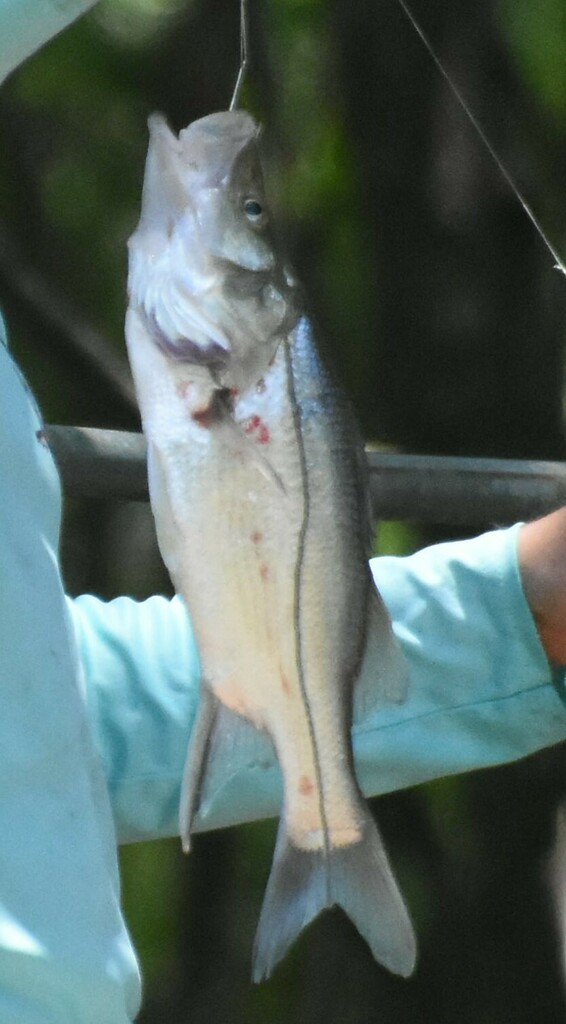

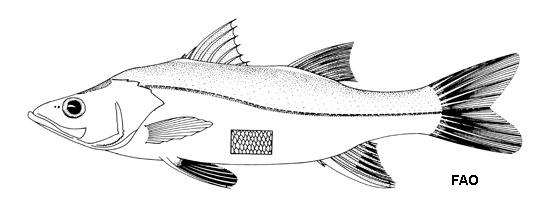
Guides for this water
Technique, gear and safety guides that fit White snook.