
Kumu gurnard
The red gurnard is a 60 cm bottom fish with a venomous dorsal spine, and New Zealand holds 9,057 of its 13,243 GBIF records. It is also one of the most important commercial fish species in New Zealand, which is an useful thing to know before treating it as a bycatch.
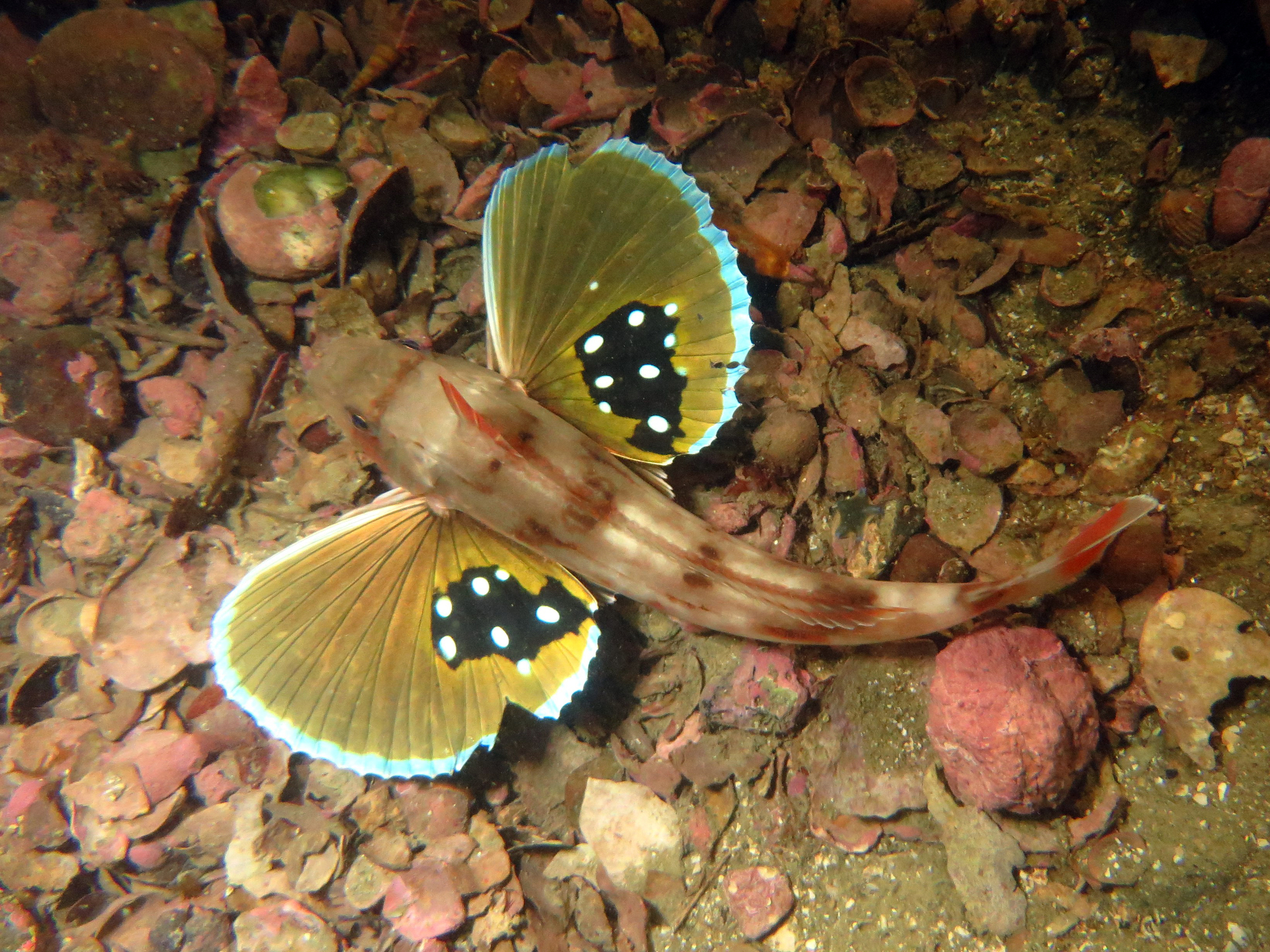
The red gurnard is a 60 cm bottom fish with a venomous dorsal spine, and New Zealand holds 9,057 of its 13,243 GBIF records. It is also one of the most important commercial fish species in New Zealand, which is a useful thing to know before treating it as a bycatch.
60 cm, 1.5 kg, mature at 21.2 cm
The maximum length is 60.0 cm TL, the common length 40.0 cm TL, the maximum published weight 1.5 kg, and the maximum reported age 15 years. The maturity estimate is 21.2 cm, with no published range. That line sits barely above half the common length, so an ordinary 40 cm fish has had several spawning years behind it.
The 15-year figure comes without a growth curve, so it cannot be converted into a size-at-age table. What it does say is that the species is not annual: a 60 cm fish may be more than a decade old. The weight and length figures are consistent with each other, which is not always true on a FishBase page.
Nine or ten dorsal spines, one of them venomous
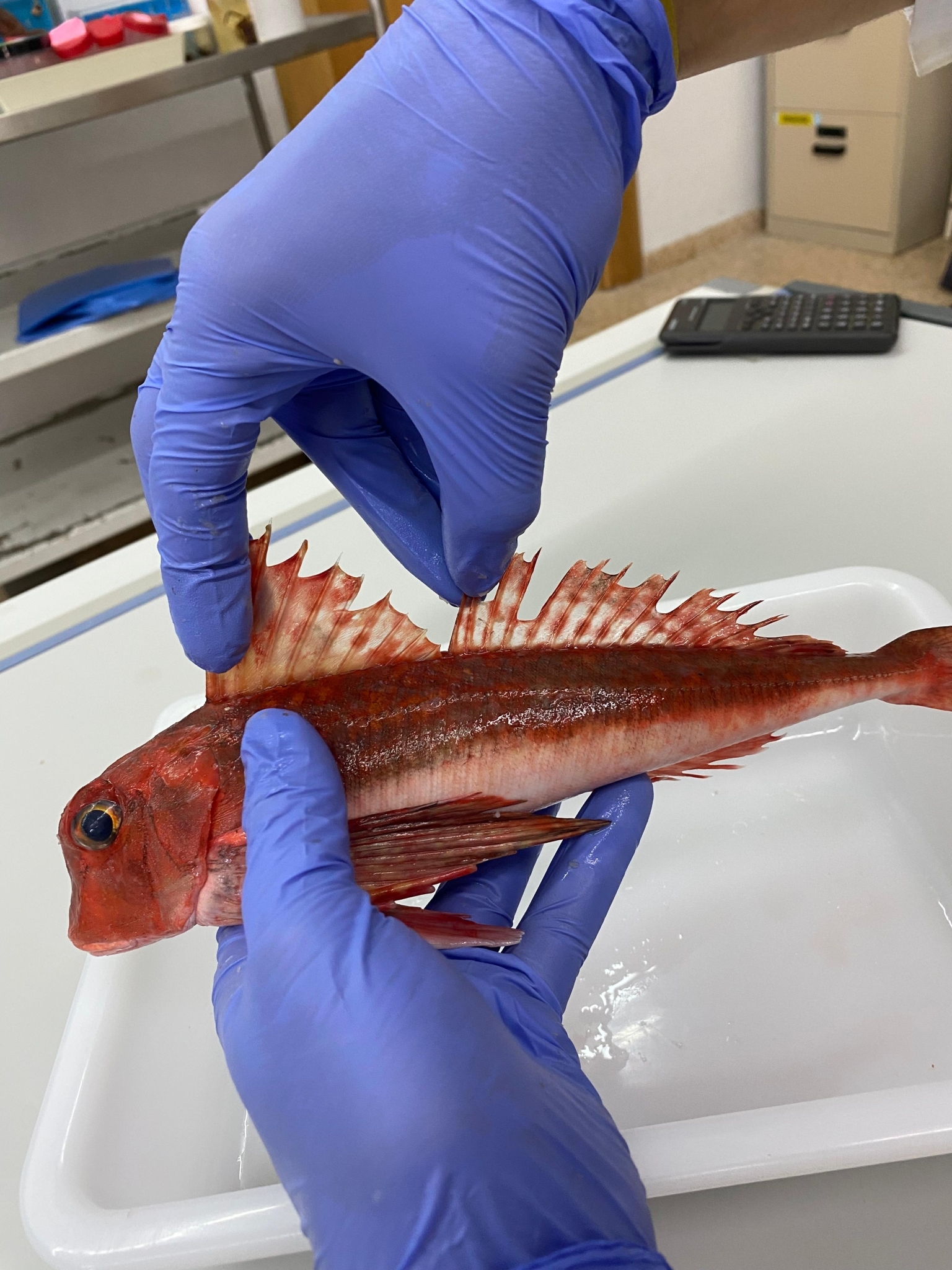
The dorsal fin carries 9–10 spines and 15–16 soft rays; the anal fin has no spines and 14–16 soft rays; the vertebral count is 33–35. FishBase records the dorsal spine as venomous, and the threat field reads Venomous. The same entry adds that neither an anterolateral glandular groove nor a venom gland is present, and that the dangerous-fish table needs verification.
The practical reading is simple: handle the fish as if the spines can hurt, because the record says they can. Grip it behind the head with a cloth, lay it flat, and cut the spines away from your hand rather than toward it. The verification note is a reason to be careful, not a reason to relax.
9,057 of 13,243 records are New Zealand
GBIF holds 13,243 records: 9,057 from New Zealand, 3,492 from Australia, 342 from South Africa, 88 from Namibia, 75 from Japan, 31 from China, 29 from Taiwan, 20 from Mozambique and 4 from South Korea. FishBase gives the range as the Indo-West Pacific, from Delagoa Bay in Mozambique to the Cape in South Africa, common in Australia and New Zealand, and reported from Japan, Korea and Hong Kong.
New Zealand's share is 68 percent of the GBIF total, and Australia's is 26 percent. Namibia's 88 records are not in the FishBase country list, which is how range edges usually look in aggregated data. iNaturalist carries 462 observations, a much smaller set than GBIF but enough to show the fish is photographed as well as landed.
One to 200 metres, usually 75 to 150
The depth range is 1–200 m, with a usual band of 75–150 m. A one-metre lower bound means the fish can be taken in an estuary or a bay; 200 m is the deepest record. The usual band is the part of the range where a boat fishery can work with a bottom rig, and it is less than half the full span.
The climate line reads subtropical, from 34°N to 43°S and 15°E to 154°W. That longitude span covers the western Indian Ocean and the western Pacific, which matches the range text. Wikipedia gives the same 200 m limit and describes the species as common around Australia and New Zealand. No temperature preference is published.
Sand and sandy shell, from estuary to shelf edge
The biology note places the species from estuaries to the edge of the continental shelf, over sand and sandy shell seabed. It adds that the fish is often found in rivers, that juveniles may occur in bays, and that the species is benthic. The environment line also flags brackish water as well as marine.
That combination is what makes the shore fishery work: an estuary mouth or a bay is inside the recorded habitat, not an edge case. The diet keyword is fish, so the bait should be fish rather than crustacean. The terrain list — sandy bottom, shelf, coastal — describes ground that a shore angler and a boat angler can both reach, at different distances.
The Hauraki Gulf spawns in two blocks
The spawning table has two regional rows. In the Hauraki Gulf the months are January to May and September to December; in New South Wales, between 32.4°S and 33.6°S, all twelve months are marked. The New Zealand record leaves a June-to-August gap, and the Australian record has no gap at all.
That is a difference between two regional studies, not a claim that spawning stops nationwide in winter. No temperature figure is published, so the months are the only seasonal signal. For planning, the New Zealand window is the more specific of the two, because it names a single gulf.
Boat and shore are both mainstream
Boat bottom fishing and shore casting are both listed as mainstream. With a one-metre lower depth bound, a shore angler can reach the top of the range without a boat. The boat covers the 75–150 m usual band, which is where the bulk of the commercial catch is likely to come from.
The rig is a bottom rig with a fish bait, fished on or just above sand and sandy shell. A running sinker keeps the bait down in current without anchoring it, which suits a fish that sits on the bottom rather than on structure. The venomous spines are the handling issue, not the fight.
FishBase describes the flesh as excellent, and the fish is utilized fresh or frozen, pan-fried, broiled, microwaved or baked. Wikipedia's line that it is one of New Zealand's most important commercial species is a statement about the market, not about the recreational fishery.
MPI rules by FMA, and the 1971 Act
New Zealand's amateur fishing rules are set by MPI and applied by fishery management area (FMA). They cover daily bag limits, minimum sizes, method restrictions and accumulation limits, and the numbers differ between areas. A fish taken in one FMA and carried into another still counts against the limit that applies where it was taken.
The Marine Reserves Act 1971 makes marine reserves no-take areas. Special rules also apply in the Hauraki Gulf, Fiordland and the Marlborough Sounds, and temporary closures or rāhui can be in force at short notice. No bag number, size limit or closed date is given here; check the current MPI rule for the FMA and the reserve map before the trip. The species is commercially important, so local depletion is a possibility even where the national assessment is Least Concern.
Where these facts come from
Check these pages before you rely on a size, range or protection status.
- FishBase — Chelidonichthys kumu — FishBase · T2
- GBIF — Chelidonichthys kumu occurrence records — GBIF · T2
- IUCN Red List — Chelidonichthys kumu — IUCN · T1
- Photo record — iNaturalist — iNaturalist · T3
Fish in the same water
These fish live in the same place.
Guides for this water
Technique, gear and safety guides that fit Kumu gurnard.