
Lyre gurnard
The lower three pectoral rays of the lyre gurnard are free. In water they work as legs, propping the body on sand and mud; out of water they can vibrate and produce sound. The fish lives below 100 m, most anglers never see one, and when they do the first problem is a deep-water release rather than a recipe.
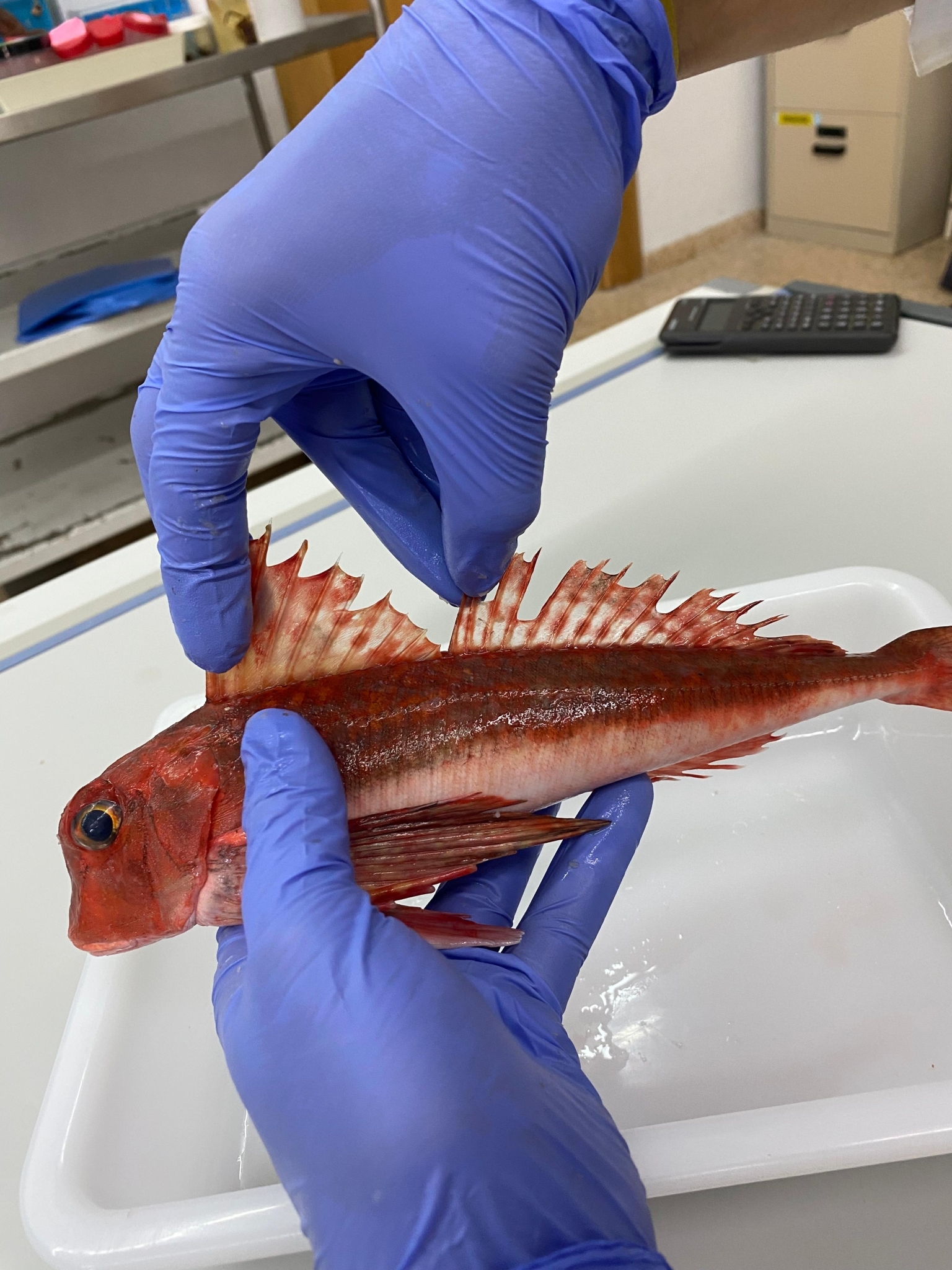
The lower three pectoral rays of the lyre gurnard are free. In water they work as legs, propping the body on sand and mud; out of water they can vibrate and produce sound. The fish lives below 100 m, most anglers never see one, and when they do the first problem is a deep-water release rather than a recipe.
Three free pectoral rays that work as legs
Look at the lower edge of the pectoral fin. The head is large and carries spines and ridges; the first dorsal fin has 9 to 10 spines, the second dorsal and the anal fin each carry 15 or 16 soft rays, and the tail is slightly concave. The reliable field mark is the three completely free pectoral rays, thick and unjointed, hanging at the sides like three fingers. On sand they are what the fish stands on. The body is red and the first dorsal fin is tall. Against Chelidonichthys the snout is longer and the colour redder; Trigla is a genus of one species, so there is no in-genus confusion to resolve. The head ridges form something like a lyre from above, which is where the name comes from, but the pectoral rays are easier. For the boat-side separation, add depth: this fish usually comes from 150 to 400 m, while the streaked gurnard usually comes from inside 40 m.
A deep shelf-edge fish, not a reef fish
FishBase gives an eastern Atlantic range from north of the British Isles and the North Sea south to Walvis Bay in Namibia, including Madeira and the Mediterranean but not the Black Sea. Chinese Wikipedia records 100 to 700 m; FishBase gives 150 to 400 m as the usual band, with a maximum near 700 m. It is a deep demersal fish over sand and mud rather than rock, and that single fact decides the fishing. For a recreational angler it means the outer shelf and the deep muddy slope: out of reach from shore, and from a boat it requires a bait at a hundred metres or more, past the comfortable limit of most light tackle.
No monthly pattern, only a depth problem
FishBase gives no month-by-month spawning table for the lyre gurnard and no spawning temperature. The maximum recorded age is 7 years, and maturity is recorded from 30 cm upward. The only defensible pattern is this: a deep-water species moves vertically less than a shallow one, so the catch depends on reaching its layer rather than on the calendar. Coastal warming and a shifting thermocline can lift its band a little, and deep boat trips in autumn, winter and spring meet it more often, but no source here supports a month-by-month curve.
Heavy bottom rigs on a muddy slope
There is one realistic method: deep bottom fishing. Anchor or drift over the muddy slope, drop a heavy weight until the bait reaches the bottom, then work it in short hops with the current. Shrimp and crabs are the food, so the bait has to be on the bottom, has to be a solid piece, and has to survive small pickers. The second option is a slow vertical iron fished after it reaches the bottom, triggered by short lifts and pauses, though it usually takes fish as a by-catch. The species does not sit in rock crevices and does not chase surface baits, so a bait suspended mid-water is wasted. Fish from depth often arrive with a swollen swim bladder and bulging eyes.
Boat tackle rated for the lead, not the fish
Use a 6 to 7 foot boat rod rated around 200 to 300 g with a 4000 to 6000 size conventional or large spinning reel, 30 to 50 lb braid, a 30 to 40 lb fluorocarbon leader and a 2/0 to 3/0 wide-gap single hook. Choose the lead by the current: enough to reach bottom and still hop. Winding from depth is the real workload, so retrieve speed matters more than rod action. Pause every 30 m on the way up to let the fish adjust, which reduces barotrauma. If the fish still has life, send it back down on a weighted release hook rather than sliding it over the side at the surface. The free pectoral rays tangle line, so pin them before unhooking.
No EU size, but a release problem instead
The flesh is white and watery, better in soup or as fish balls than as a fillet, and less firm than the shallow-water gurnards. Fish from depth often arrive with everted stomachs; vent them before icing. EU: Regulation (EU) 2019/1241 Annex IX Part A does not list the Triglidae, so there is no EU minimum conservation reference size for this species. No size does not mean no rules: recreational catch may not be sold, and the gear restrictions of Regulation 1967/2006 Article 17 still apply. Spain: RD 560/1995 Annex II has no entry for this species, and the Spanish Gallo entry refers to Lepidorhombus (megrim), not gurnards, so it must not be applied. A regional licence is required from shore and boat. France: the Mediterranean section of the 26 October 2012 arrêté has no entry; no permit is needed, but registration under RecFishing is required from age 16 and the catch may not be sold. Croatia: the national table has no entry, a licence is required, and the daily limit is 5 kg plus one fish over 5 kg. Italy: no separate national recreational table, so the EU MCRS applies and this species is not on it; annual MASAF declaration required. Greece: no recreational licence, 5 kg daily, 10 kg with longlines. For this fish, barotrauma deserves more thought than the size rule. Check the current year's official notice.
Where the FishBase record stops
Distribution, the 700 m maximum depth, the 150 to 400 m usual band, the 60 cm maximum total length, the 30 cm common length, the 7 year maximum age, the 9 to 10 dorsal spines and 15 or 16 soft rays, the shrimp and crab diet and IUCN LC (2013) all come from FishBase. The head ridges, the free pectoral rays, the slightly concave tail and the single-species genus come from English Wikipedia. Chinese Wikipedia gives 100 to 700 m, which does not match the FishBase usual band, so both are stated. Month-by-month catch strength has no data source and is written as deep-boat experience.
How to catch it
Boat bottom fishing
Fished with the listed approach, matched to the recorded depth and size.
Bottom fishing
Fished with the listed approach, matched to the recorded depth and size.
Where these facts come from
Check these pages before you rely on a size, range or protection status.
- FishBase — Trigla lyra — FishBase · T2
- GBIF — Trigla lyra occurrence records — GBIF · T2
- IUCN Red List — Trigla lyra — IUCN · T1
- Photo record — iNaturalist — iNaturalist · T3
Fish in the same water
These fish live in the same place.
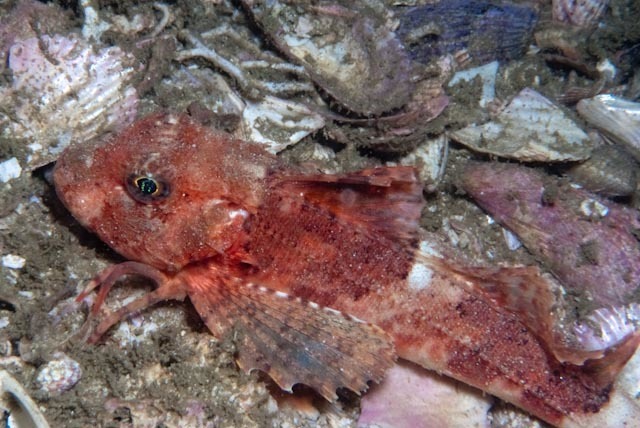
Cape gurnard
- Family
- Triglidae
- Depth
- 10–390 m
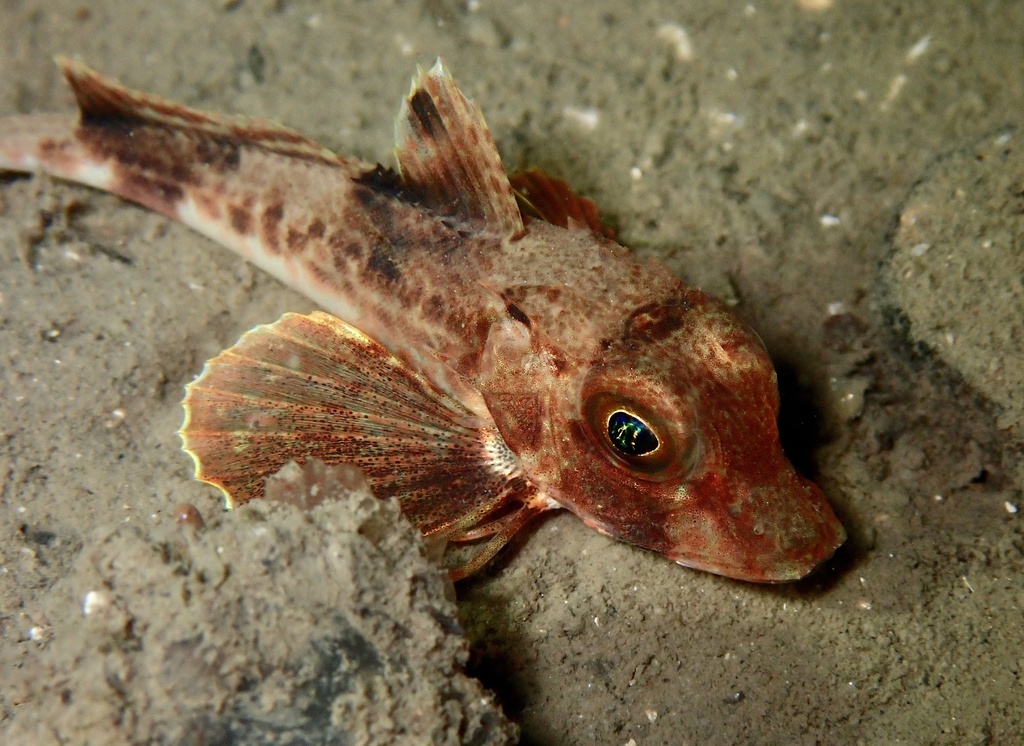
Grey gurnard
- Family
- Triglidae
- Depth
- 10–340 m
- Season
- Feb, Mar, Apr, May, Jun, Jul, Aug
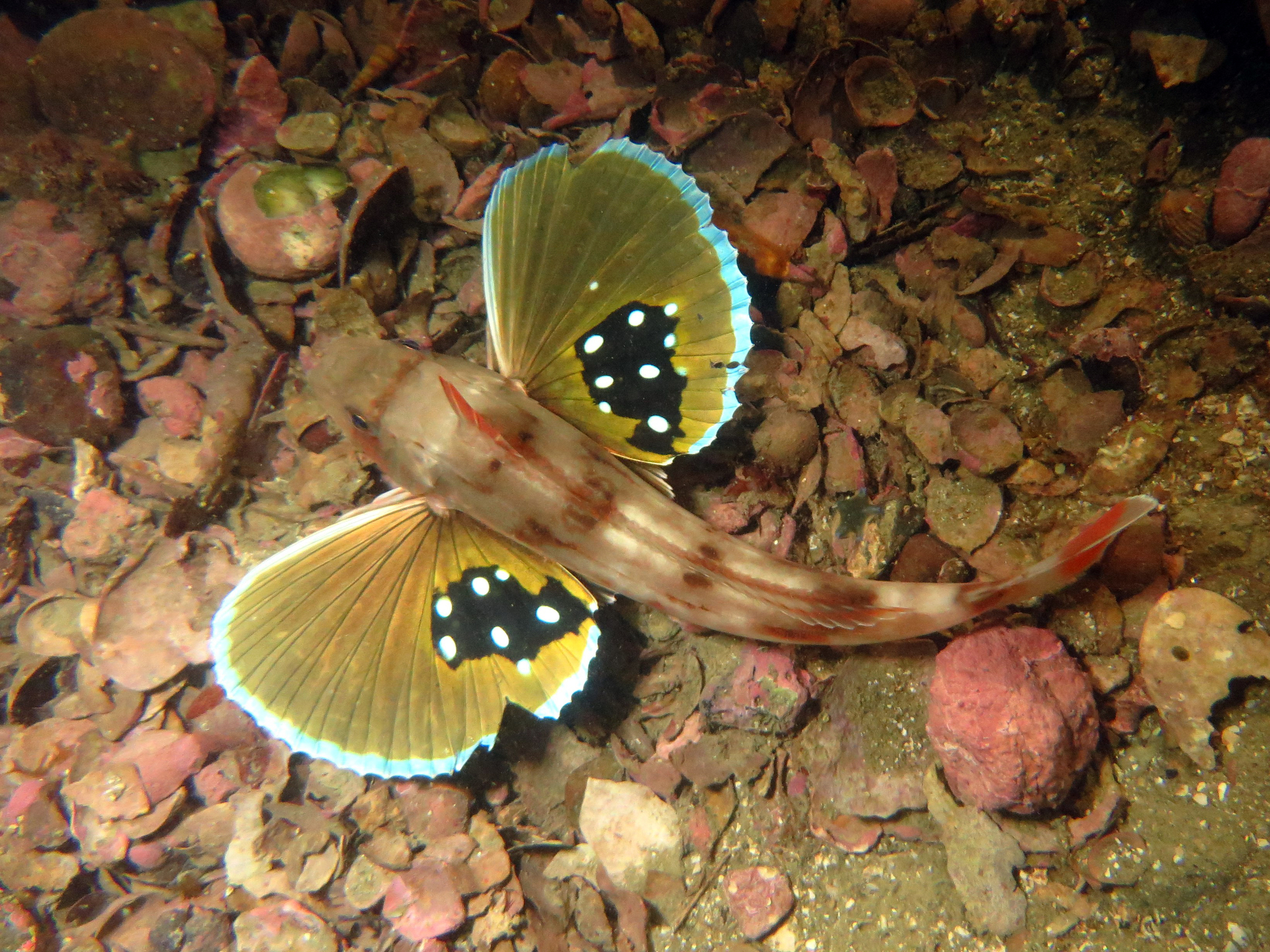
Kumu gurnard
- Family
- Triglidae
- Depth
- 1–200 m
- Season
- Jan, Feb, Mar, Apr, May, Jun, Jul, Aug, Sep, Oct, Nov, Dec
Guides for this water
Technique, gear and safety guides that fit Lyre gurnard.