
Grey gurnard
Grey gurnard is a bottom fish of the eastern Atlantic and Mediterranean, found from Norway and Iceland down to Morocco and Madeira. It works a wide band of shelf, from 10 m out to 340 m, and feeds on crustaceans and small fish. The largest recorded fish reached 60 cm TL and just under a kilo, and the season here runs February to August.
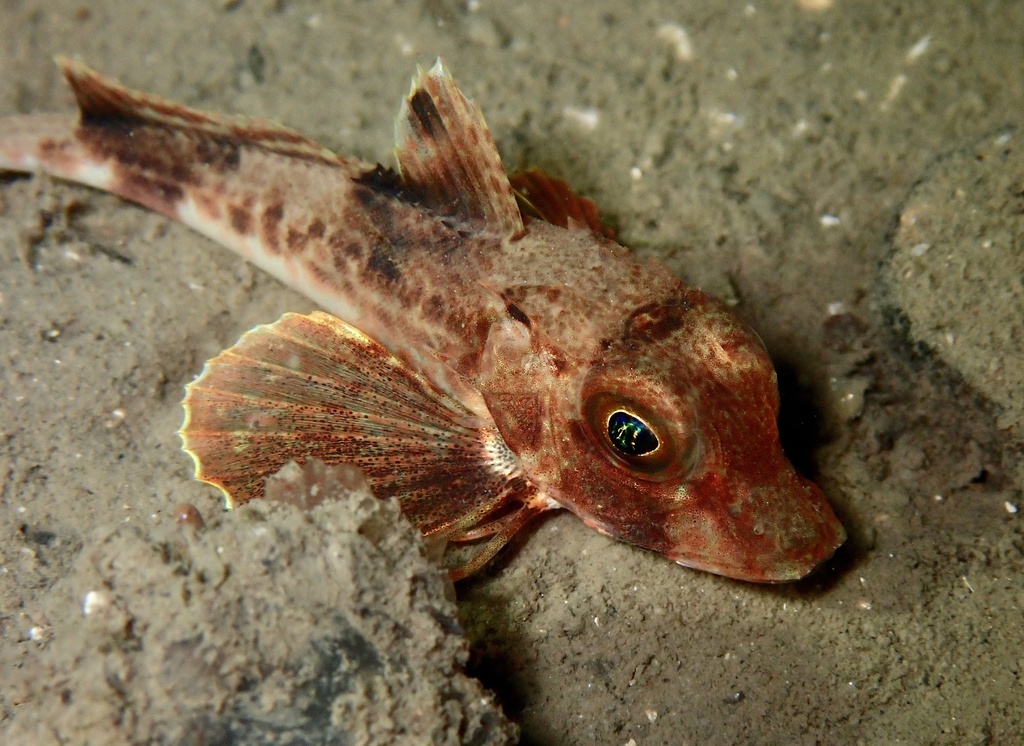
Grey gurnard (Eutrigla gurnardus) is a fish of the family Triglidae. FishBase gives its range as: Eastern Atlantic: Norway to Morocco, Madeira, Iceland , including Greenland. Also known from the Mediterranean and Black Sea. It is recorded from 10 to 340 m, in temperate water. The recorded maxima are 60 cm TL, 0.956 kg. Diet includes crustaceans and fishes. IUCN status: Not Evaluated (NE). Chinese name: .
A 330-metre band, three salt regimes
FishBase gives 10 to 340 m, with a working range of 10 to 150 m. The country table then lists 44 entries, and three groups matter here: the Atlantic shelf states, the Baltic states (Denmark, Germany, Poland, Sweden), and the Black Sea states (Bulgaria, Romania, Ukraine, Georgia).
That is a geographic spread across three salinities, not a description of one estuary. A gurnard taken off Portugal, one taken in the Baltic and one taken off Georgia all sit inside the same table, but the water beneath them is not interchangeable.
What the brackish tag is attached to
The environment field carries the three words marine, brackish and demersal. The biology keywords, however, are rocky, sandy and muddy — no estuary, no lagoon, no river mouth. A species genuinely tied to estuaries usually carries that word in the same keyword list; this one does not.
So "brackish" here is a sea-level statement. It says the fish tolerates diluted seawater somewhere in its range, and the country list supplies the somewhere: the Baltic and the Black Sea. Reading it as "fish the estuary mouth" would import a conclusion from a different species.
The 10–150 m working band
Ten metres is the shallow end, and on a coast with deep water close in that is still within a long cast of the rocks. The 150 m figure is where the bulk of the records sit; the remaining 190 m to the maximum is a tail.
The consequence is plain. Across most of its range it is fished from a boat; only a steep shelf brings it within casting distance of land. Check the band against a chart before deciding on bait or tide.
Where the band has to be read differently
The source pools every basin into one 10–340 m figure. It does not publish a separate band for the Baltic or the Black Sea. That matters because the maximum is an Atlantic number until someone shows otherwise; the northern Baltic and the Black Sea are the two places where assuming the same 340 m would be least safe.
The shortfall belongs to the record, not to the fish. The honest use is to treat 10–150 m as the Atlantic working band and to treat the other two basins as places with no depth figure in this record at all.
February to August, with a North Sea subset
Two spawning entries cover the species: February to August for the northeastern Atlantic, and April to August for the North Sea. The second sits inside the first, so the combined window is February to August.
No spawning row covers the Mediterranean, and none covers the Black Sea. That silence does not mean those fish never spawn; it means the spawning table has no row for them. A southern trip should not inherit the North Sea calendar.
18.8 cm, 30 cm, 60 cm
The size row is more interesting than it looks. Maturity appears as 18.8 cm, with a printed interval that starts at 24 cm and has no upper figure. The single value falls under the bottom of the interval printed next to it. No explanation accompanies the mismatch, and none will be supplied here.
Typical size is 30 cm, the largest 60 cm, and the heaviest specimen 956 g. No maximum age is given. Anyone releasing fish has just this one maturity value; keep its interval attached instead of treating 18.8 cm as a clean cut-off.
Sounds, and three names
Wikipedia adds one fact the other sources do not: the species is known for producing sounds, and it is the only member of the genus Eutrigla. Sound is not a fishing method, but it is a reminder that a scuba survey and a rod survey do not sample the same thing.
The names are ordinary and divided. FishBase's English table gives Grey gurnard from Malta, Spain, the Isle of Man and the FAO list. iNaturalist uses Grey Gurnard. FishBase lists and among Chinese names; the expansion list prefers . None of these changes the binomial, which is the only name that survives a border.
What to take to the water
Take the band first: 10–150 m, and only the top of it from shore. Take the 18.8 cm maturity figure with its contradictory range attached. Leave the 340 m maximum where it belongs, as an Atlantic tail, not as a Baltic promise.
The species is listed as commercial, with no gamefish tick. That is no argument for leaving it alone; it simply means expecting market sizes instead of trophy sizes. The band, the maturity line and the salinity map are enough to plan a session.
GBIF's distribution set puts the same split in record form: 14 assertions, with Belgian records (4), Denmark, Britain, Greece, Ireland, Norway and Sweden (1 each), and localities that include the Black Sea, the Zeeschelde and the Oosterschelde. The Dutch delta entries are the closest thing in this record to an estuary, and they sit beside the Black Sea rather than replacing it. The three-regime reading is not an interpretation layered on top of the data; it is what the distribution rows actually contain.
Where these facts come from
Check these pages before you rely on a size, range or protection status.
- FishBase — Eutrigla gurnardus — FishBase · T2
- GBIF — Eutrigla gurnardus occurrence records — GBIF · T2
- IUCN Red List — Eutrigla gurnardus — IUCN · T1
- Photo record — iNaturalist — iNaturalist · T3
Fish in the same water
These fish live in the same place.
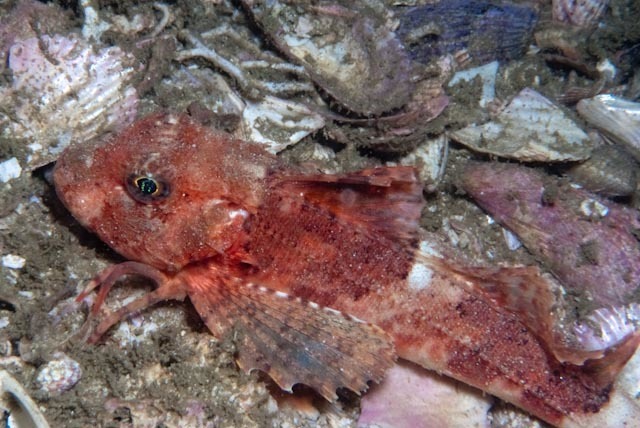
Cape gurnard
- Family
- Triglidae
- Depth
- 10–390 m
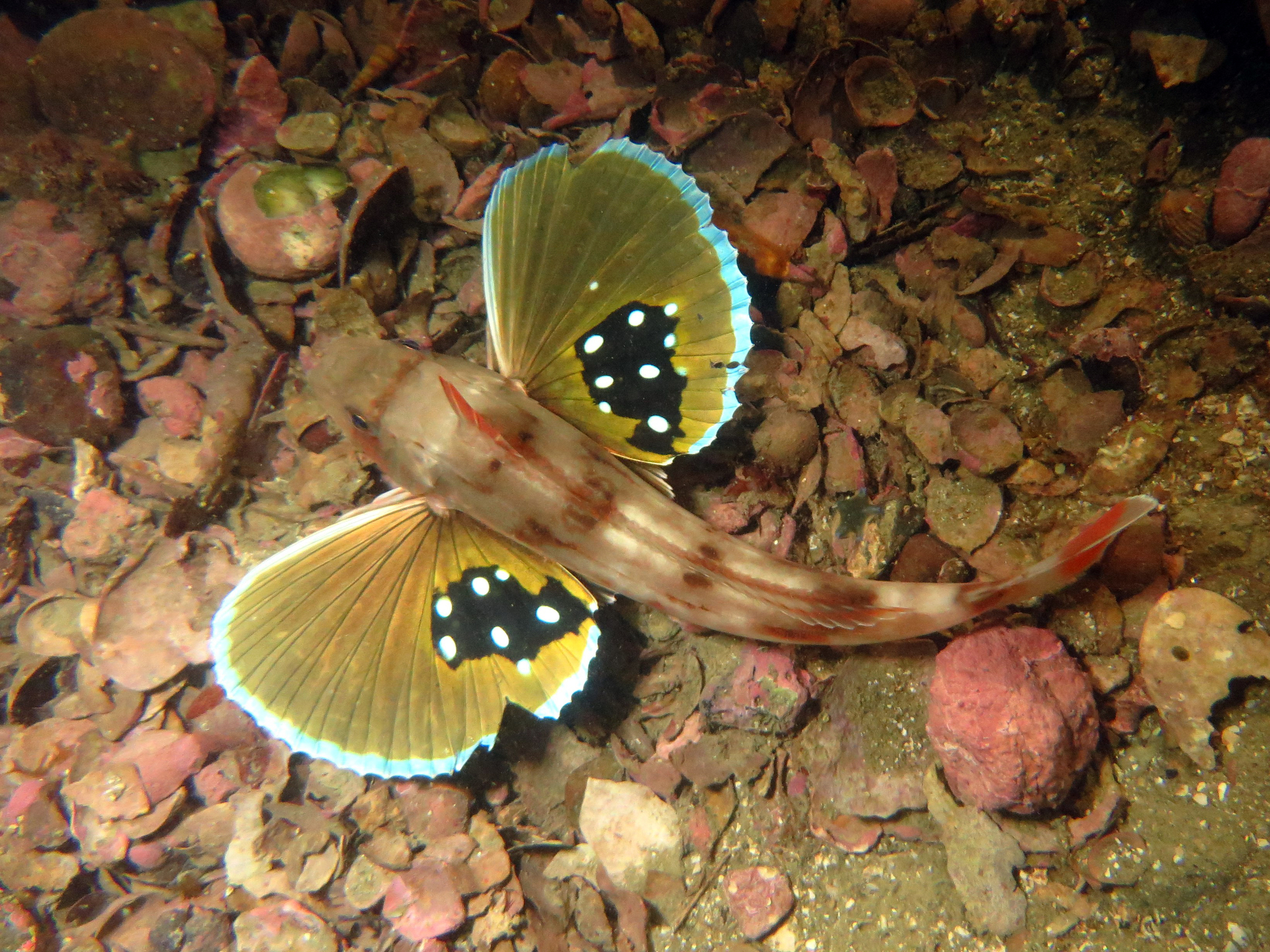
Kumu gurnard
- Family
- Triglidae
- Depth
- 1–200 m
- Season
- Jan, Feb, Mar, Apr, May, Jun, Jul, Aug, Sep, Oct, Nov, Dec
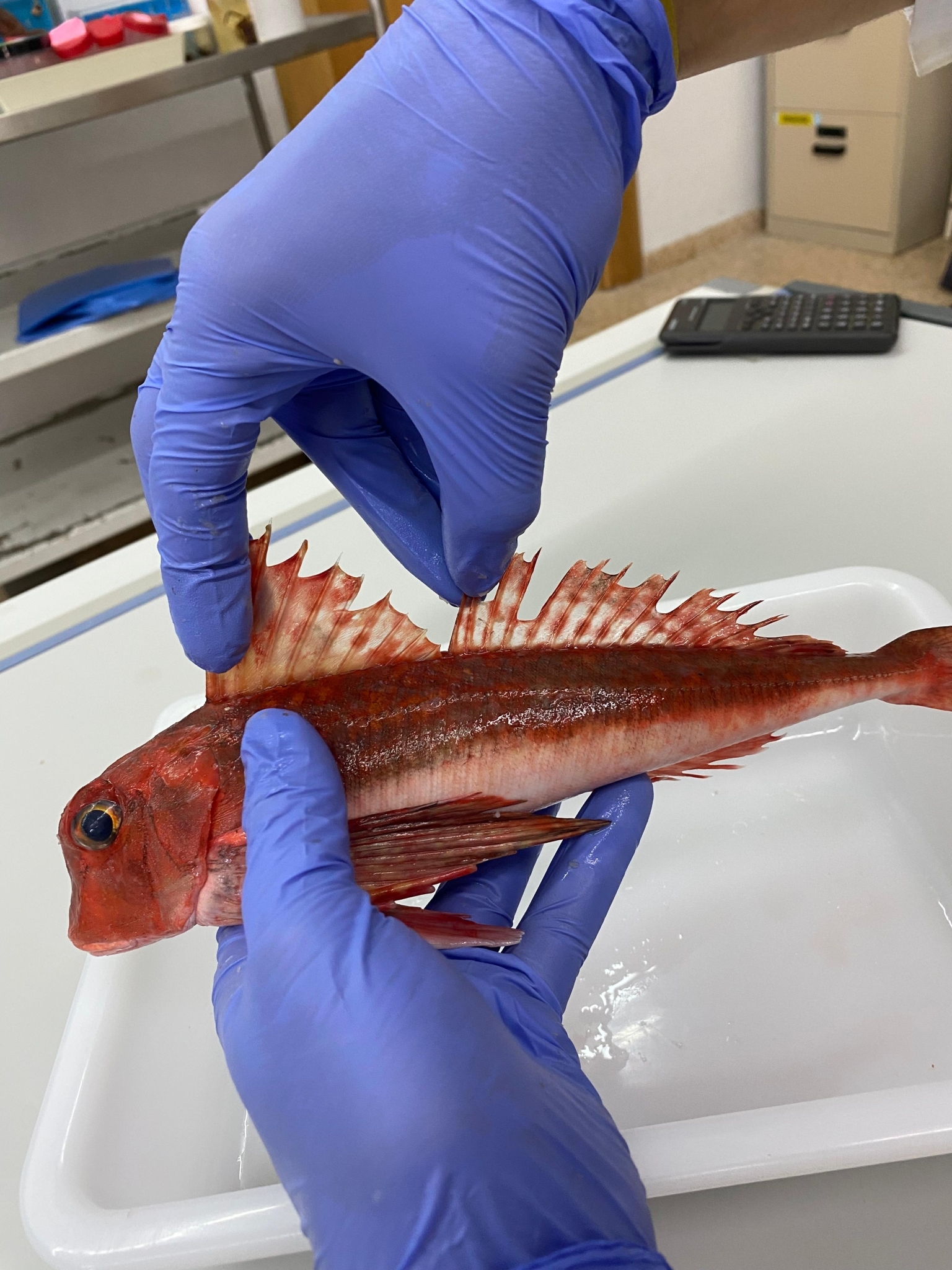
Lyre gurnard
- Family
- Triglidae
- Depth
- 150–400 m
Guides for this water
Technique, gear and safety guides that fit Grey gurnard.