
Spiny red gurnard
Spiny red gurnard is a bottom-dwelling triglid of the northwest Pacific, from southern Hokkaido to the South China Sea. It lives from 25 to 615 m in tropical water, reaches 40 cm TL and 0.95 kg, and has a wide depth range.
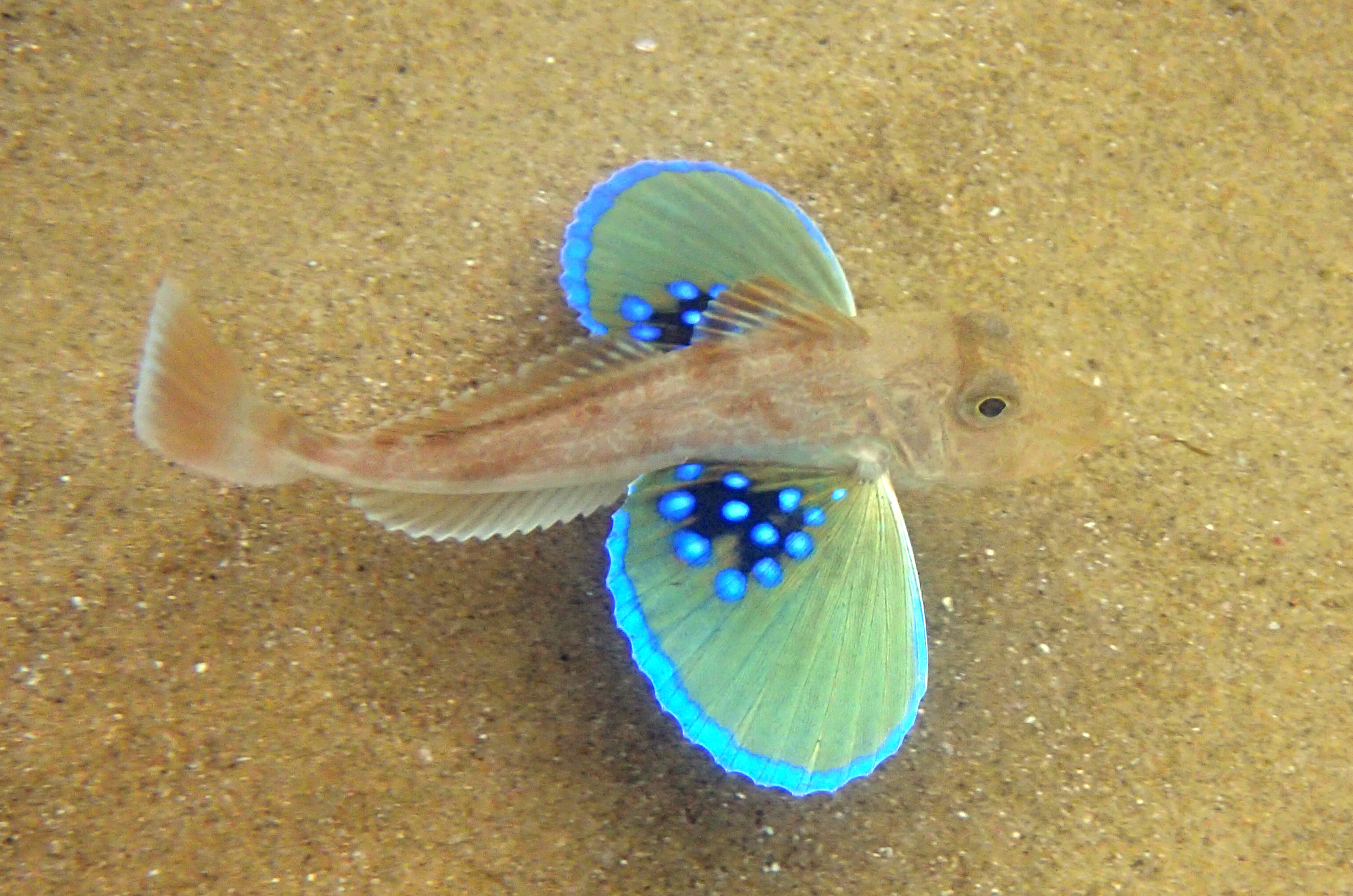
The record carries two labels that pull in different directions. The climate field says Tropical. The distribution sentence runs from southern Hokkaido to the South China Sea. The depth row says 25–615 m and gives no "usually" figure. This page sets the labels side by side and asks which one survives contact with the water.
Tropical, and southern Hokkaido
Southern Hokkaido is cool-temperate water, not tropical. Both statements sit in the same source, one in the climate field and one in the distribution field, and neither is marked as an error.
The climate label is a coarse category applied to the whole range. The distribution sentence is a list of places. When they disagree, the place list is the part a trip can be planned against, and the climate word is the part that should be treated as a summary rather than an instruction.
Which line is checkable
The distribution gives the northwest Pacific, from southern Hokkaido south to the South China Sea. The country table lists eight entries: Cambodia, China, Japan, North Korea, South Korea, Taiwan region, Thailand and Vietnam.
Those eight countries are checkable; the word Tropical is not. GBIF's occurrence aggregation makes the same point harder: 1,282 records, of which Japan holds 680 and South Korea 407, with Taiwan, China at 30 and China at 12. Japan and South Korea together hold 1,087 of the 1,282 records. The centre of gravity is the temperate and subtropical northwest Pacific, not a tropical sea. The aggregation has no records from Cambodia, Thailand or Vietnam, which is a sampling gap rather than a range limit. Britain and Portugal appear once each, outside the country table; Hong Kong SAR and North Korea also appear once each, inside the described range.
25 to 615 metres without a usual band
The depth row gives 25–615 m and no working range. Few species in this set lack one: a "usually" figure normally ranks the band, and here it is absent.
So 615 m is as well supported as 25 m on paper. At 615 m a 40 cm gurnard means deep bottom work; at 25 m it is a short run from the ramp. Nothing states where the bulk of the population sits across those 590 m, and no ranking is invented here.
Sand and mud, no diet row
The habitat keywords are sandy and muddy. There is no rocky entry, and the diet keyword row is empty.
The absence of a diet entry matters. It means the record cannot be used to argue that the fish feeds on one bottom type rather than another. The defensible claim is smaller: sand and mud are the two bottoms named, and no third is asserted. Neither keyword is tied to a depth, so the record does not say which of the two carries the 25 m fish and which the 615 m one.
The spawning row is absent
There is no spawning record at all. No months, no locality, no temperature. The cell is empty; it does not assert year-round spawning, nor spawning at any named place.
A plan built on a spawning season would be built on nothing in this source. Records show where and how deep the fish has been taken; they say nothing about when it breeds. What can be recorded instead is the date and depth of every fish taken, so that the next trip has something to compare against.
Forty centimetres and 950 grams
Maximum length is 40 cm TL and maximum weight 950 g. No common length is given, and no maturity length is given. A 950 g fish at 40 cm is a heavy build for a gurnard.
Without a common length, there is no "typical" fish to rig for. With no maturity length, the source offers no release cut-off. The 40 cm figure is the only size anchor, and it belongs to the largest fish, not the ordinary one. The 950 g weight describes that same largest fish; it is not a typical weight for the species, and no second weight is given.
Spiny red gurnard
FishBase gives the English name Spiny red gurnard. The Chinese name is , and the expansion list prefers . The two Chinese labels point at different naming traditions rather than different fish.
Wikipedia describes it as a northwest Pacific species found at 25–615 m, growing to 40 cm TL, with commercial importance as a food fish. iNaturalist carries 63 observations. None of these sources resolves the climate label; they simply repeat the range.
A provisional plan that stays neutral
Start where the records are: the Japan–Korea–Taiwan, China block, inside the 25–150 m upper part of the band, over sand and mud. That is a hypothesis built from the occurrence centre and the two substrate keywords, not a claim that the fish is absent deeper.
Take the 615 m maximum as an outer bound, not a target. Take the missing spawning row as a reason to log dates rather than assume a season. And keep the Tropical label in quotation marks until a source separates the climate category from the place list. The conflict is the honest state of the record.
Where these facts come from
Check these pages before you rely on a size, range or protection status.
- FishBase — Chelidonichthys spinosus — FishBase · T2
- GBIF — Chelidonichthys spinosus occurrence records — GBIF · T2
- IUCN Red List — Chelidonichthys spinosus — IUCN · T1
- Photo record — iNaturalist — iNaturalist · T3
Fish in the same water
These fish live in the same place.
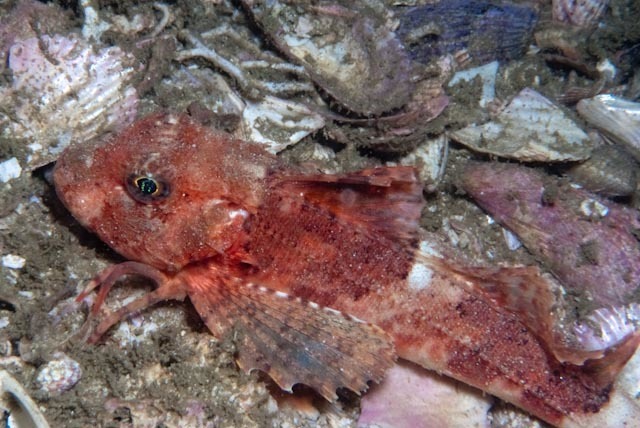
Cape gurnard
- Family
- Triglidae
- Depth
- 10–390 m
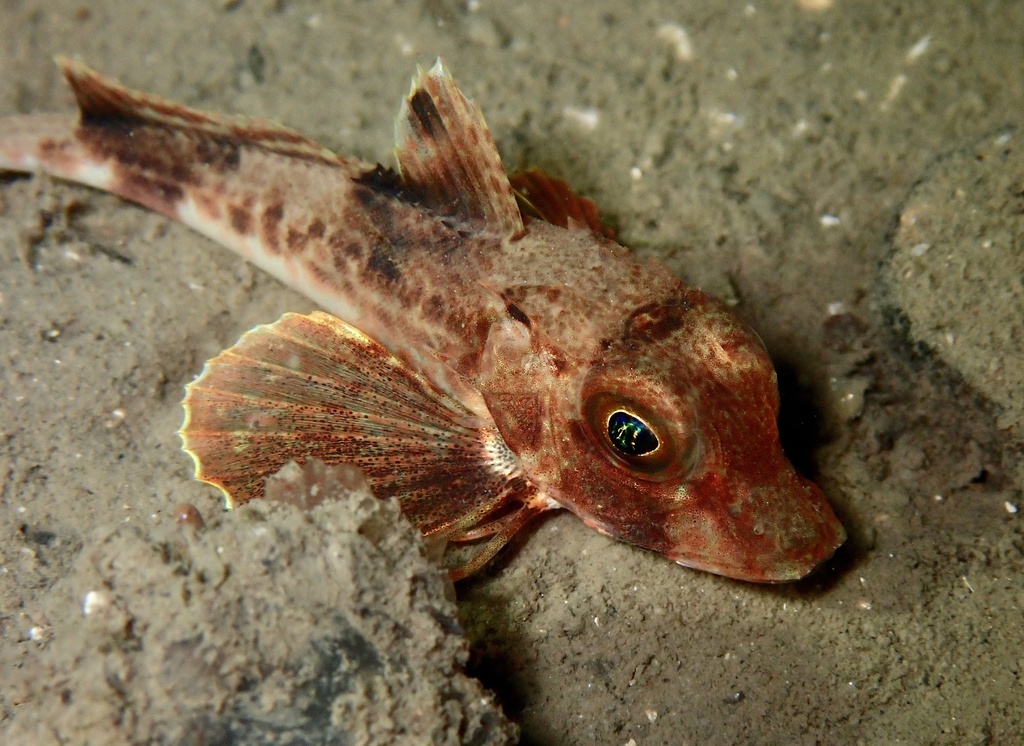
Grey gurnard
- Family
- Triglidae
- Depth
- 10–340 m
- Season
- Feb, Mar, Apr, May, Jun, Jul, Aug
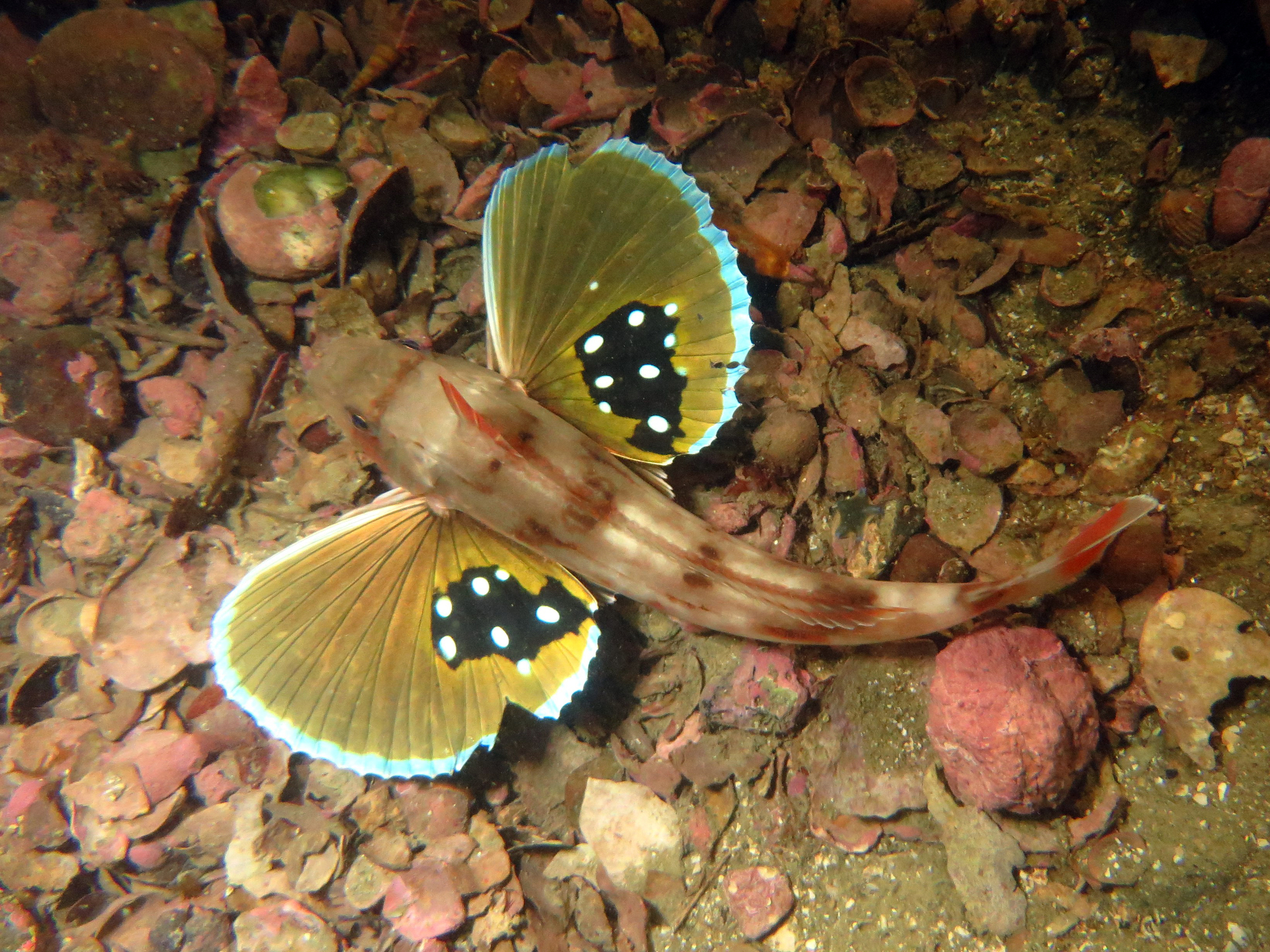
Kumu gurnard
- Family
- Triglidae
- Depth
- 1–200 m
- Season
- Jan, Feb, Mar, Apr, May, Jun, Jul, Aug, Sep, Oct, Nov, Dec
Guides for this water
Technique, gear and safety guides that fit Spiny red gurnard.