
Rabbit fish
The rabbit fish, Chimaera monstrosa, is a cartilaginous deep-water species in the family Chimaeridae, not a true bony fish. It is widespread in the Northeast Atlantic, including the Mid-Atlantic Ridge and the Mediterranean, and is usually found between 300 and 500 metres, with records from 40 to 1400. It reaches 150 cm and is taken only as minor commercial bycatch; there is no gamefish entry.
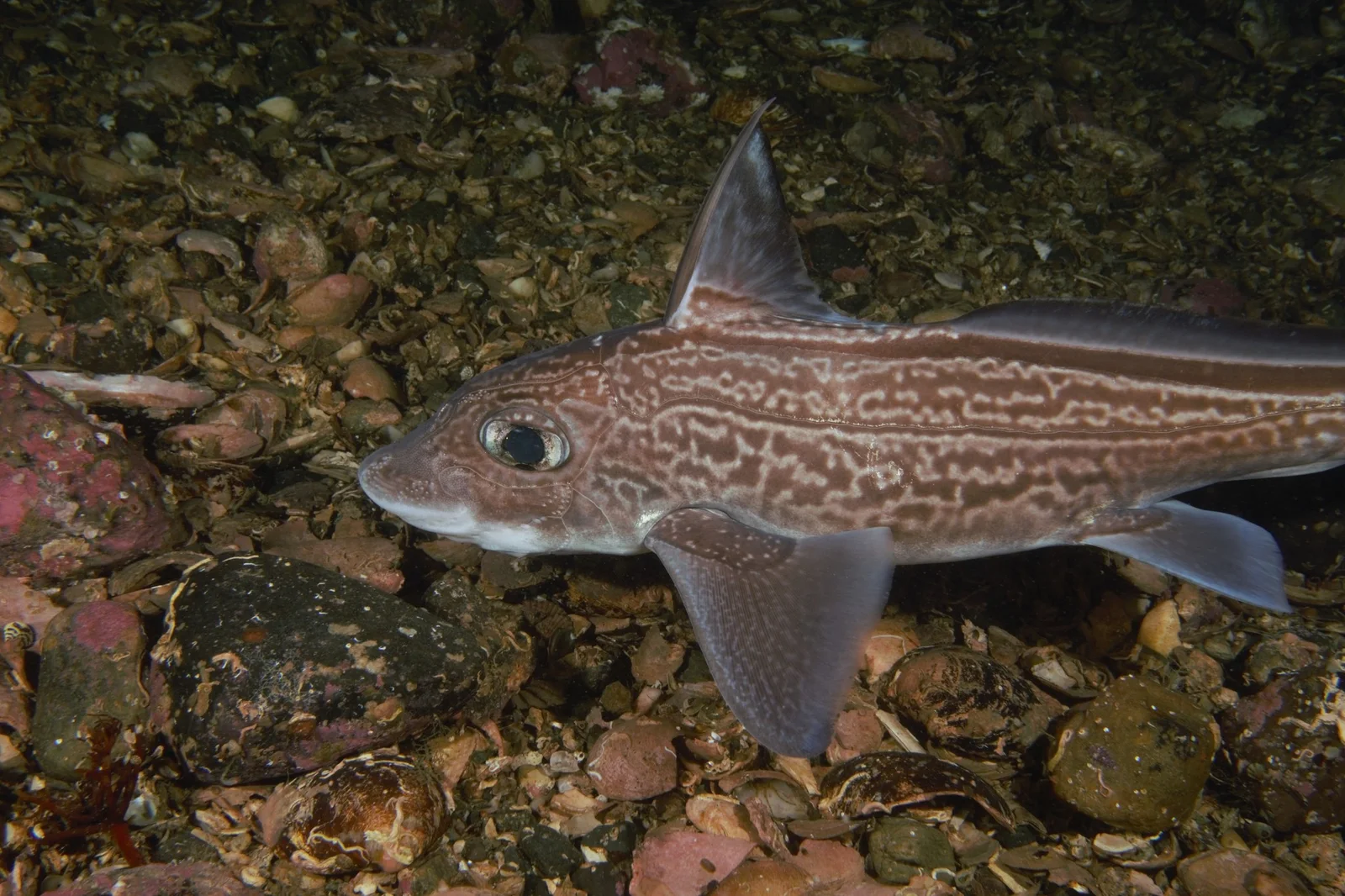
The rabbit fish, Chimaera monstrosa, is a cartilaginous deep-water species in the family Chimaeridae, not a true bony fish. It is widespread in the Northeast Atlantic, including the Mid-Atlantic Ridge and the Mediterranean, and is usually found between 300 and 500 metres, with records from 40 to 1400. It reaches 150 cm and is taken only as minor commercial bycatch; there is no gamefish entry. Its IUCN status is Vulnerable, a further reason to treat it as an observation species rather than a target.
Identification
Chimaeridae, Chimaeriformes, outside the teleosts. Maximum 150 cm TL, first maturity 45.9 cm, no common length, no reported age, and no weight retained in the capture. Nothing on morphology either, so there are no fin counts or vertebral counts here.
Wikipedia supplies 1.5 m and a lifespan of up to 30 years. The length agrees with the record; the age has no counterpart in it. Treat the 30 years as Wikipedia's figure, not as a second confirmation.
The vernacular list runs from Chimaera, Ghost shark and King of the herring to Ratfish, Rattail and Sea rat; the FishBase principal English name is Rabbit fish, and iNaturalist's preferred name is rabbit fish. Six names for one animal is the first hint that this page will not line up neatly.
Habitat and distribution
The labels stop agreeing here. Environment reads bathydemersal — on the bottom — 40–1400 m, usually 300–500 m, deep-water, 75°N–27°N, oceanodromous. Habitat keywords read coastal, slope, open-water. "On the bottom" and "open-water" cannot both be the primary description, and the record does not choose between them.
The depth band is what both readings accept: 300–500 m is a slope band, 40 m at the shallow end is an extreme, and 1400 m at the other.
No diet keyword was captured, so nothing here says what it feeds on. Distribution is the northeast Atlantic, called widespread, including the Mid-Atlantic Ridge and the Mediterranean; the country table holds 30 entries. GBIF holds 16 rows — Sweden four, France two, one each Belgium, Denmark, Greece, Israel, Norway and Portugal, four without a country — and iNaturalist holds 46 observations.
A GBIF list weighted to Sweden and a range sentence that names the Mid-Atlantic Ridge are different kinds of statement: one is recording effort, the other a distribution claim.
Season and fishing approach
The spawning table has one row: Mediterranean, March to August. A single Mediterranean sample under a range that also runs the length of the northeast Atlantic is the sharpest form of this page's problem — the only dated spawn comes from the smallest sea in the range.
The operational choice this page can defend is narrower than either label: work the slope, not the flat. The slope keyword and the 300–500 m usual band both point at an incline, and open-water may describe where the fish swims above that incline. That is a hypothesis with a test attached — if the marks come only over level ground, the slope reading is wrong.
Edibility and regulations
Vulnerable, assessed 2 September 2019. The fisheries line says minor commercial and there is no gamefish entry. VU and "minor" do not contradict: a small share of a mixed catch can still belong to a declining species.
The record carries a hazard tag as well: traumatogenic. That is a handling statement, and it is the one warning here that applies at the boat rather than at the desk.
Where these facts come from
Check these pages before you rely on a size, range or protection status.
- FishBase — Chimaera monstrosa — FishBase · T2
- GBIF — Chimaera monstrosa occurrence records — GBIF · T2
- IUCN Red List — Chimaera monstrosa — IUCN · T1
- Photo record — iNaturalist — iNaturalist · T3
Fish in the same water
These fish live in the same place.

Acoupa weakfish
- Family
- Sciaenidae
- Depth
- 1–20 m
- Season
- Jan, Feb, Mar, Apr, May, Jun, Jul, Aug, Sep, Oct, Nov, Dec

American angler
- Family
- Lophiidae
- Depth
- 0–800 m
- Season
- Mar, Apr, May, Jun

American eel
- Family
- Anguillidae
- Depth
- 0–464 m
- Season
- Jan, Feb, Mar, May, Jun, Jul
Guides for this water
Technique, gear and safety guides that fit Rabbit fish.