
Orange-dotted tuskfish
Orange-dotted tuskfish is an Indo-West Pacific labrid of the genus Choerodon, from Sri Lanka east to French Polynesia, north to the Ryukyu Islands and south to New Caledonia. It is a reef fish of 1 to 25 m in tropical water, matures from 23 cm and reaches 50 cm TL. Bottom fishing and lures are the methods listed for it.

The orange-dotted tuskfish is an Indo-West Pacific labrid of the genus Choerodon, from Sri Lanka east to French Polynesia, north to the Ryukyu Islands and south to New Caledonia. It is recorded as marine and reef-associated, at 1–25 m, in tropical water from 15°N to 30°S. FishBase gives a maturity length starting at 23 cm and a maximum of 50 cm total length. IUCN lists it as Least Concern, assessed on 12 June 2008. It is also a regular fish in Hong Kong live-fish markets.
A wedge, a saddle and orange speckles
The dorsal fin has XII–XIII spines and 7 soft rays; the anal fin has III spines and 9 soft rays. The body is deep, its depth 2.4–2.7 times in standard length; the dorsal profile of the head is convex above the eyes; the anterior tip of the head forms a broad angle with a steeply inclined snout; the jaws are prominent; four strong canines sit anteriorly in each jaw, with the second pair in the lower jaw directed laterally; an enlarged canine is present on each side at the rear of the upper jaw; the dorsal spines and anterior soft rays are continuous and similar in length; the pectoral fin has ii unbranched and 13–14 branched rays; the pelvic fins are not filamentous; the caudal fin is truncate to slightly rounded; the lateral line is continuous and smoothly curved with 29 pored scales; scales barely reach the dorsal and anal fin bases; the scales in front of the dorsal fin do not extend forward above the eye; the cheek and opercle are scaly, the preopercle scales are small, less than a quarter the size of body scales; the lower jaw is scaleless. Colour is greenish to grey with the underside of the head, chest and lower sides white or bluish; a wedge-shaped white band runs upward onto the back behind the pectoral fins; a large rectangular white saddle sits dorsally on the caudal peduncle and extends forward below the rear of the dorsal fin; the head is speckled with orange; the pectoral-fin base carries a large blue to black spot; the dorsal fin is greenish grey anteriorly and yellowish posteriorly; the caudal fin is greenish orange; the anal fin is yellow with orange markings; the dorsal and anal fins have a narrow blue margin; small fish are overall greenish grey with several whitish bars. “Wedge” and “saddle” name different white patches, which is why both Chinese labels circulate.
Reef flats, lagoons and seagrass
FishBase's range is the Indo-West Pacific: Sri Lanka east to French Polynesia, north to the Ryukyu Islands and south to New Caledonia. The country table includes the Andaman and Nicobar Islands, Australia, French Polynesia, Hong Kong SAR, India, Indonesia, Japan, Malaysia, Micronesia, New Caledonia, Niue, the Ogasawara Islands, Palau, Papua New Guinea, the Philippines, the Ryukyu Islands, Singapore, Sri Lanka, Taiwan region, Thailand, Timor-Leste, Tonga, Vanuatu and Vietnam. Adults live on reef flats and lagoon reefs, in areas with seagrass or mixed sand, rubble and coral; they often form small aggregations; juveniles are inshore and usually form small groups in estuarine seagrass beds; adults occur on inner and outer reefs and are territorial; they feed mainly on hard-shelled prey including crustaceans, molluscs and sea urchins; they are oviparous with distinct pairing during breeding. GBIF's 1,732 records are led by Indonesia (399), Australia (274), the Philippines (256), Palau (135), Japan (114), Singapore (108), Malaysia (73), New Caledonia (72), the Solomon Islands (72) and Papua New Guinea (62); iNaturalist has a taxon for the species.
No season table
FishBase records no spawning months and no water temperature. The only frame is the tropical label and the 15°N–30°S band. It is a reef-flat and lagoon fish at 1–25 m, catchable all year; season has to come from local temperature and reports, and no month table is asserted. On tide, fish move up over the reef flat as it floods and drop back to the lagoon and reef edge as it drains; the change of tide is the main window. Juveniles in estuarine seagrass are a separate fishery from adults.
Crab-and-shell baits
Shore and boat fishing both work, focused on reef flats, lagoons and seagrass edges. It eats hard-shelled prey, so crab, prawn, shellfish flesh and sea urchin are natural baits; hooks must be strong and leaders abrasion-resistant. Bottom rigs use a small crab or prawn, placed at reef crevices and seagrass edges; lures are jighead soft plastics, small metal jigs and hard baits crawled along the bottom to imitate shrimp and crab. It is territorial, so after one fish, move to the next patch of structure rather than waiting on the same spot; steer a hooked fish away from the reef immediately. Juveniles in estuarine seagrass should be released.
Medium tackle, 23 cm release line
For 50 cm maximum and 23 cm maturity, use a medium shore or boat rod, a 3000–5000 spinning reel, 1–1.5 braid and a 20–30 lb fluorocarbon leader. It works reef and hard bottom, so abrasion resistance matters more than raw strength, and the fish is not large enough to need heavy tackle. Maturity starts at 23 cm, so fish below that have not spawned and should go back. It is taken by commercial fisheries and sold in Hong Kong live-fish markets, so the local size rule applies to any kept fish.
Eating and the rules
Recorded uses are commercial fisheries and the commercial aquarium trade. Steam, braise or soup the flesh; bleed, gut and ice promptly. The threat field says harmless and there is no ciguatera report, but reef fish should still follow local advice. In Taiwan region, the Fisheries Agency and local governments manage inshore fishing through closed areas, closed seasons, gear restrictions and minimum sizes. Hong Kong SAR's Fisheries Protection Ordinance regulates methods, marine parks and reserves prohibit angling and collecting, and the live-fish trade is separately regulated. Southeast Asian states differ widely, with Malaysia, Indonesia, the Philippines and Thailand setting size and closed-season rules and usually prohibiting take in core protected-area zones. Check the current local notice.
What the record leaves open
The page uses FishBase taxonomy, morphology, distribution, environment, biology, use and IUCN entries, with the country table for range and GBIF/iNaturalist for occurrence. No spawning months or water temperature are recorded and no estimates are added. The Chinese formal name follows the FishBase and Taiwanese usage , with the master-plan name kept as an alias; the “ ” label used for some tuskfish is not recorded for this species and is not adopted.
How to catch it
Bottom fishing
Fished with the listed approach, matched to the recorded depth and size.
Lure fishing
Fished with the listed approach, matched to the recorded depth and size.
Where these facts come from
Check these pages before you rely on a size, range or protection status.
- FishBase — Choerodon anchorago — FishBase · T2
- GBIF — Choerodon anchorago occurrence records — GBIF · T2
- IUCN Red List — Choerodon anchorago — IUCN · T1
- Photo record — iNaturalist — iNaturalist · T3
Fish in the same water
These fish live in the same place.
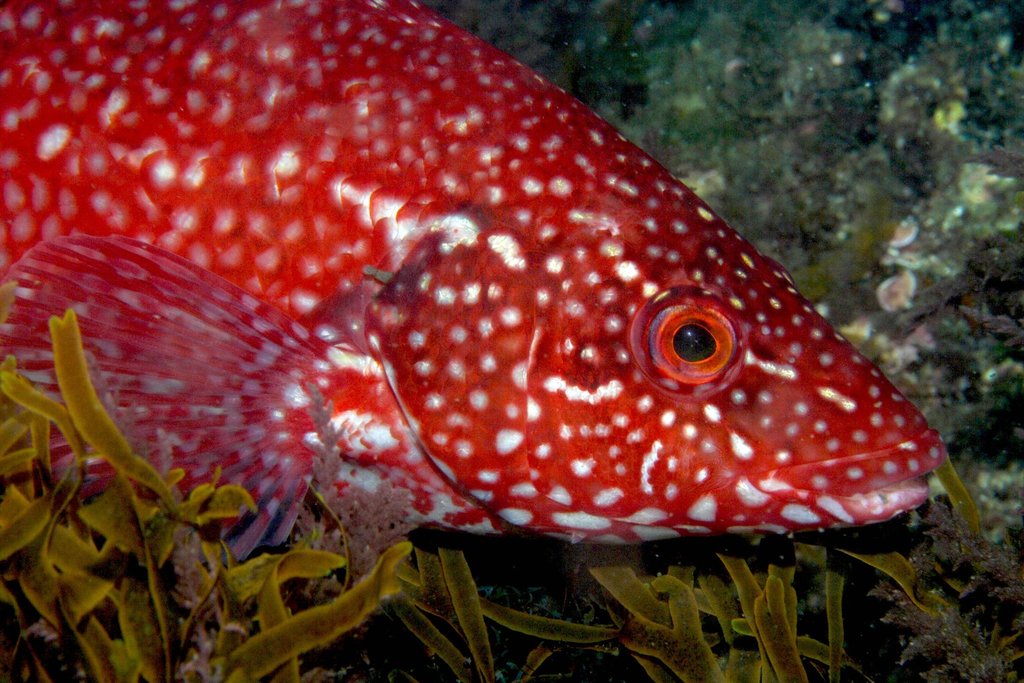
Ballan wrasse
- Family
- Labridae
- Depth
- 1–50 m
- Season
- Apr, May, Jun, Jul, Aug
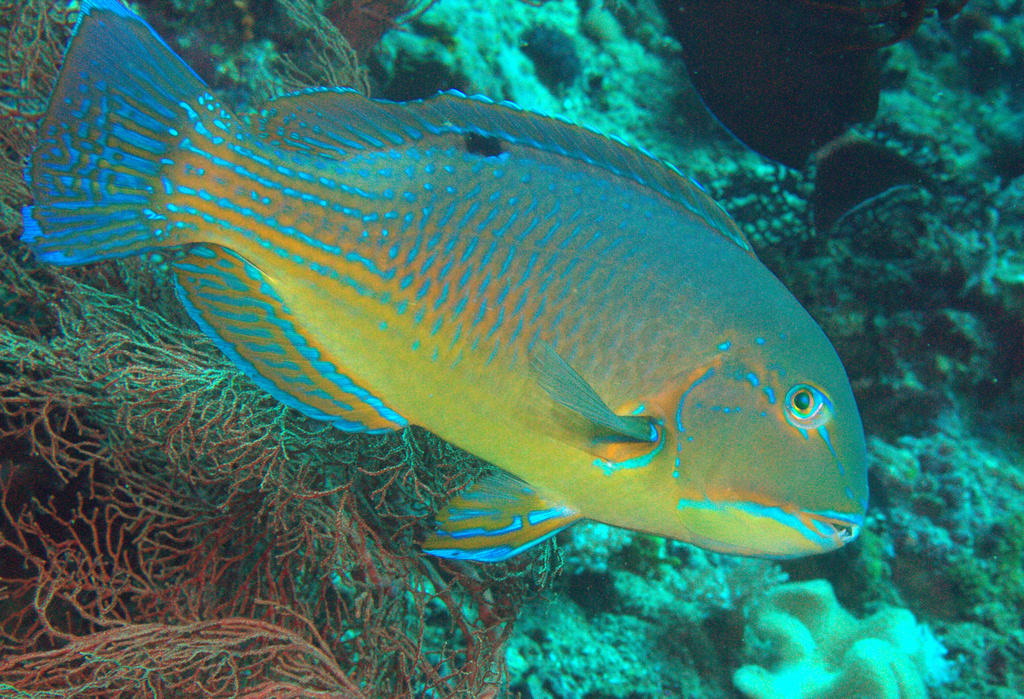
Blackspot tuskfish
- Family
- Labridae
- Depth
- 10–60 m
- Season
- Jan, Feb, Mar, Apr, May, Jun, Jul, Aug, Sep, Oct, Nov, Dec

Blue tuskfish
- Family
- Labridae
Guides for this water
Technique, gear and safety guides that fit Orange-dotted tuskfish.