
Blue-barred parrotfish
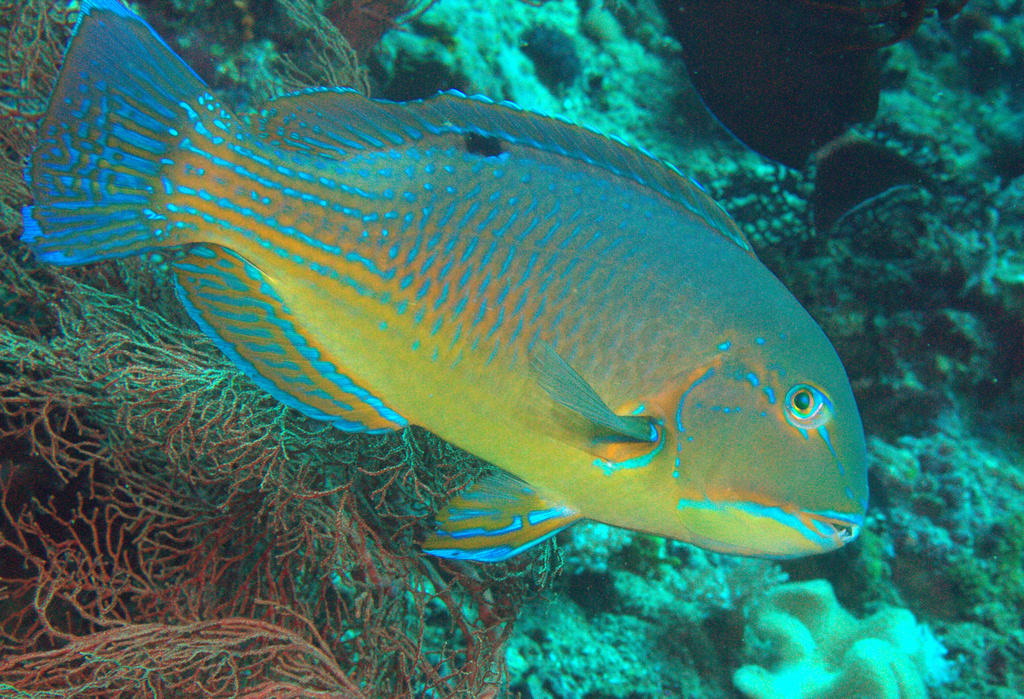
Blue-barred parrotfish is a large labrid of the Indo-West Pacific, from Algoa Bay, the Red Sea and the Persian Gulf across to Rapa and Ducie, north to southern Japan and south to Perth and New South Wales. It is a fusiform, laterally compressed fish marked with blue lines and yellow patches, and it works reef from 1 to 90 m in tropical water. It feeds on fish and algae, reaches 75 cm TL and can live 13 years.

Blue-barred parrotfish (Scarus ghobban) is a fish of the family Labridae. FishBase gives its range as: Indo-West Pacific: Algoa Bay, South Africa and Red Sea , Persian Gulf to Rapa and Ducie islands, north to southern Japan, south to Perth, New South Wales. Likely in Seychelles. Eastern Pacific: Gulf of California to Ecuador. Wikipedia lists several vernacular names for it, among blue-barred, blue trim, cream and yellow scale parrotfish. It is recorded from 1 to 90 m, in tropical water. The recorded maxima are 75 cm TL, 13 years. Diet includes fishes and algae. IUCN status: Least Concern (LC). Chinese name: .
Identification
Scarus ghobban, a parrotfish, has a fusiform and compressed body, with three anal spines and nine soft anal rays. The record tops out at 75 cm total length, calls 30 cm the common length, gives 13 years as the greatest age, and puts the start of maturity at 49 cm. Maturity therefore sits near the top of the size range: the common 30 cm fish is far below the 49 cm threshold. Wikipedia lists several vernacular names for it, among blue-barred, blue trim, cream and yellow scale parrotfish. Taxon 84175 has 5464 iNaturalist observations.
Habitat and distribution
Marine and brackish, reef-associated and tropical, with a 1–90 m depth span: those are the record's labels. The Indo-West Pacific range reaches from Algoa Bay, the Red Sea and the Persian Gulf to Rapa and Ducie, and north to southern Japan. Its country list is the longest here, taking in East Africa, the Red Sea and Gulf, South and Southeast Asia, Australia, the Pacific islands and the eastern Pacific rim. The batch's salinity-gradient theme runs through this entry, but the evidence is thin: brackish is the sole salinity word, and it never says which part of an estuary the fish uses. Depth begins at 1 m and ends at 90 m, so reef and coastal runoff define the fishable ground, not a river channel. Wikipedia supplies the name list.
Season and fishing approach
The spawning months are unknown, so no season can be rebuilt from the database. What the gradient idea contributes is placement: with brackish as the only salinity clue, fish where reef or rock coast meets freshwater-influenced water, not upstream. Reef, rock and coastal are the habitat keywords, and the 1 m shallow end supports starting at the reef edge before moving deeper. Fish and algae are eaten, making fish baits and weed-zone grazing presentations equally plausible. Commercial fishing and the commercial aquarium trade are recorded. A 75 cm ceiling and a 30 cm common size shape the tackle choice; 5464 iNaturalist observations indicate how often divers and shore observers encounter it.
Edibility and regulations
IUCN assessed the species as Least Concern on 18 September 2009. Both CITES and CMS omit it. Boats land it commercially, and it is sold for aquariums. A legal minimum length or take limit sits in the rule for the jurisdiction you fish, not in a species account. The clutch of English aliases creates a lookup problem: a regulation may name the blue-barred parrotfish while a landings sheet names the cream parrotfish, and only the scientific name joins the two. The 49 cm maturity point is a biological threshold, not a legal minimum, and nothing in the sources converts it into one.
Where these facts come from
Check these pages before you rely on a size, range or protection status.
- FishBase — Scarus ghobban — FishBase · T2
- GBIF — Scarus ghobban occurrence records — GBIF · T2
- IUCN Red List — Scarus ghobban — IUCN · T1
- Photo record — iNaturalist — iNaturalist · T3
Fish in the same water
These fish live in the same place.
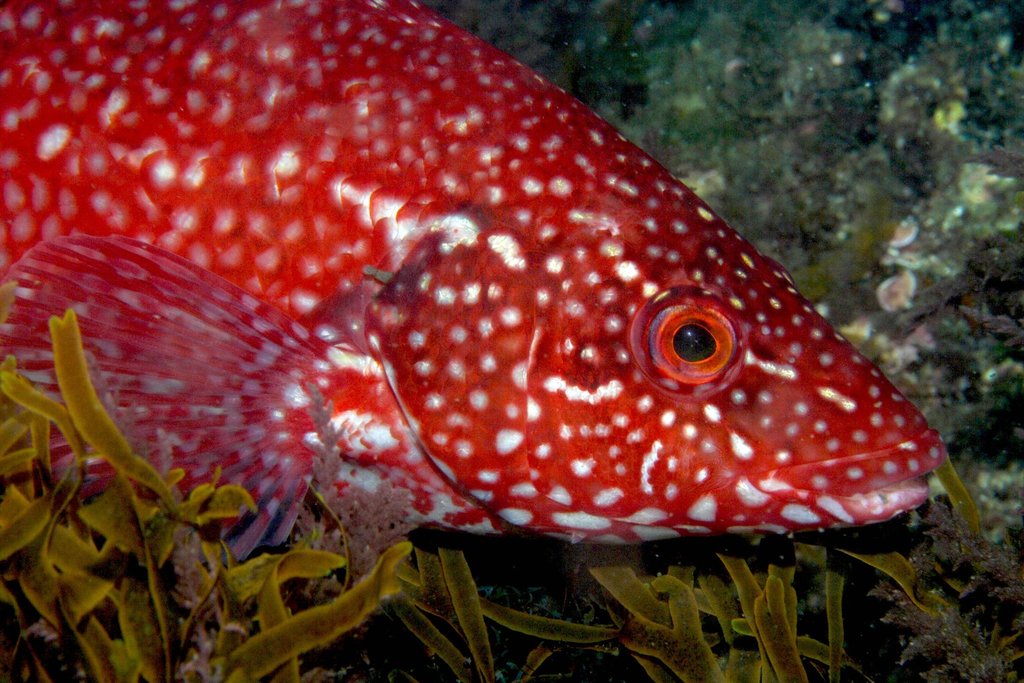
Ballan wrasse
- Family
- Labridae
- Depth
- 1–50 m
- Season
- Apr, May, Jun, Jul, Aug
Blackspot tuskfish
- Family
- Labridae
- Depth
- 10–60 m
- Season
- Jan, Feb, Mar, Apr, May, Jun, Jul, Aug, Sep, Oct, Nov, Dec

Blue tuskfish
- Family
- Labridae
Guides for this water
Technique, gear and safety guides that fit Blue-barred parrotfish.