
Spotted flounder
The spotted flounder is a left-eyed flatfish: lying on sand or mud, the side facing up is its left, and both eyes sit there. It does not hide in rock. It presses itself into soft sediment and relies on low contrast, which means catching one starts with accepting a flat that looks like it holds nothing at all.
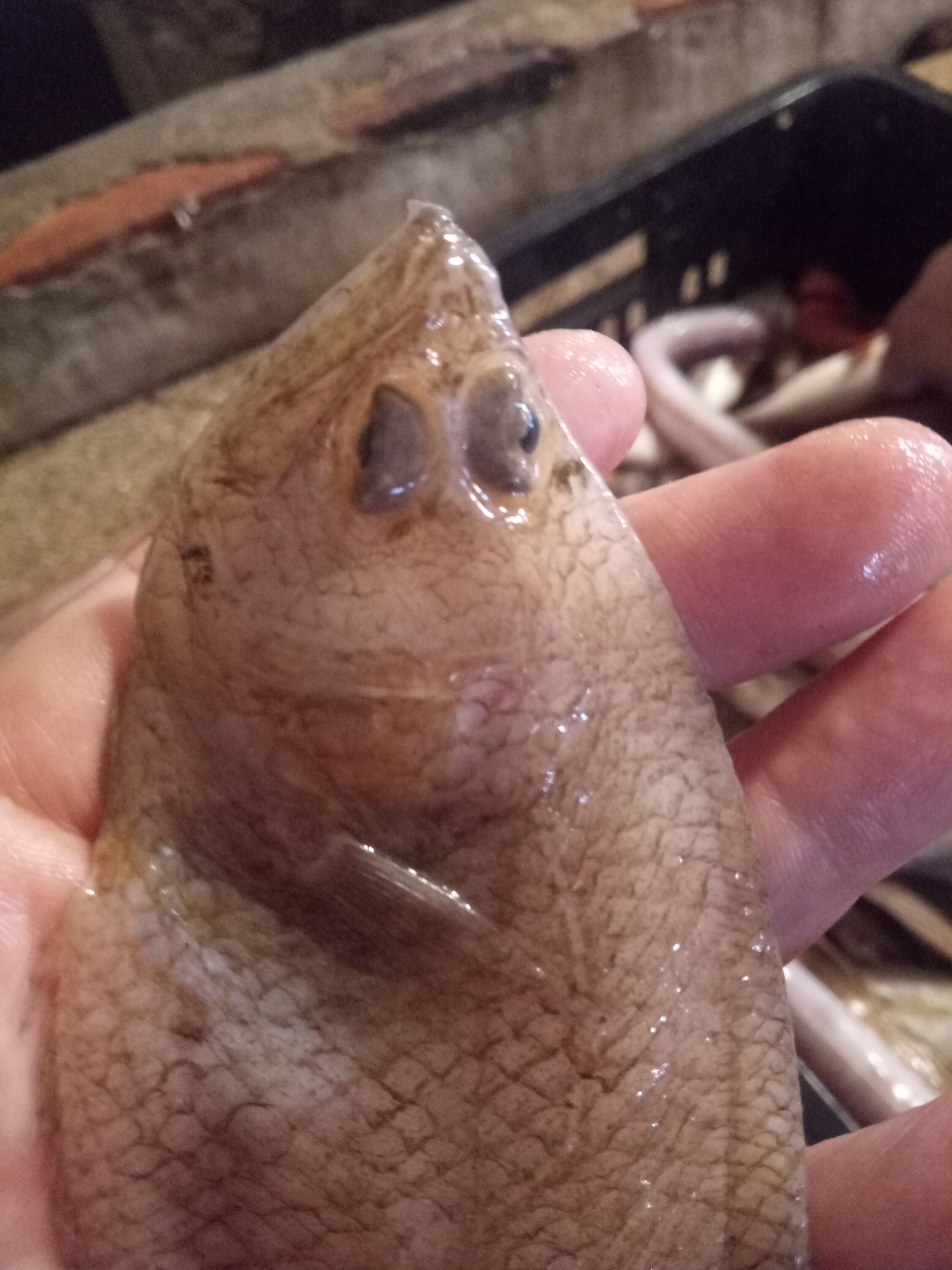
The spotted flounder is a left-eyed flatfish: lying on sand or mud, the side facing up is its left, and both eyes sit there. It does not hide in rock. It presses itself into soft sediment and relies on low contrast, which means catching one starts with accepting a flat that looks like it holds nothing at all.
Both eyes on the left side of a flat head
Confirm the eye position first; it is the fastest check at the boat. Both eyes sit on the left side of the head, so with the fish lying flat the left side faces up and the right side rests on the bottom. The body is flat and close to oval, the mouth is on the large side, and the lateral line runs nearly straight along the front section. Irregular dark blotches cover the flank and the caudal fin carries spots too, which is where the name comes from. The Mediterranean holds several flatfish, and eye position is the boundary that fails least often, so settle that before comparing pattern or size. Never assume a flatfish is right-eyed; getting the direction backwards sends the whole key the wrong way. Maximum recorded length is 39.7 cm, common length only 15 cm.
Soft mud off river mouths, not reef edge
FishBase gives an eastern Atlantic range from the northwest coast of Africa south to 23 degrees south, plus the Mediterranean, with a recorded depth down to 300 m. Adults live on soft bottom from the shoreline to about 300 m, but are rarely caught deeper than 200 m. That sentence shapes the fishing: the fish worth catching sit on sand and mud between a few tens of metres and about two hundred. The usual grounds are the soft mud outside a river mouth, the flat inside a bay and the coastal sand belt, not the edge of a reef. Flat ground looks like it holds nothing, which is how the fish avoids attention; reading changes in the bottom, mud patch into sand, sand into shell rubble, beats looking for a mark.
Nothing published on spawning, so read the light
FishBase gives no month-by-month spawning table and no spawning temperature for this species; the maturity length is recorded at 14.3 cm. Chinese Wikipedia states outright that its habits are unknown, which is an honest description of the evidence. What can be said is general: it is a burying, nocturnal bottom fish that spends much of the day pressed into soft mud with only the eyes and back exposed, becoming more active at night and in dirty water. Catch strength therefore follows light and bottom rather than the calendar. Low light and coloured water usually beat midday, and the same holds after a blow.
An ambush feeder that needs the bait at its mouth
This is an ambush fish, not a chaser, so the bait has to arrive in front of it. From a boat, a slow drifted bottom rig: the lead drags the bait along the floor, stops every so often, and lets it sit still on the sand for a few seconds, which is when the flounder draws it in. From shore or a small boat off a breakwater head, a light lead and a short cast walked along the bottom in short steps does the same job. A third option is a small iron or soft plastic hopped and allowed to fall back, with the landing the only real window. Small fish and crustaceans are the diet, so the bait needs body and scent. A fast retrieve with a bare hook achieves very little.
Light tackle, short snoods and a soft hand
From shore or a small boat, a 7 foot medium-action rod with a 2500 or 3000 reel, 0.6 to 0.8 braid and an 8 to 12 lb fluorocarbon leader; from a boat, a 6.6 foot rod rated 30 to 60 g. Use a size 1 to 1/0 wide-gap single hook with the point exposed, because the mouth is not small but closes tight. Keep the snood at 30 to 50 cm; longer than that and it balls up on soft mud. Choose a light lead that sits on the surface of the mud instead of sinking in, because a buried lead kills all movement in the bait. Support the body when unhooking and never grip the tail wrist, which is thin and easily damaged in flatfish.
No minimum size, but the sale ban still binds
The flesh is thin and white, suited to frying whole, salt-grilling or soup; skinning removes more of the fishy note, and small fish are not worth filleting. EU: Regulation (EU) 2019/1241 Annex IX Part A does not list the Citharidae, so there is no EU minimum conservation reference size. Recreational catch may not be sold, and the gear restrictions of Regulation 1967/2006 Article 17 still apply. Spain: RD 560/1995 Annex II has no entry, and its flatfish lines do not cover Citharus, so they must not be stretched to fit; a regional licence is required from shore and boat. France: no entry in the Mediterranean section of the 26 October 2012 arrêté; no permit, registration under RecFishing from age 16, no sale of catch. Croatia: no national entry; licence required, 5 kg per day plus one fish over 5 kg. Italy: no separate national recreational table, the EU MCRS applies and this species is not on it; annual MASAF declaration required. Greece: no recreational licence, 5 kg daily. No species-specific size does not mean no limits. Check the current year's official notice.
A thin file, and an honest note about it
Distribution, the 300 m maximum depth and the note that it is rarely caught below 200 m, the 39.7 cm maximum total length, the 15 cm common length, the 14.3 cm maturity length, the diet of small fish and crustaceans and IUCN LC (2014) all come from FishBase. Chinese Wikipedia gives 30 cm and states that the habits are unknown; the length differs from FishBase, and the second point explains why the main text stays with burying and nocturnal behaviour rather than describing a feeding cycle. Month-by-month strength is arranged from soft-bottom boat experience and has no survey behind it.
How to catch it
Boat bottom fishing
Fished with the listed approach, matched to the recorded depth and size.
Lure fishing
Fished with the listed approach, matched to the recorded depth and size.
Where these facts come from
Check these pages before you rely on a size, range or protection status.
- FishBase — Citharus linguatula — FishBase · T2
- GBIF — Citharus linguatula occurrence records — GBIF · T2
- IUCN Red List — Citharus linguatula — IUCN · T1
- Photo record — iNaturalist — iNaturalist · T3
Fish in the same water
These fish live in the same place.

Acoupa weakfish
- Family
- Sciaenidae
- Depth
- 1–20 m
- Season
- Jan, Feb, Mar, Apr, May, Jun, Jul, Aug, Sep, Oct, Nov, Dec

American angler
- Family
- Lophiidae
- Depth
- 0–800 m
- Season
- Mar, Apr, May, Jun

American eel
- Family
- Anguillidae
- Depth
- 0–464 m
- Season
- Jan, Feb, Mar, May, Jun, Jul
Guides for this water
Technique, gear and safety guides that fit Spotted flounder.