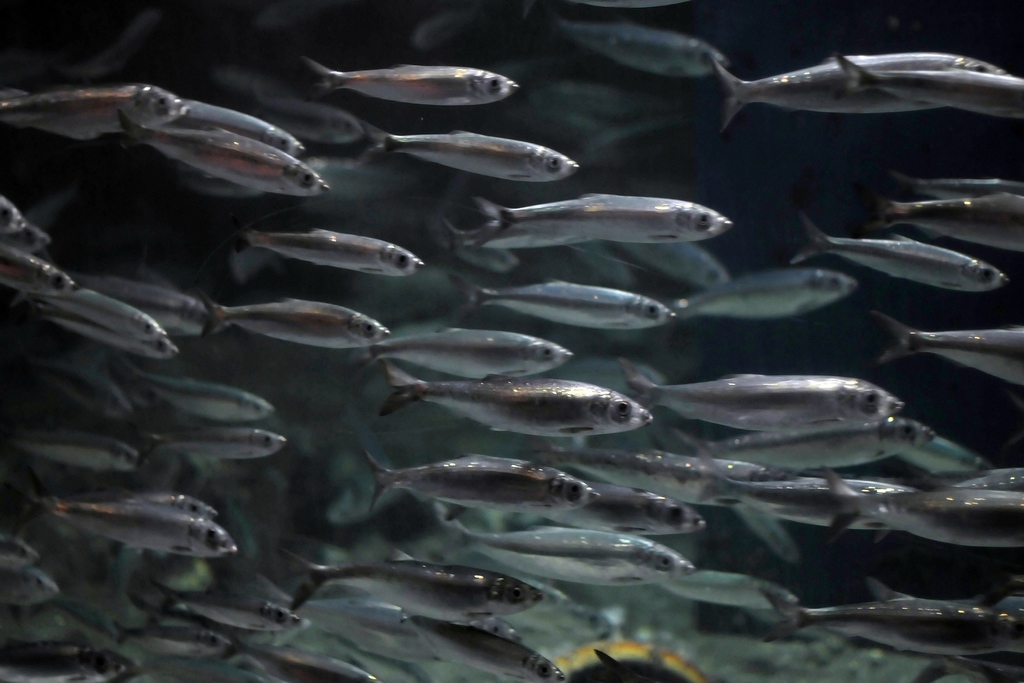
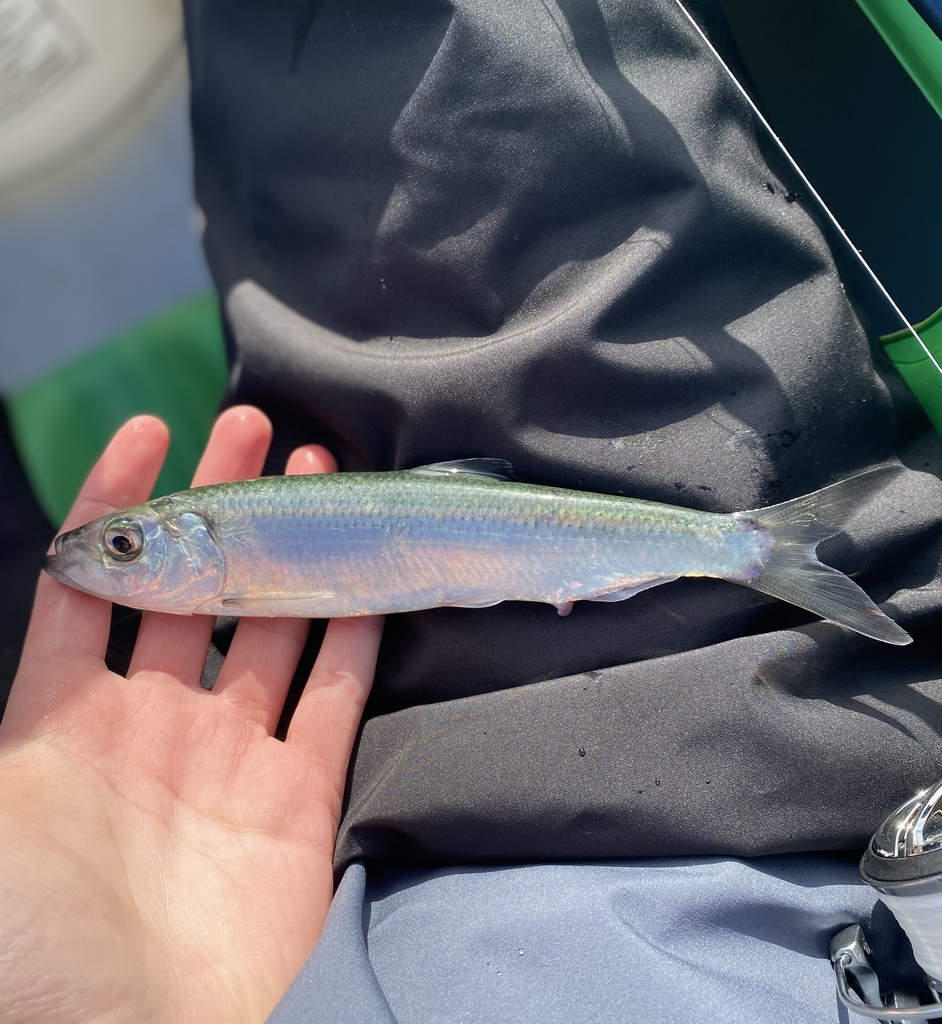
Atlantic herring (Clupea harengus) is a fish of the family Clupeidae. FishBase gives its range as: North Atlantic: in the west, it ranges from southwestern Greenland and Labrador southward to South Carolina, USA. In the east, it ranges from Iceland and southern Greenland southward to the northern Bay of Biscay and eastward to Spitsbergen and Novaya Zemlya in Russia, including the Baltic Sea. The fin counts are 13 to 21 dorsal soft rays, 12 to 23 anal soft rays, no anal spines, and 51 to 60 vertebrae; the body is fusiform and laterally compressed. It is recorded from 0 to 364 m, in temperate water at 0–18 °C. The recorded maxima are 45 cm SL, 1.1 kg, 25 years. Diet includes fishes. IUCN status: Least Concern (LC). Chinese name: .
Identification
Clupea harengus is a herring of the family Clupeidae, order Clupeiformes. The fin counts are 13 to 21 dorsal soft rays, 12 to 23 anal soft rays, no anal spines, and 51 to 60 vertebrae; the body is fusiform and laterally compressed. It is the fish most people mean when they say herring, and it is also the fish most often reduced to a word on a menu.
The size record uses one measure throughout: maximum length is 45 cm SL, common length 30 cm SL, maximum published weight 1.1 kg, and maximum reported age 25 years. First maturity is recorded at 16.7 cm, so a herring below that has not spawned and is the one to put back without debating it. Because both figures are standard length, the 45 cm maximum and the 30 cm common length can be read against each other; what the page does not give is a spread around the maturity point.
One name, many stocks
The English table reads like a list of fishing seasons rather than a list of species. Atlantic herring, Bank herring, Fall herring, Labrador herring, Murman herring and Norwegian herring all appear, each attached to a country or a fishery. The FAO and AFS entries use Atlantic herring, and the page title follows them.
Those names describe stocks and runs, not separate animals. Wikipedia notes that the species forms large schools on both sides of the North Atlantic. A spring-spawning stock and an autumn-spawning stock in the same sea are the same species biologically, and different management units politically. That distinction is the reason the spawning table below looks the way it does.
Depth and ground
The environment line reads marine and brackish, benthopelagic, oceanodromous, 0 to 364 m, usually 0 to 200 m, temperate at 0 to 18°C, between 80°N and 32°N. The brackish flag is not decorative: the Baltic population lives and spawns in water a strictly marine fish could not use. The FishBase diet entry lists fishes only, while Wikipedia describes feeding on copepods, krill and small fish. Both can be true, because a herring takes whatever the season offers, and for an angler the practical reading is that a small bright lure imitates most of that list.
Seasonal window
Spawning is recorded in every month of the year. That is not one long season; it is the sum of many regional ones. The rows show an autumn spawner along the English east coast in September to November; a spring spawner between the Danish islands in March to May; the Archipelago Sea in Finland from April to August; the Celtic Sea from January to March and October to December; the Dover Straits in November and December; and Clyde and Donegal Bay grounds in September.
Read the table as a set of local windows. A boat in the Baltic in June is fishing a different spawn from a boat in the Celtic Sea in January, and neither one tells you what a third stock is doing.
Gear and approach
At 1.1 kg and 45 cm SL the fish does not demand heavy tackle. A light spinning rod, 10 to 15 lb braid and a multi-hook rig are enough, and a landing net saves more fish than a tight drag. The 16.7 cm maturity length is the release figure that matters if the fish is to be returned.
The 25-year maximum age is the surprising number on the page. A fish that small can live a quarter of a century, which is why the stock structure, not the individual, is the thing to protect.
Edibility and regulations
FishBase records highly commercial fisheries and gamefish use. Wikipedia calls the species one of the most abundant fish species in the world. It is food, bait and, in some places, a sport fish, and the same animal supports all three.
The Swedish rows in GBIF are marked NEAR_THREATENED under the Swedish Red List 2025 and Dyntaxa, while the assessment covering the whole species is Least Concern. That is not a contradiction: one describes the local stock, the other the species across its range, and only the local one tells a Baltic boat anything about what to expect.
For herring the keep rule is set stock by stock, because the same fish in the North Sea and in the Baltic is managed as two different units. A size limit and a daily cap may both exist, but they belong to the stock in front of you rather than to the species. Whether the boat may sail is a separate question, settled by closures that follow that stock's spawning window. North-east Atlantic figures come from the coastal states and the European Union, western ones from Canada and the United States; FishBase carries none of them.
Where to look
The distribution text covers the North Atlantic. In the west, from south-western Greenland and Labrador south to South Carolina; in the east, from Iceland and southern Greenland south to the northern Bay of Biscay, and east to Spitsbergen and Novaya Zemlya, including the Baltic Sea. The country table follows that arc: Belgium, Canada, the Channel Islands, Denmark, England and Wales, the Faroes, Finland, France, Germany, Greenland, Iceland, Ireland, the Isle of Man, Latvia, Lithuania, the Netherlands, Northern Ireland, Norway, Poland, Russia, Saint Pierre and Miquelon, Scotland, Spain, Svalbard, Sweden, the United Kingdom and the contiguous United States.
GBIF returns 54 rows, and the pattern is a shelf species recorded wherever a national monitoring scheme samples: the Dutch estuaries, the Belgian coast, the Baltic, the Arctic Sea, Hudson Bay and Hudson Strait. The IJsselmeer row is a freshwater lake, a reminder that this fish tolerates low salinity well beyond the open sea.
iNaturalist holds 1,138 observations. The usable frame is the North Atlantic shelf: Arctic south to the Bay of Biscay and South Carolina, above 200 m, with the Baltic treated as its own brackish case.
Regulations before you keep it
These are the published regulations for this fish. Read the number first. The notice below it is the actual regulation.
Minimum size4
The minimum size for Atlantic herring in Spain is ≥20 cm.
| Arenque (Clupea harengus) | 20 |
The minimum size for Atlantic herring in France is ≥20 cm.
| HARENG | Clupea harengus | 20 cm |
The minimum size for Atlantic herring in Portugal is ≥20 cm.
Arenque (Clupea harengus) | 20 cm
≥20 cm
United Kingdom · UK
The minimum size for Atlantic herring in UK waters is ≥20 cm.
| Herring | Clupea harengus | 20 cm |
Bag limit1
No minimum size · unlimited possession · all year
United States — federal (Atlantic) · US-FED-ATL
Federal Atlantic rules set no size or possession limit for Atlantic herring.
Atlantic Herring
Open season: All year
Minimum size: None
Possession limit: Unlimited
Every record above names its source and the date it was retrieved. See the regulation register for the full list, or how to read these regulations.
Where these facts come from
Check these pages before you rely on a size, range or protection status.
-
FishBase — Clupea harengus
— FishBase · T2
-
GBIF — Clupea harengus occurrence records
— GBIF · T2
-
IUCN Red List — Clupea harengus
— IUCN · T1
-
Photo record — iNaturalist
— iNaturalist · T3