≥50 cm
Australia — Queensland · AU-QLD
Queensland sets a 50 cm minimum size for mahi mahi (dolphin fish).
Mahi mahi (dolphin fish) | Min: 50cm | Limit: 5

Mahi-mahi is a large surface fish of warm seas, known in markets as dorado and sometimes confused with the dolphin mammal. It lives from the surface to 85 m, reaches 210 cm and 40 kg, and can live four years. Trolling or jigging is the usual approach, with fish present year-round in water of 21 to 30 °C.
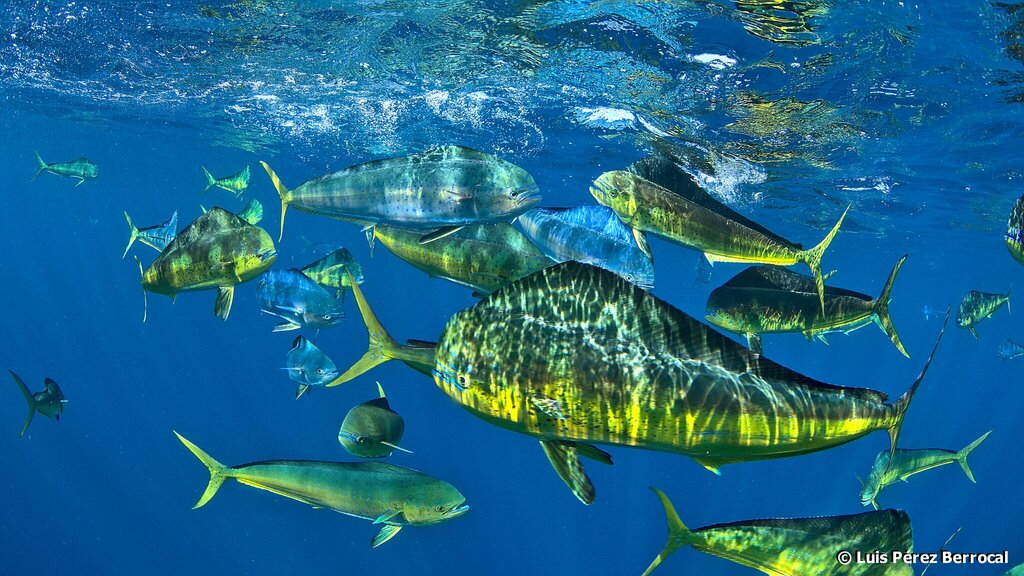
This fish has two English names that behave very differently. Mahi-mahi and dorado are market and angling words, and both point at one animal. Dolphin is the one that causes trouble, because in ordinary English it belongs to a mammal. The page keeps all of them in a single alias list and lets the reader sort it out. Sorting out which name owns which record is the job of this article.
The alias table runs: common dolphin, common dolphin fish, common dolphinfish, dolphin, dolphin fish, dolphinfish, dorado, green dolphin, mahi mahi. The family is Coryphaenidae and the order is Carangiformes. Nothing in that taxonomy touches Cetacea; the collision is purely lexical. The record does not comment on the confusion, but it preserves both spellings side by side, which is the honest way to show it.
The Chinese names split along the same line. FishBase's approved name is , and the alias list adds , , , , and . On the water in Taiwan, China the fish is usually ; in a mainland reference it is . These are not two species but two registers, and a buyer who knows only one of them will not recognise the other on a price board.
The page gives the fish 31 vertebrae, 58–66 dorsal soft rays, no dorsal spines, no anal spines and 25–31 anal soft rays. The body is long and laterally flattened. Those counts are the stable identity, and they are what a name is supposed to point at. The order, Carangiformes, places it with the jacks and their relatives, not with anything warm-blooded. A name is assigned by a community; the counts are carried by the animal. When a community borrows a word that already means something else, the pointing breaks.
GBIF holds 133,914 preserved records: United States 58,122, Chile 40,918, an unassigned bucket 9,073, Cuba 2,872 and Mexico 2,018. iNaturalist has 2,129 observations. All of those are filed under the binomial, not under any one common name. A search for dolphin in an occurrence database returns two different animals; a search for dorado returns Spanish-language records of several fishes. FishBase lists 177 territories, and a list that long is exactly why a common name cannot serve as a key: the same word is reused in different languages across that range. Only the Latin name collects the intended set.
Wikipedia narrows the family to two: this species and the pompano dolphinfish, and places the densest records around the Gulf of Mexico, Costa Rica, Hawaii and the Indian Ocean. It also gives the Italian names — corifena, lampuga, pesce capone — and notes that caponata took its name from this fish before eggplant replaced it. A dish name, like a common name, can outlive the animal it came from.
Maximum length is 210 cm total length and maximum published weight 40 kg. The common length is 100 cm total length. Maturity is listed at 55.8 cm, with a range of 35–93.1 cm. The oldest reported fish is four years.
A four-year life compresses the size spread in time. A 100 cm fish is not old; it is a fast-growing adult. The maturity band runs from 35 to 93.1 cm, wide enough to cover several stocks, and the common length sits at the top of it, so the average fish here has reached maturity. That makes the name problem more than a labelling annoyance: records filed under another name are not just mislabelled, they are years of growth data filed in the wrong drawer.
Rules are written in the names people use. A text that says dolphinfish or dorado may never print mahi-mahi, and a text that says may never print . The page carries no regulation text at all, so the only safe procedure is to search the local rulebook under every name on the list plus the binomial. A regulation found under one alias is still a regulation for the same animal. In practice, a warden checking a catch will use the local word; a data manager will use the binomial. Keep both on the same note.
The depth entry begins at the surface and ends at 85 m, usually 5–10 m. The temperature envelope is 21–30°C, and the habitat keywords are coastal and open-water. The method list is trolling and jigging. This is a surface fish around floating structure, weed lines and temperature edges; the deeper end of the range is an occasional record, not a target. Trolling a spread of small lures along a weed line is the standard surface approach; jigging is for fish sitting below the usual 5–10 m band. In both cases the temperature window, not the name, decides whether the fish is there.
Use the binomial in your own notes and in any search that matters. Use the local name in conversation, and expect the person beside you to use a different one. The 133,914 GBIF records are already filed that way; an observation added under a common name only adds noise. The fish does not change when the word changes, but the record does.
Trolled from a moving boat; suits roaming or pelagic species.
Vertical jigging over the recorded depth range.
These are the published regulations for this fish. Read the number first. The notice below it is the actual regulation.
Queensland sets a 50 cm minimum size for mahi mahi (dolphin fish).
Mahi mahi (dolphin fish) | Min: 50cm | Limit: 5
Western Australia sets a 500 mm minimum legal size for mahi mahi (dolphinfish).
"Mahi Mahi (dolphinfish) Coryphaena spp. 500 mm"
New South Wales, Australia: Mahi Mahi has a minimum size of 60 cm, only 1 fish over 110 cm may be kept, and the daily bag limit is 10.
Mahi Mahi (Dolphinfish) | Mahi Mahi (Dolphinfish) | 60 cm, only 1 over 110 cm | 10
Queensland sets a possession limit of 5 Mahi-mahi.
A possession limit is the total number of fish you may keep at any time, including fish at home or in the freezer; it is not a daily take limit.
Mahi mahi (dolphin fish) | Min: 50cm | Limit: 5
Mexican federal recreational fishing rules cap dorado (mahi-mahi) at two fish per angler per day, and those two fish count as five fish of other species against the ten-fish daily limit.
Clause 4.7.1 of the standard, published in the Diario Oficial de la Federación on 9 May 1995.
En el caso de sábalo, dorado o pez gallo, el límite máximo será de dos ejemplares de cualquiera de tales especies, los que también serán equivalentes a cinco organismos de otras especies.
In the Atlantic Exclusive Economic Zone from North Carolina to Maine, the recreational mahi-mahi bag limit is 10 fish per person with a 54-fish vessel limit, and there is no minimum size.
Georgia, Florida and South Carolina set their own minimum sizes in state waters.
Atlantic Exclusive Economic Zone (EEZ) (North Carolina - Maine) | None | 10 fish per person; not to exceed vessel limit | 54 fish (excluding headboats)
North Carolina allows 10 dolphin per person per day, capped at 54 per trip.
Limit of 10 per person per day or 54 per trip, whichever is less.
Every record above names its source and the date it was retrieved. See the regulation register for the full list, or how to read these regulations.
Check these pages before you rely on a size, range or protection status.
These fish live in the same place.
Technique, gear and safety guides that fit Mahi-mahi.