
Roundnose grenadier
Roundnose grenadier is a deep-water macrourid of the North Atlantic, from about 37°N to Baffin Island and Greenland in the west, and from Iceland and Norway to the Barents Sea and North Africa in the east. It lives from 180 to 2,600 m, reaches 110 cm TL and 1.7 kg, can live 54 years, and feeds on crustaceans, fish and molluscs.
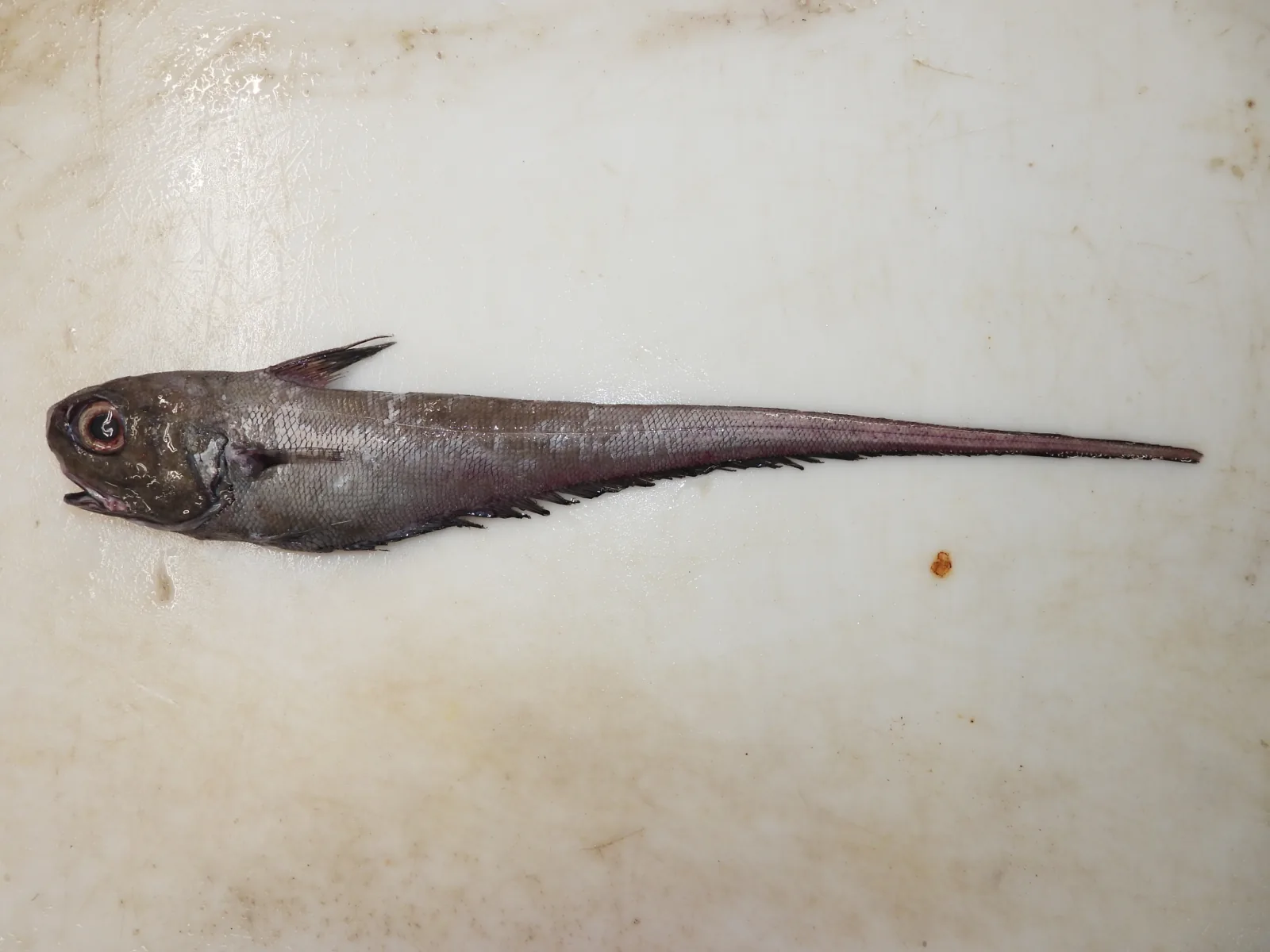
Roundnose grenadier (Coryphaenoides rupestris) is a fish of the family Macrouridae. FishBase gives its range as: North Atlantic: from about 37°N to Baffin Island and Greenland in the western Atlantic, and off Iceland and Norway to 73°N to Barents Sea, south to North Africa in the eastern Atlantic. Reported to occur from the tongue of the Ocean east of Andros Islands (about 24°N, 77°W) in the Bahamas. It is recorded from 180 to 2600 m, in deep water. The recorded maxima are 110 cm TL, 1.7 kg, 54 years. Diet includes crustaceans, fishes and molluscs. IUCN status: Critically Endangered (CR). Chinese name: .
Identification
Three figures share one size block and do not describe the same fish: 110 cm TL, 1.7 kg, and an oldest reported age of 54 years. A metre-plus animal at 1.7 kg carries most of its length in a long tapering tail; the shape note is elongated with a circular cross-section and no anal spine. Measured from snout to the tip of that tail, the grenadier is much smaller than the headline number.
The maturity line contradicts itself: Lm 52.7 cm, range 60 cm to unrecorded. A first-maturity length below the lower edge of its own range cannot both stand. Take 52.7 cm as the working threshold and 60 cm as the start of a sample with no recorded upper bound; averaging the two would invent a third number.
Wikipedia's name list adds rock grenadier and roundhead rat-tail, with grenadier de roche in France and granadero de roca in Spain. Five names for one fish is normal for a deepwater species; it is also why a landing sheet can hide it.
Habitat and distribution
Bathypelagic, 180–2600 m, usually 400–1200 m, deep-water, 73°N–20°N. The habitat keyword list holds one item, open-water, and the diet — crustaceans, fishes, molluscs — is a midwater menu. Bathypelagic and open-water agree, and nothing here puts the fish on the bottom.
The range runs from about 37°N to Baffin Island and Greenland in the west, Iceland and Norway to 73°N and the Barents Sea in the east, south to North Africa, with one Bahamas record near 24°N, 77°W; the country table holds 24 entries. GBIF's 15 rows lean north — Sweden four, Denmark, Norway and Portugal one each, eight without a country — and iNaturalist holds 84 observations.
A Bahamas row and a Barents row are both true and neither is typical. For planning, the useful part of the range is the eastern Atlantic slope between the two, not the extremes at either end.
Season and fishing approach
Five rows carry both months and places: Iceland June–November; northeastern Atlantic March–May and September–November; Rockall and Hatton Banks in a single April, 1975; Rockall Trough July–November, 1993–95; Skagerrak, Norwegian Deep, August–November, 1986–87. Outer bounds are March to November. Two rows are autumn-only, one is a single month, and two carry survey years instead of seasons — the 1975 April row is a snapshot, not a month that repeats.
A 54-year lifespan changes what a mark means. Removing the 52.7 cm class from a deep slope does not take a few fast-growing fish; it takes animals that may be decades old, and the usual "wait for the next year class" advice has nothing to work with.
The page gives no method, and the depth figures rule out most of them. A usual band of 400–1200 m is drop-fishing water, and a 110 cm TL fish weighing 1.7 kg will not fight like its length suggests.
Edibility and regulations
Critically Endangered, assessed 11 July 2012. CR is a dated assessment, not a ban, and a 2012 call on a wide-ranging deepwater species carries its own uncertainty. The human-uses line records a commercial fishery; nothing marks it as a gamefish.
Deepwater limits are usually written by gear or depth zone rather than by species, so a rule covering this fish may exist without its name on it. The number that matters before a trip is the depth you mean to work, not the category printed here.
Where these facts come from
Check these pages before you rely on a size, range or protection status.
- FishBase — Coryphaenoides rupestris — FishBase · T2
- GBIF — Coryphaenoides rupestris occurrence records — GBIF · T2
- IUCN Red List — Coryphaenoides rupestris — IUCN · T1
- Photo record — iNaturalist — iNaturalist · T3
Fish in the same water
These fish live in the same place.

Acoupa weakfish
- Family
- Sciaenidae
- Depth
- 1–20 m
- Season
- Jan, Feb, Mar, Apr, May, Jun, Jul, Aug, Sep, Oct, Nov, Dec

American angler
- Family
- Lophiidae
- Depth
- 0–800 m
- Season
- Mar, Apr, May, Jun

American eel
- Family
- Anguillidae
- Depth
- 0–464 m
- Season
- Jan, Feb, Mar, May, Jun, Jul
Guides for this water
Technique, gear and safety guides that fit Roundnose grenadier.