The shiner perch carries the oddest rule in its family: 14 CCR § 28.59 gives it a separate 20-fish allowance that sits on top of the general bag. It is also the easiest small live bait in Southern California to collect in numbers, topping out around 20 cm and showing in loose schools along eelgrass and pilings. Most people who catch one were not fishing for it.
Three anal spines and a body built like a coin
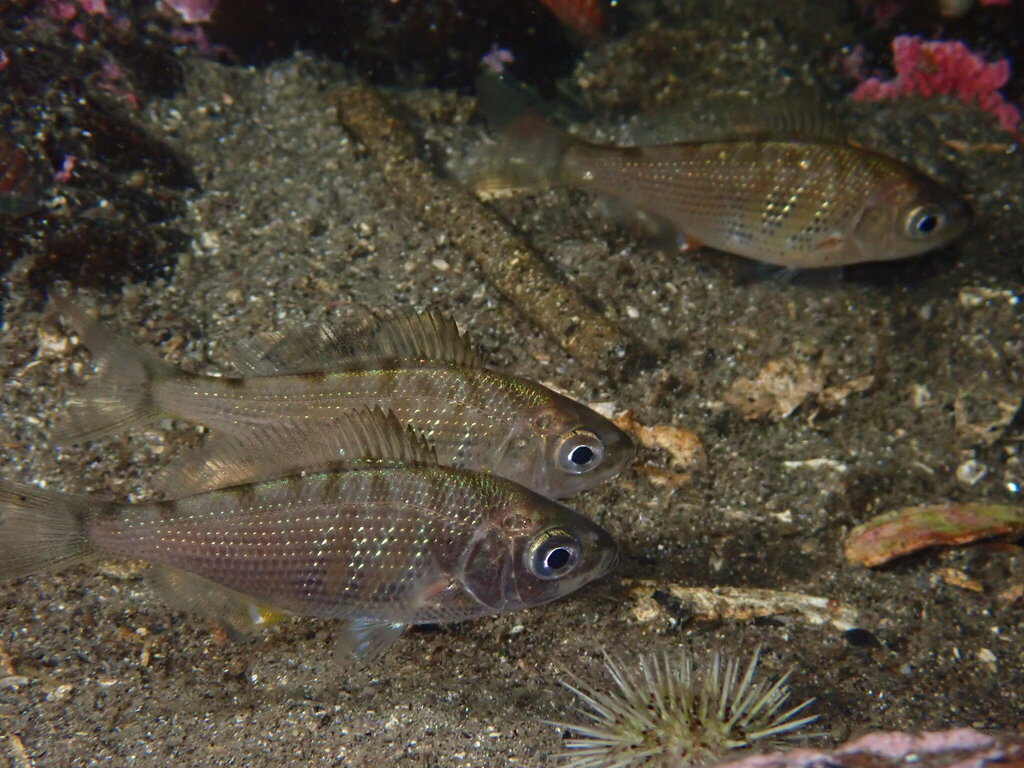
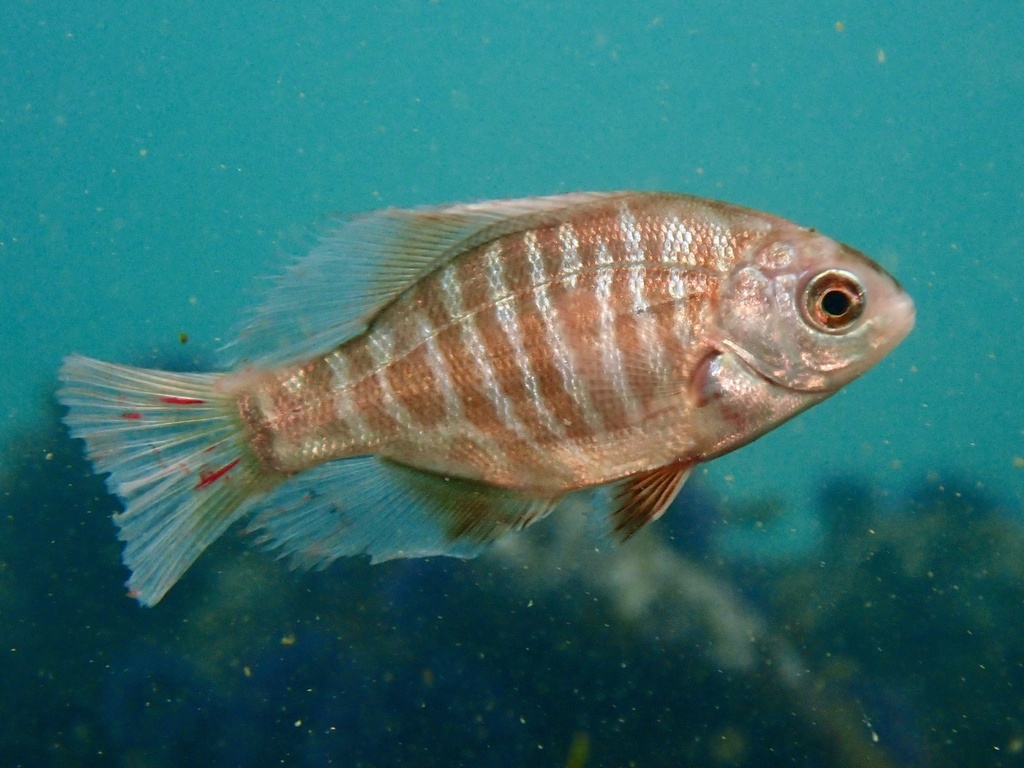
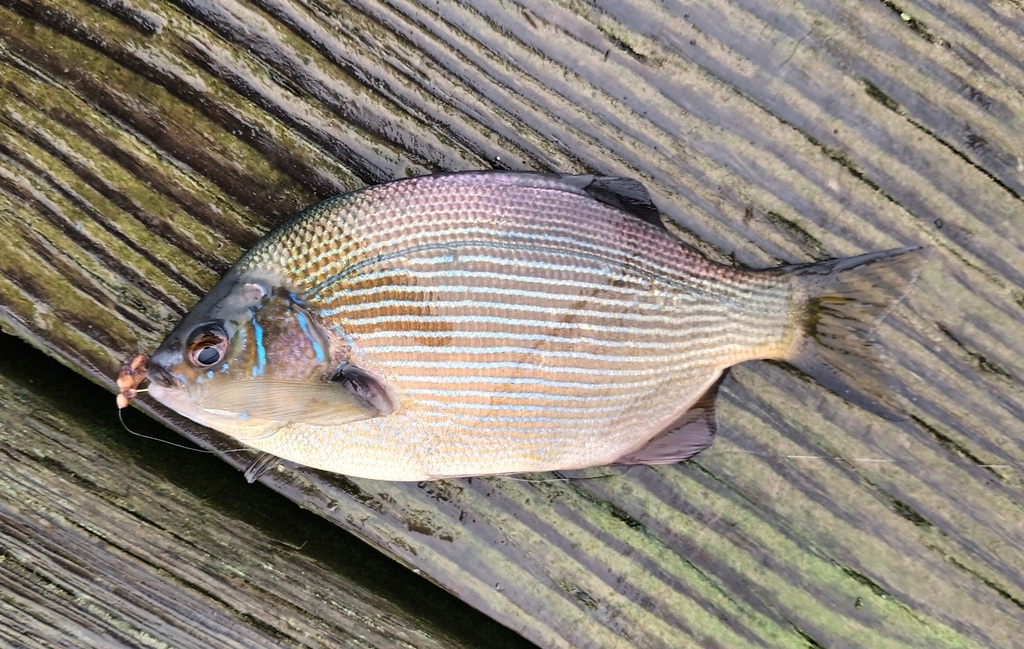
Size is the first clue: FishBase lists a maximum of 20.3 cm total length, with 11.5 cm as the common figure. The body is short, deep and compressed, the scales are large, and the anal fin carries three spines, which is a quick separation from the rest of the family. Overall the fish is bright silver with a grey-green back. Eight or so thin stripes of fine black dots run along the flank and are broken by three pale yellow vertical bands, clearest on light-coloured fish. Breeding males turn almost solid black and grow fleshy lobes beside the anal fin.
Eelgrass, pilings, and quiet back water
FishBase runs the range from Wrangell in southeastern Alaska to Bahia San Quintin in northern Baja California. It is an inshore bottom fish, recorded from 1 to 146 m, and in practice it lives in bays, eelgrass beds, around pilings and in quiet backwater, and it enters estuaries and brackish water. Loose schools drift between the shallows and somewhat deeper water with the season. In Southern California the usual catch comes from the back of a bay, the shade of a pier and the eelgrass inside a breakwater. The 146 m figure marks the edge of the record, not a place to fish, and most fish are caught in water a fraction of that deep.
A fish that moves inshore with the season
FishBase describes a seasonal onshore and offshore movement and gives no month-by-month spawning table; the species is viviparous, with the female carrying developing young. In Southern California the fishing improves in spring, peaks through summer and autumn, and small schools are easy to find around piers in the warm months. Winter pushes them a little deeper, and shore catches thin without stopping. No source here gives the pupping months, so judge by body shape and put back females with visibly swollen bellies. No preferred temperature is listed either; work from water colour and the way the bay warms. A run of warm afternoons can shift the school a week earlier than the calendar suggests.
Sabiki for numbers, a float for fun
A sabiki is the practical tool: size 8 to 12 hooks tipped with glow fibre or a scrap of squid, no lead, the rig sinking slowly along the eelgrass edge, several fish at a time. To fish for them on purpose, a small hook with a piece of worm or shrimp under a float set just above the weed, because the take is light and easy to miss. They are also a bait source: back-hooked or nose-hooked and slow-trolled for halibut, bass and yellowtail. The diet is small crustaceans, molluscs and algae, so the bait stays small and an exposed hook point helps.
Six-pound line because the bait must still sink
A six to seven-foot light spinning rod with a 1000 to 2500 reel, 6 to 10-pound braid and a 4 to 6-pound fluorocarbon leader. Hooks run from size 8 to 12, and the sabiki joins the main line through a swivel to keep it from wrapping. The light line is not about fighting power. It is about sink rate: heavy line makes a small bait hang stiffly and the bites stop. Kept alive, these fish need water changes and an air pump more than they need ice, because a small body runs out of oxygen quickly. A bucket holds a useful amount of bait and no more; split a big catch between two buckets rather than crowding one.
Twenty fish, and what that allowance does not cover
There is little meat and it is soft; most people keep this fish as bait or hand the rod to a child, and frying whole is the one common use. California gives the shiner perch a separate 20-fish allowance in 14 CCR § 28.59 that can be added on top of the general bag, and it is exempt from the April 1 to July 31 surfperch closure in San Francisco Bay and San Pablo Bay, which carry a separate five-fish aggregate, so check before fishing there. State and federal water can differ. Take is banned or restricted inside marine protected areas, and many piers and bay shorelines fall within them. A licence is required from age 16.
Evidence limits on a fish nobody studies
The 20.3 cm maximum, the 11.5 cm common length, the nine-year lifespan, the 1 to 146 m depth, the Alaska to Baja range, the live-bearing habit and the diet all come from FishBase; no maximum weight is listed. The separate 20-fish allowance comes from 14 CCR § 28.59, whose wording puts it on top of the general bag, and this article repeats the wording without turning it into a total. IUCN rates the species Least Concern, assessed in 2019. The banding and male colour notes follow FishBase morphology; in the field, count the three anal spines first.
How to catch it
Sabiki along the eelgrass
Size 8 to 12 hooks with glow fibre, no lead, sinking slowly down the edge of the weed.
Float fishing
A float set half a metre above the weed, a small hook with worm, lifting only when the float dips.
Trolling
Back-hooked and trolled very slowly over sand for halibut and bass.
Regulations before you keep it
These are the published regulations for this fish. Read the number first. The notice below it is the actual regulation.
Bag limit1
20 shiner perch per day, in addition to the 20-finfish overall bag
United States — California · US-CA
California gives shiner perch a separate daily limit of 20 fish, on top of the general 20-finfish bag limit.
Shiner perch are exempt from the 1 April–31 July surfperch closure in San Francisco Bay and San Pablo Bay, where the surfperch aggregate limit is 5 (shiner perch excluded).
(2) The special limit for shiner perch is 20, which may be taken or possessed in addition to the overall daily bag limit of 20 finfish specified in subsection 27.60(a).
Every record above names its source and the date it was retrieved. See the regulation register for the full list, or how to read these regulations.
Where these facts come from
Check these pages before you rely on a size, range or protection status.
-
FishBase — Cymatogaster aggregata
— FishBase · T2
-
GBIF — Cymatogaster aggregata occurrence records
— GBIF · T2
-
IUCN Red List — Cymatogaster aggregata
— IUCN · T1
-
Photo record — iNaturalist
— iNaturalist · T3