
Pile perch
The pile perch is named for where it turns up most often: the pilings under a pier or beside a breakwater. It uses heavy lips and a short, powerful jaw to prise barnacles, mussels and crabs off the timber, which is also the best clue among the surfperches — silver to dark brown, a deep body, and a very small mouth. What separates it from a black surfperch is not size but silver and the set of the lips.
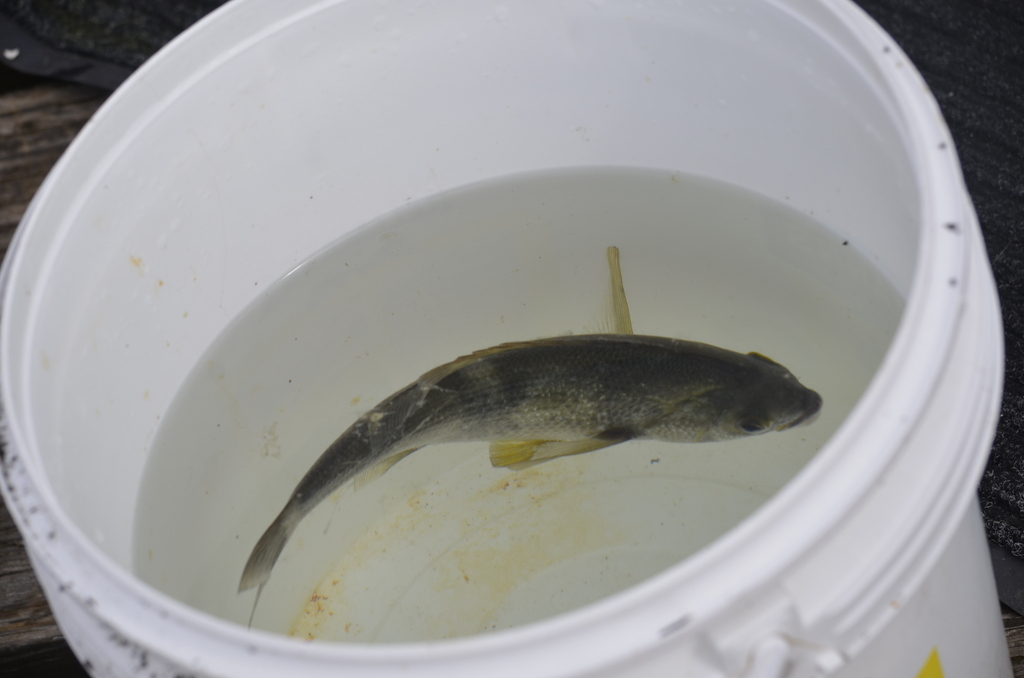
The pile perch is named for where it turns up most often: the pilings under a pier or beside a breakwater. It uses heavy lips and a short, powerful jaw to prise barnacles, mussels and crabs off the timber, which is also the best clue among the surfperches — silver to dark brown, a deep body, and a very small mouth. What separates it from a black surfperch is not size but silver and the set of the lips.
A silver surfperch with an overbuilt lip
Deep-bodied and compressed, adults dark grey or dark brown above with silver rising over the flank and brightest on the belly; irregular dark blotches sit along the back and sides, and juveniles carry dark vertical bars that adults lose. The mouth is small, the lips thick and protruding, and the tail is rounder than in most embiotocids. Against a black surfperch: that fish is deep olive to near-black with little silver and a smaller gape, while the pile perch is more silver, more brown, and its lips stand out in profile. Against a striped surfperch it has no blue stripes. FishBase gives nine to eleven dorsal spines and three anal spines. The gill rakers are short, which suits a diet of shells rather than fish.
Wrangell to Guadalupe, mostly on structure
FishBase runs the range from Wrangell in southeastern Alaska to Guadalupe Island in Baja California. The fish lives on rocky shore, often around kelp, pilings and underwater structure, and is recorded to 46 m. In Southern California the regular spots are pier pilings, the rubble beside a breakwater, structure inside a bay and the kelp margin; the name points at the most reliable of them. The Alaska records sit at the cold end of the range, while Southern California fish depend more on man-made structure than on natural rock. Look for the piling with the heaviest growth and start there.
Live young, and a structure-driven season
FishBase notes only that the species is viviparous and that the female carries the young; no birth month is given. Local catches appear all year, hold steadiest around pilings from late spring into autumn, and slow in winter as fish move deeper into structure. Because the fish stays on station, the fishing depends on the growth cycle of what covers the piling rather than on the month: a piling thick with barnacles and mussels holds more fish. Birth timing, juvenile habitat and growth rate are missing and listed as gaps. A piling cleaned by a diver fishes poorly for a season.
Vertical at the piling, bait on the hard part
Fishing straight down a piling is the main method: drop the bait against the timber to the base, lift thirty centimetres along the face, and repeat, imitating something torn loose. The diet is hard-shelled molluscs, crabs and barnacles, so crab, mussel and shrimp all work, but the hook has to sit in the tough part of the bait or it strips in a few bites. A small soft plastic or a skirted head crawled down the piling takes fish defending territory. Snags are severe, so use light sinkers and short leaders, and re-bait rather than pull hard. Losing a rig is cheaper than tearing the piling apart.
Heavy lips, small mouth, short leader
A 7 foot medium-heavy spinning rod, a 3000 to 4000 size reel, 20 to 30 lb braid, a 15 to 20 lb fluorocarbon leader and a 1/0 to 2/0 wide-gap hook. The piling edge abrades line, so keep a rod's length of leader clear of the timber, and turn the fish away from the piling the moment it is hooked, or it will wrap you. The mouth is small and the lips thick, so expose the point and set the hook firmly. Do not lock the drag. Support the belly on release rather than squeezing the flank. A wet towel on the deck keeps the fish steady for the photo.
Firm flesh under the surfperch limit
White, firm flesh and a larger frame than most surfperch; pan-fry it, bake it or use it in soup, and bleed and ice it early because a shell-eating fish sours quickly in the viscera. California regulates surfperch as a group: 20 fish in total and no more than 10 of any one species (14 CCR § 28.59). San Francisco Bay and San Pablo Bay carry a 5-fish aggregate limit, and shiner perch count separately at 20. The pile perch has no size limit; surfperch are closed in San Francisco Bay and San Pablo Bay from April 1 to July 31, shiner perch excepted, so Southern California has no closed season. State and federal water can differ, Southern California piers often sit near MPA boundaries, and the CDFW notice decides. A licence is required from 16.
Two names for one fish, and what is missing
Range, the 46 m depth ceiling, the 44.2 cm standard length, the viviparous habit, the rocky and piling habitat and the diet of hard-shelled molluscs and barnacles all come from FishBase; family placement follows GBIF's Embiotocidae. The surfperch limit comes from 14 CCR § 28.59. On taxonomy, FishBase uses Rhacochilus vacca while iNaturalist and some recent treatments use Phanerodon vacca; this page follows the batch assignment and flags the difference. Weight, age and local trend are not published in the sources used for this page.
How to catch it
Jigging
Drop the bait against the timber, lift thirty centimetres along the face, and repeat to imitate something torn loose.
Boat bottom fishing
A short leader and light sinker at the rubble-piling junction, close enough to structure without constant hang-ups.
Skirted head down the timber
A small skirted jig lowered slowly along the piling; territorial fish take it inside the shadow.
Where these facts come from
Check these pages before you rely on a size, range or protection status.
- FishBase — Rhacochilus vacca — FishBase · T2
- GBIF — Rhacochilus vacca occurrence records — GBIF · T2
- IUCN Red List — Rhacochilus vacca — IUCN · T1
- Photo record — iNaturalist — iNaturalist · T3
Fish in the same water
These fish live in the same place.
Guides for this water
Technique, gear and safety guides that fit Pile perch.