
Black surfperch
Two oddities of the surfperch family meet in the black surfperch: it gives birth to fully formed young, and its lips are thick enough to work like a soft pad. A third fact matters at the rail — deep olive to near-black, with no bars on the flank. It holds around pier pilings, rock crevices and kelp edges, and crushes crab shells with a force its small size does not suggest.
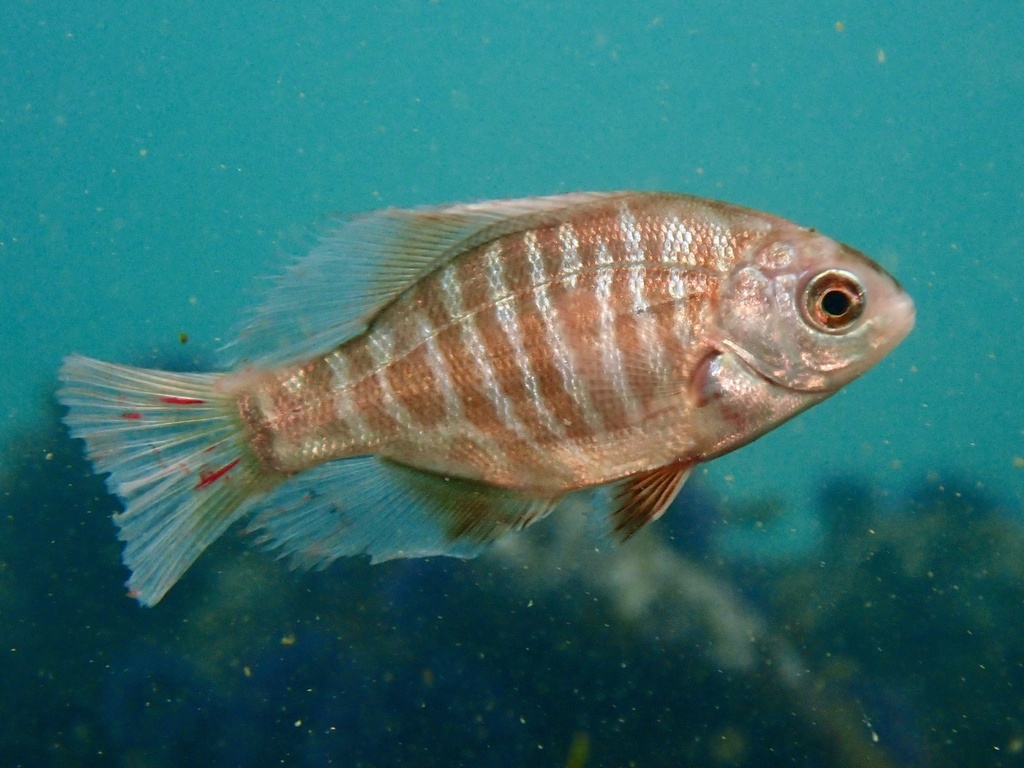
Two oddities of the surfperch family meet in the black surfperch: it gives birth to fully formed young, and its lips are thick enough to work like a soft pad. A third fact matters at the rail — deep olive to near-black, with no bars on the flank. It holds around pier pilings, rock crevices and kelp edges, and crushes crab shells with a force its small size does not suggest.
Thick lips, deep olive, and no bars at all
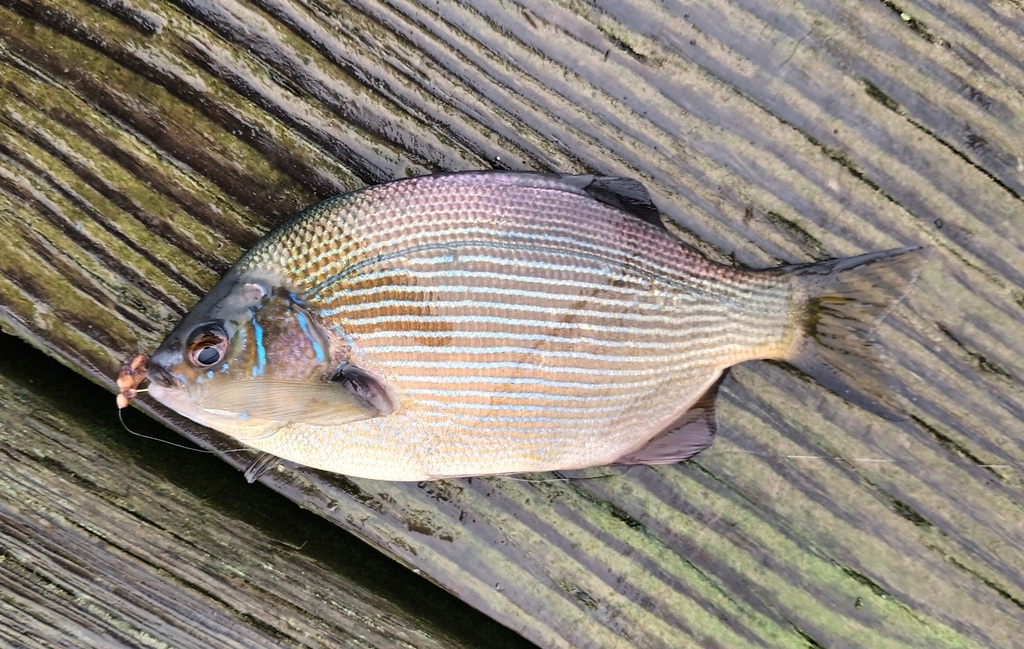
Deep-bodied and compressed, close to oval, adults deep olive to almost black with only a slightly paler belly and dusky fins. The lips are thick, the mouth small and set low. The striped surfperch is the one it gets confused with: that fish has a blue-silver ground, several blue horizontal stripes and copper-red fins, while the black surfperch has no stripes and a much darker overall tone. Against a pile perch it is darker, shows less silver, and has a smaller gape despite the heavy lips. All three mix in pier shadow; in poor light, look for stripes first and silver second. The lip is the last check, and it is the one that names the fish.
A resident of pilings, rock and kelp edge
FishBase runs the range from Fort Bragg in northern California to central Baja California, including Guadalupe Island. It is an inshore resident: adults live mainly on rocky ground near kelp, but also over sand in coastal bays, around piers and pilings, and rarely in the surf. The recorded depth is 0 to 46 m, usually around 6 m. In Southern California the working spots are pier pilings, rubble inside and outside a breakwater, the kelp margin and structure inside a bay. The deeper records come mostly from divers and mean little to a shore angler. A pier with heavy barnacle growth is the closest thing to a sure mark.
Live young, and no published birth month
FishBase states only that the species is viviparous and that the female carries the developing young. It gives no birth month and no monthly spawning table. Local catches improve as the water warms in late spring, stay steady through summer and autumn around piers and rock, and slow in winter as fish move deeper into structure. The species does not roam far, so the fishing depends more on whether a piece of structure has been disturbed than on the month. Birth timing and juvenile habitat are not published, and both are listed as gaps. Winter fish are still catchable, just fewer per piling.
Vertical at the piling, a float along the rock
At a pier or breakwater, fish vertically: drop the bait to the base of the piling, lift twenty centimetres, let it fall, and repeat until fish follow it out of the shadow. On rock, a float set a metre off the bottom lets the swell walk a shrimp along the structure. With lures, a small soft plastic or a tiny iron crawled slowly along the bottom works because the fish defends territory and bites an intruder before it decides. The diet is crustaceans, worms and mussels, so crab and shrimp at structure beat anything fished on clean sand. Keep hooks small; the mouth is the hard limit. If the bait is bigger than the gape, the fish will worry it without ever taking it.
Light gear, fresh hooks, short fights
A 7 foot medium-action spinning rod, a 2500 to 3000 size reel, 15 to 20 lb braid, a 10 to 15 lb fluorocarbon leader, and a size 1 to 2 wide-gap hook or a 1/0 circle. It lives against structure, so keep a rod's length of leader outside the rock edge and stop the main line from rubbing. The lips are thick and the mouth small: set the hook firmly and start with a sharp point. Do not lock the drag, because the first move is a dive into the piling gap. Keep the fish out of the water only as long as a photo needs, and release it head-down. A wet hand matters more than a glove here; the scales are small and lift easily.
Twenty surfperch in total, ten of this one
White, soft flesh on a small frame; gut, bleed and ice it quickly or the weedy taste takes over, then pan-fry it or use it in soup. California lists surfperch separately: 20 fish in total and no more than 10 of any one species (14 CCR § 28.59). San Francisco Bay and San Pablo Bay carry a 5-fish aggregate limit, and shiner perch count separately at 20. The black surfperch has no size limit; surfperch are closed in San Francisco Bay and San Pablo Bay from April 1 to July 31, shiner perch excepted, so Southern California has no closed season. State and federal water can differ, and many Southern California piers and reefs sit inside or beside MPAs, so check the CDFW notice and the MPA map. A licence is required from 16.
FishBase for the biology, the code for the limit
Range, the 0 to 46 m depth band, the 39 cm total length, 700 g, 10 years, the viviparous habit and the habitat description all come from FishBase; family placement follows GBIF's Embiotocidae. The 20-fish aggregate and the 10-fish single-species cap come from 14 CCR § 28.59, which also carries the 5-fish San Francisco Bay exception. Birth month, juvenile habitat and local population trend are missing and listed as gaps. Monthly strength is regional angling experience. The Chinese name follows the master plan.
How to catch it
Jigging
Drop to the base of the piling, lift twenty centimetres, let it fall, and repeat until fish follow the bait out of the shadow.
Float fishing
Set the float a metre off the bottom and let the swell walk a shrimp down the kelp edge at the mouth of a crevice.
Slow pitch jigging
A 2 to 3 inch plastic on a light head, crawled along rubble and weed, paused at structure before starting again.
Where these facts come from
Check these pages before you rely on a size, range or protection status.
- FishBase — Embiotoca jacksoni — FishBase · T2
- GBIF — Embiotoca jacksoni occurrence records — GBIF · T2
- IUCN Red List — Embiotoca jacksoni — IUCN · T1
- Photo record — iNaturalist — iNaturalist · T3
Fish in the same water
These fish live in the same place.
Guides for this water
Technique, gear and safety guides that fit Black surfperch.