
Common stingray
A common stingray is hooked in minutes on a sandy flat and released badly in seconds. The disc is diamond-shaped, the tail is a whip carrying one serrated spine, and the fish has no interest in coming aboard. Everything worth learning about this species happens at the boat: where it lies in wait, how to make a bottom bait sit still, and how to get the hook out without taking a spine to the leg.
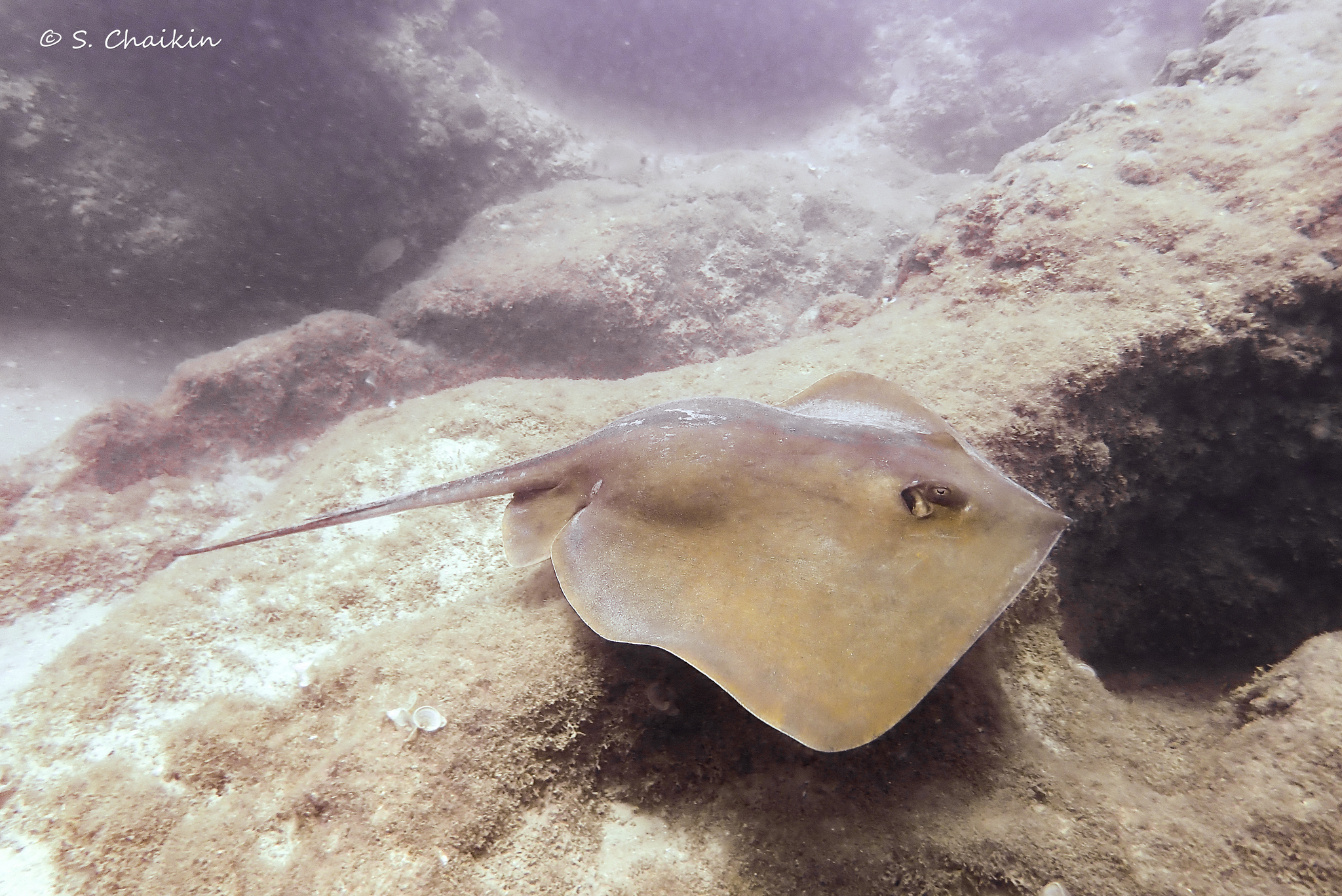
A common stingray is hooked in minutes on a sandy flat and released badly in seconds. The disc is diamond-shaped, the tail is a whip carrying one serrated spine, and the fish has no interest in coming aboard. Everything worth learning about this species happens at the boat: where it lies in wait, how to make a bottom bait sit still, and how to get the hook out without taking a spine to the leg.
A diamond disc and a whip tail with one spine
The tail settles it. It is long, thin and whiplike, with a serrated spine about a third of the way down and fin folds above and below behind the spine. The disc is rhombic with an obtuse angle at the front edge; the back runs grey-green to greenish-brown, the belly whitish with darker pectoral margins. Adults carry a row of thorny tubercles along the midline from the nape to the base of the spine, and young fish do not. Skates of the genus Raja have a thicker tail, two small dorsal fins near the end and no exposed spine. Check the tail first, then the angle of the disc, and you can separate the two without lifting the fish.
Lagoons, estuaries and shallow muddy ground
FishBase runs the range through the eastern Atlantic, the Mediterranean and the Black Sea, from the North Sea to Angola. This is a coastal ray that enters lagoons, shallow bays and estuaries and lies over sand and mud, sometimes near rocky reef, from 5 to 200 m but usually between 20 and 35 m. The water worth fishing is the sandy shelf outside an estuary mouth, the entrance to a lagoon and the inner edge of a shallow bay, where prey is concentrated. By day the fish is buried with only the eyes and spiracles showing, so a bait half a metre off the mark can miss it entirely. The deeper records matter little from shore.
Warm water brings rays into the shallows
FishBase gives a gestation of about four months and four to seven young, but no month-by-month spawning table. Chinese Wikipedia summarises studies that place spawning in May to September or in July and August, and notes adults gathering around the Balearics from mid-June to mid-July, possibly to breed. The fishing pattern is simpler: warm spring water pushes rays into shallow ground and lagoons, dawn, dusk and night produce the best bites, autumn still works, and winter sends fish deeper and shore sport goes quiet. No source here names a feeding temperature, so work from water colour and bait movement rather than a number.
Still bottom baits on sand and mud
From shore, a heavy running lead with a whole sardine or a strip of squid, set on the bottom so the scent works along a current line, is the standard approach; at a lagoon mouth, place the bait on the edge of the flow rather than in the middle. From a boat, cast and then leave the bait alone, because a ray hunts by electroreception and a bait that keeps moving gets ignored. Night fishing with a large fish bait is the way to meet the bigger animals. The diet is bottom fish, crustaceans and molluscs, so scent and size matter more than colour. Expose the hook point, but do not bind the bait into a hard lump, or it will not turn into a hook-up.
Heavy leader and a plan for the tail
The usual outfit is an 8 to 9 ft medium-heavy shore rod or a 7 ft boat rod, a 6000 to 8000 spinning reel, 30 to 40 lb braid and a 60 to 80 lb fluorocarbon or nylon leader that deals with both the tail and sand abrasion. Use a 4/0 to 6/0 wide-gap single or circle hook, and choose the lead by current, with a flat shape that does not roll on sand. Do not lock the drag: a ray uses the whole disc against the water and a hard pull tears hooks out. Long pliers keep hands away from the spine. If the fish must come aboard, two people work together, one controlling the tail base while the other frees the hook, and the spine stays pointed away from everyone.
Good eating, Vulnerable, and no special size rule
The flesh is white and wet; bleed it, ice it, and skin and cartilage it before cooking, because the fishy note sits in the surface slime and rinsing matters more than seasoning. Livers and “wings” are eaten in some places, but no contamination data were available here for large individuals. On the rules: at EU level, Regulation (EU) 2019/1241 Annex IX Part A lists no minimum size for any stingray, and those MCRS do not bind recreational anglers automatically, since Article 2(2) extends only Articles 7, 10, 11 and 12 to recreational fishing; Regulation (EC) 1967/2006 Article 17 forbids selling the catch. Spain requires a regional licence for shore and boat fishing under RD 347/2011, and its Mediterranean table in RD 560/1995 Annex II has no ray entry. France needs no permit but requires RecFishing registration from age 16, and the 2012 Mediterranean arrêté lists no rays. Italy requires the annual MASAF communication, Greece has no recreational licence and a 5 kg daily limit, Croatia requires a licence with a 5 kg limit plus one heavier fish. Turkey's 2024/21 size table was not retrieved, so no Turkish figure is given. Nature-conservation law for rays in individual countries was not verified. The species is assessed Vulnerable, so release it. Check the current year's official notices before you go.
What FishBase fixes and what remains open
The 75 cm disc width, the 14.6 kg maximum weight, the 5 to 200 m depth band and the Vulnerable assessment of 2020 all come from FishBase, as does the habitat description. The same FishBase biology text mentions a reported width of about 150 cm, which conflicts with the max_length field; this entry follows the field and logs the discrepancy. The Balearic gathering dates come from a Chinese Wikipedia summary, not the original paper. Regulations are limited to retrieved texts, and no number is filled in for a country that was not checked.
How to catch it
Bottom fishing
Fished with the listed approach, matched to the recorded depth and size.
Night fishing
Fished with the listed approach, matched to the recorded depth and size.
Where these facts come from
Check these pages before you rely on a size, range or protection status.
- FishBase — Dasyatis pastinaca — FishBase · T2
- GBIF — Dasyatis pastinaca occurrence records — GBIF · T2
- IUCN Red List — Dasyatis pastinaca — IUCN · T1
- Photo record — iNaturalist — iNaturalist · T3
Fish in the same water
These fish live in the same place.

Southern stingray
- Family
- Dasyatidae
- Depth
- 0–53 m

Acoupa weakfish
- Family
- Sciaenidae
- Depth
- 1–20 m
- Season
- Jan, Feb, Mar, Apr, May, Jun, Jul, Aug, Sep, Oct, Nov, Dec

American angler
- Family
- Lophiidae
- Depth
- 0–800 m
- Season
- Mar, Apr, May, Jun
Guides for this water
Technique, gear and safety guides that fit Common stingray.