
Southern stingray
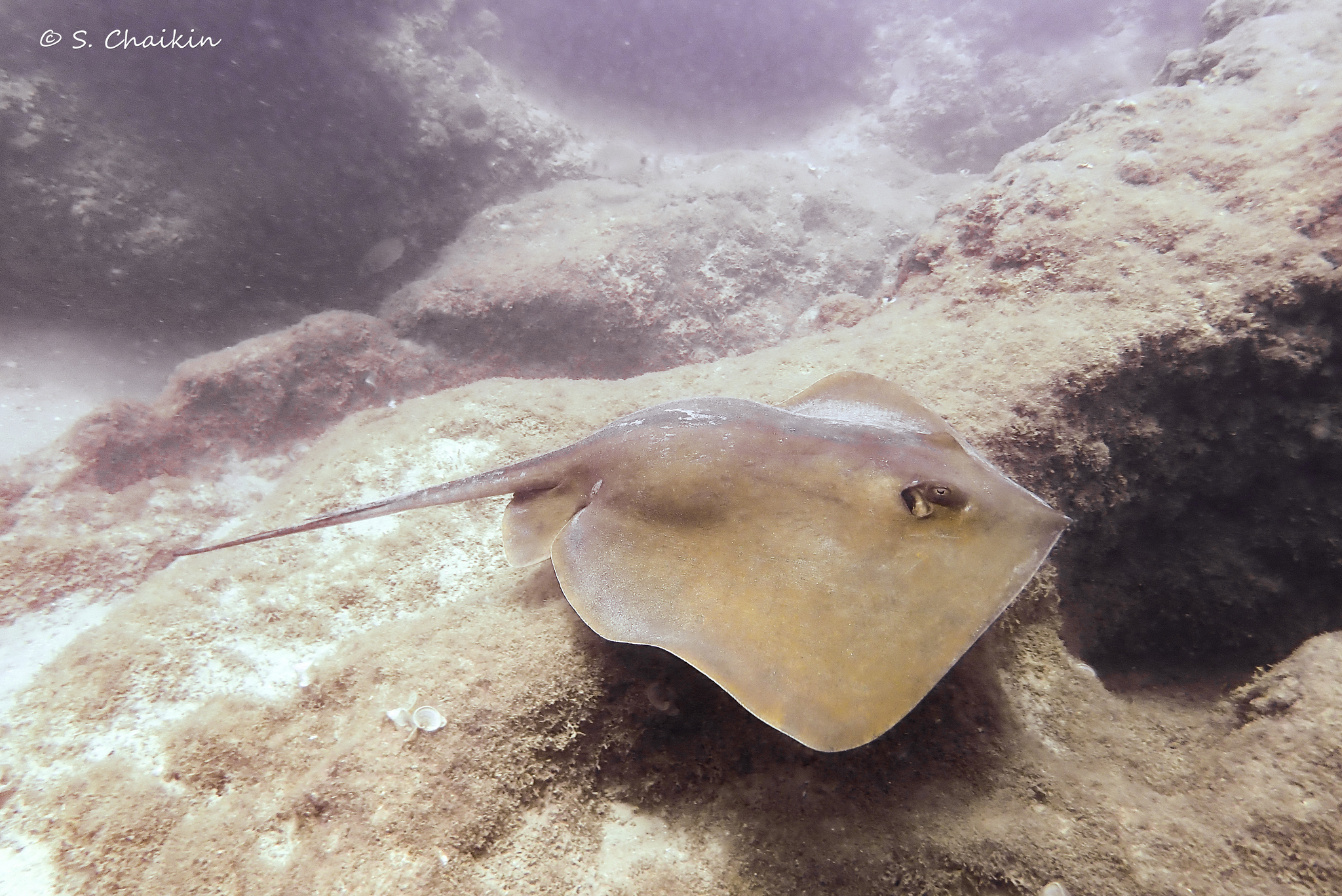
Southern stingray is a big western Atlantic ray, found from New Jersey and the northern Gulf of Mexico down to southern Brazil and through the Antilles. It works shallow ground in 0 to 53 m of subtropical water on a diet of fish, molluscs and worms. The disc can reach 200 cm and 135.6 kg, though most fish run about half that, and a maximum age of 28 years marks it as slow-growing.

Southern stingray (Hypanus americanus) is a fish of the family Dasyatidae. FishBase gives its range as: Western Atlantic: New Jersey, USA and northern Gulf of Mexico to southern Brazil, including the Antilles. A southern stingray is measured across the disc, not from snout to tail tip. It is recorded from 0 to 53 m, in subtropical water. The recorded maxima are 200 cm, 135.6 kg, 28 years. Diet includes fishes, molluscs and worms. IUCN status: Near Threatened (NT). Chinese name: .
Identification
A southern stingray is measured across the disc, not from snout to tail tip. The record gives a maximum of 200 cm WD, a common length of 90 cm WD and a maximum published weight of 135.6 kg. The 200 cm animal is the rare one, and the weight belongs to it. Maximum reported age is 28 years.
The maturity entry is a single figure with an interval printed beside it that does not contain it, so it cannot be used as a release line. Measure the disc across instead. The tail carries a serrated barb, and the record classes the species as traumatogenic, which matters more than size once the fish is aboard.
The English handles change from island to island, from kit in Cuba to whip stingray in the Antilles. None of them will find the right paragraph in a regulation, so quote Hypanus americanus when you check a rule.
Habitat and distribution
The environment tags put it in both marine and brackish water, on reef, from 0 to 53 m, with the usual band running only to 4 m. The shallow half is the useful half: this is a ray of the top few metres, not of the shelf slope. Its habitat keywords run reef, sand, estuary and seagrass, which is one continuous edge from a river mouth out to the reef flat, not four separate places.
That edge is where the fishing happens. At the brackish end the ray lies over sand and mud in water barely deeper than a boat draws; at the reef end it works the sand ribbons between coral heads. The written range runs from New Jersey and the northern Gulf of Mexico to southern Brazil, including the Antilles. GBIF's distribution rows name Brazil, Mexico, Sint Maarten and Venezuela, plus a global IUCN row. OBIS returns 4,794 records for the taxon across that range, and iNaturalist holds 5,027 observations in the same coastal belt, so the western Atlantic picture is well documented from the Caribbean south.
Season and fishing approach
Tide, not the calendar, sets the window. On a flooding tide the ray pushes onto the flats and into the lower estuary; at low water it drops back into the channel. Fish the last two hours of the flood at the mouth, then the first of the ebb over sand beside seagrass. Crab or a strip of fish on a circle hook, a heavy leader for the tail, and a sand spike for the rod cover most situations.
The diet keywords are fishes, molluscs and worms. That is a bottom-feeding animal: keep the bait down and move it slowly rather than lifting it through the water. Do not anchor in the channel. In two metres of water the ray's approach shows as a push on the surface, so cast ahead of it instead of on top of it.
Edibility and regulations
FishBase lists it as both a commercial and a gamefish species. The Red List assessment is Near Threatened, dated 21 June 2019. That category is an assessment of the population, not a landing rule; what decides whether a ray may be kept is the recreational fishing regulation of the state or country whose water you are in.
The barb is the rule that travels with the fish. Bring a hooked ray alongside, cut the hook or back it out with long pliers, and keep the tail away from hands and from the deck. A ray released at the boat with its barb intact is the practical outcome to aim for, whatever the local size and bag numbers say.
Where these facts come from
Check these pages before you rely on a size, range or protection status.
- FishBase — Hypanus americanus — FishBase · T2
- GBIF — Hypanus americanus occurrence records — GBIF · T2
- IUCN Red List — Hypanus americanus — IUCN · T1
- Photo record — iNaturalist — iNaturalist · T3
Fish in the same water
These fish live in the same place.

Guides for this water
Technique, gear and safety guides that fit Southern stingray.