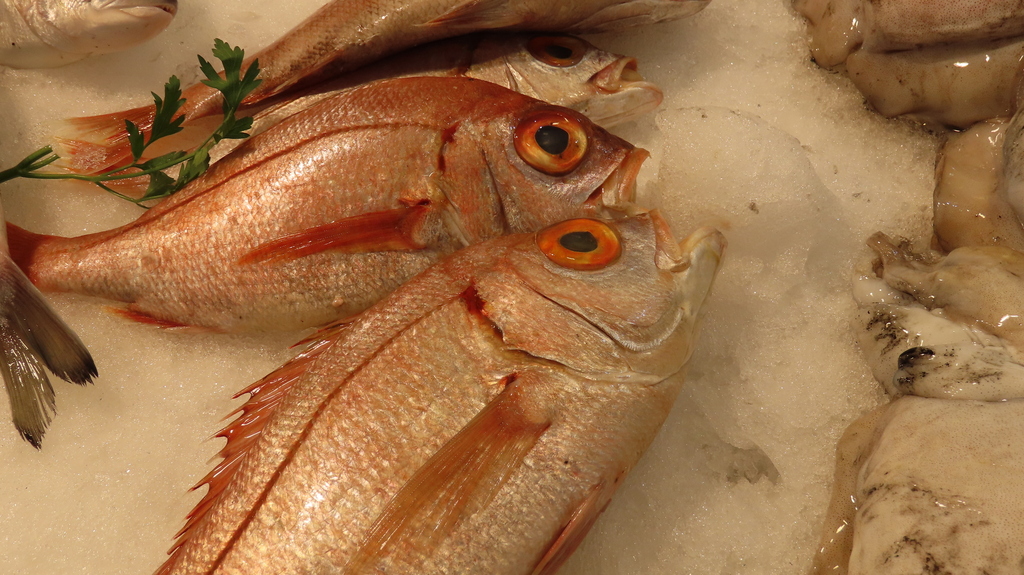
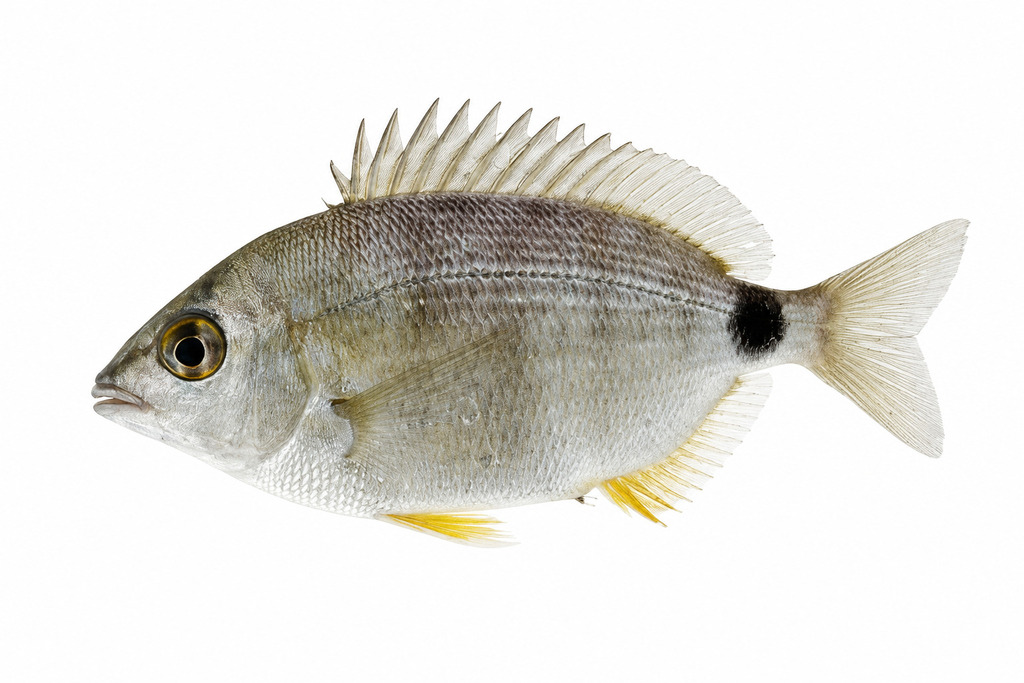
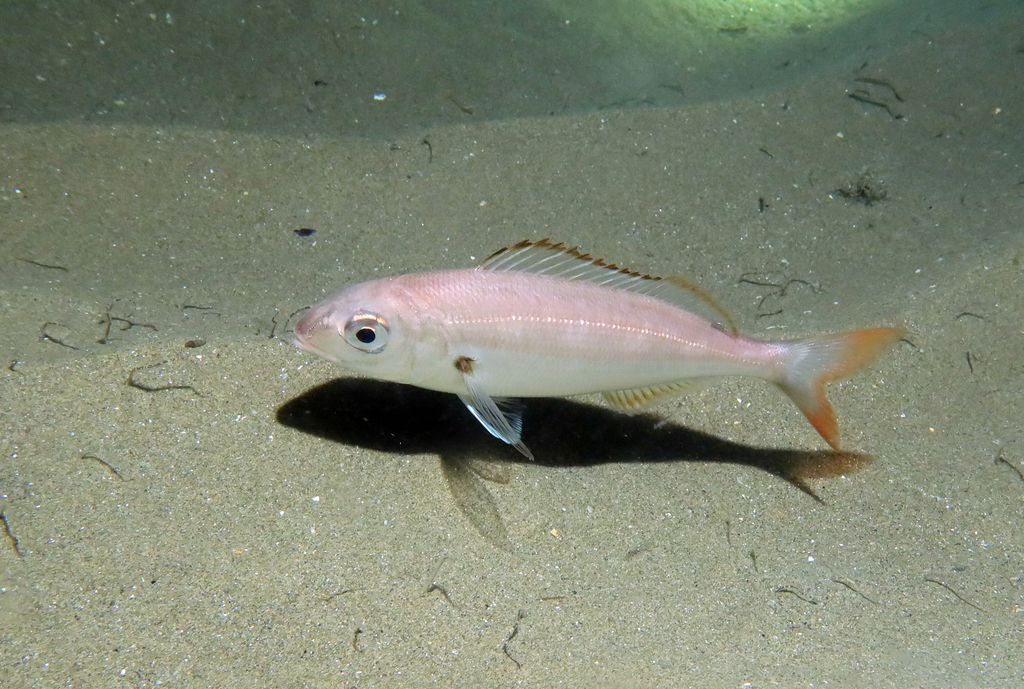
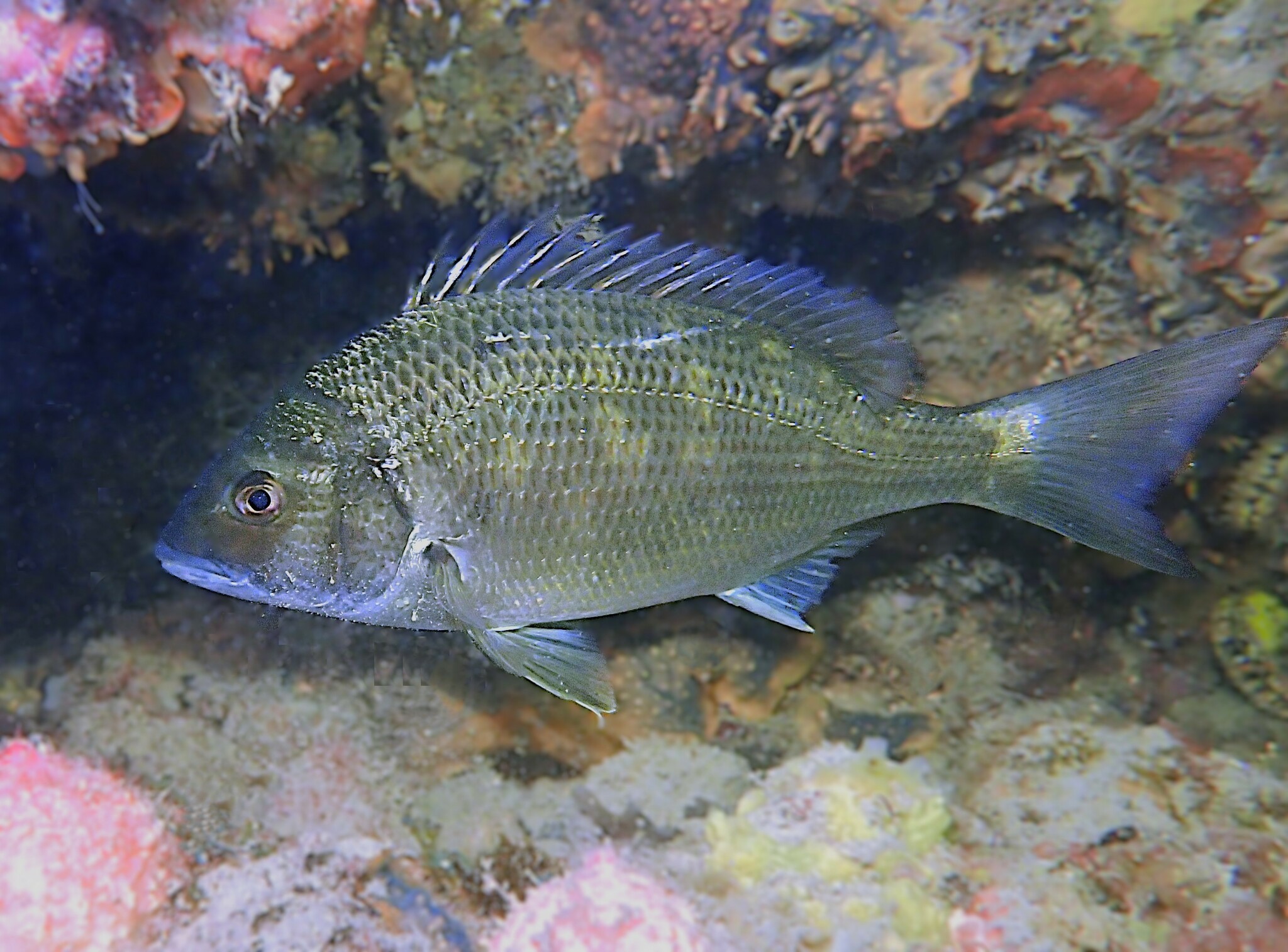
The large-eyed dentex is a deep-water red fish that sits on the bottom by day and lifts at night, so the fishing is about finding the right depth and putting a bait in that layer. It is also the fish most often misnamed at the boat: a red body invites the name Dentex dentex, and the Croatian 30 cm rule belongs to that other species.
A red deep-water fish with an oversized eye
Read the eye against the colour. The eye is large in proportion to the head, the body and fins are red, the anal fin and the lower lobe of the tail carry a white edge, and there are no bars along the flank. Against Dentex dentex, the eye is proportionally smaller on that species, the body can grow much larger and the tail shape differs; here the red is more even and the white edging concentrates on the anal fin and lower tail lobe. Lay the fish flat and compare eye diameter with head length, which survives the dulling that pressure gives a deep-caught fish. The 11 to 12 dorsal spines, 10 to 11 soft rays and 3 plus 8 anal fin are the counts to check against a guide.
Rock and sand from 30 to 500 metres
FishBase gives an eastern Atlantic range from Portugal and the Strait of Gibraltar to Namibia, including Cape Verde and the Canary Islands, plus the Mediterranean. The species lives over rock and sand from 30 to 500 m, and the text notes that individuals descend with growth, so adults sit deeper. Stocks migrate seasonally between the coast and deeper water according to local hydrography and life cycle, which explains why the same mark fishes well in one part of the year and poorly in another. For an angler, 30 m is near the limit of shore and shallow boat work; the reliable fishing is on deeper slope and sand edge, which is deep-boat territory.
Seasonal movements, without a published calendar
FishBase calls the species oceanodromous and describes seasonal movement between coast and depth driven by hydrographic conditions, but gives no monthly spawning table and no direction for the shift. The usable pattern: as water warms in spring the fish favour the shallower end of the slope, and deep-boat catches concentrate there; in autumn they withdraw deeper; in winter they work deep water and success depends on reaching that layer. Light also matters, because the fish sits on the bottom by day and lifts at night, so the layer at night and at dawn differs from the layer at noon.
Heavy lead, slow sink, deep water
Deep bottom fishing is the main method: hold the boat over a slope or a sand edge and send a heavy lead down 80 to 200 m or more, letting it settle and waiting for a fish to rise off the structure. A second method is drifting, letting the boat move with the current while the bait hangs a few metres off the bottom and covers a wider strip. The third is slow-pitch jigging on a steep slope, lifting and dropping along the bottom so the fall triggers the take. All three start with confirming depth and ground: long leaders and heavy leads over sand, shorter leaders and a fast lift over rock, or the rig snags and breaks. The fish eats fish and crustaceans, with plankton for the young, so a larger bait is no disadvantage.
Boat gear built for a hundred metres and more
A 1.8 to 2.1 m boat rod rated 150 to 300 g, a conventional or electric reel, 1.5 to 2.5 braid, a 25 to 40 lb fluorocarbon leader and a 3/0 to 5/0 heavy-wire single. The lead has to be heavy enough that you feel the bottom; otherwise the whole fishing depth is guesswork. Fish hauled from deep water often arrive with a swollen swim bladder and bulging eyes, and release needs decompression; no release-survival data exists for this species. If the fish is not for the table, fish shallower or send it back with a decompression release rather than dropping a bloated fish over the side.
No EU size, no Spanish Mediterranean size, no Croatian match
The flesh is firm and white, good fried, grilled or in soup; a deep-caught fish needs bleeding and icing quickly or the texture softens. Large fish are better skinned and trimmed of belly fat. No size rule does not mean no rules, and the sale ban and gear restrictions still apply. EU: Regulation (EU) 2019/1241 Annex IX Part A sets no size for Dentex, Article 2(2) does not extend Annex IX sizes to recreational fishing, and Article 17 of Regulation (EC) 1967/2006 bans selling recreational catch. Spain: an autonomous-community licence is required from shore and from a boat (RD 347/2011), and RD 560/1995 Annex II for the Mediterranean has no entry; the 22 cm figure in the Canary Islands annex does not apply in the Mediterranean. France: no licence, RecFishing registration from 16, no entry in the 2012 Mediterranean order. Italy: annual MASAF declaration, with electronic catch registration from 2026. Greece: no licence, 5 kg per person per day, 10 kg with longlines, May spearfishing ban. Croatia: licence required, 5 kg bag, and the 30 cm entry in the national table is Dentex dentex, a different species, so it cannot be applied here. Check the current year's notices.
Sources and open questions
The 65 cm maximum, the 30 cm common length, the 30 to 500 m band, the eastern Atlantic and Mediterranean range, the descent with growth, the seasonal coast-to-depth movement, the fish and crustacean diet and the IUCN Least Concern assessment of 2009 come from FishBase. The reach of the Canary Islands 22 cm figure comes from the annex structure of RD 560/1995, and the Croatian 30 cm figure from the national table. The depth and lead weights in the fishing sections are deep-boat practice, not survey values. Spawning months and the direction of the seasonal shift are not stated in FishBase.
How to catch it
Boat bottom fishing
Fished with the listed approach, matched to the recorded depth and size.
Jigging
Fished with the listed approach, matched to the recorded depth and size.
Regulations before you keep it
These are the published regulations for this fish. Read the number first. The notice below it is the actual regulation.
Minimum size1
≥22 cm
Spain — Canary Islands · ES-CN
The minimum size for Large-eyed dentex in the Canary Islands is ≥22 cm.
| Cachucho (Dentex macrophtalmus) | Antoñito, dientón | 22 |
Every record above names its source and the date it was retrieved. See the regulation register for the full list, or how to read these regulations.
Where these facts come from
Check these pages before you rely on a size, range or protection status.
-
FishBase — Dentex macrophthalmus
— FishBase · T2
-
GBIF — Dentex macrophthalmus occurrence records
— GBIF · T2
-
IUCN Red List — Dentex macrophthalmus
— IUCN · T1
-
Photo record — iNaturalist
— iNaturalist · T3