
Galjoen
Galjoen is the national fish of South Africa, running from southern Angola to Natal. It is not a kob, a seabream or a sparid but the sole member of its own family, Dichistiidae. It reaches 80 cm TL and 6.5 kg and matures at 34 cm. It has never been assessed by IUCN. Shore fishing, rock fishing and boat bottom fishing are the methods listed, and the depth given is simply 10 m or deeper.

FishBase gives *Dichistius capensis* 80 cm TL maximum, 6.5 kg published weight and first maturity at 34.0 cm, with no common length listed. It runs from southern Angola to Natal in South Africa, it is the national fish of South Africa, and it has never been assessed by the IUCN. It is not a kob, not a seabream and not a sparid: it sits in its own family, Dichistiidae.
Identification
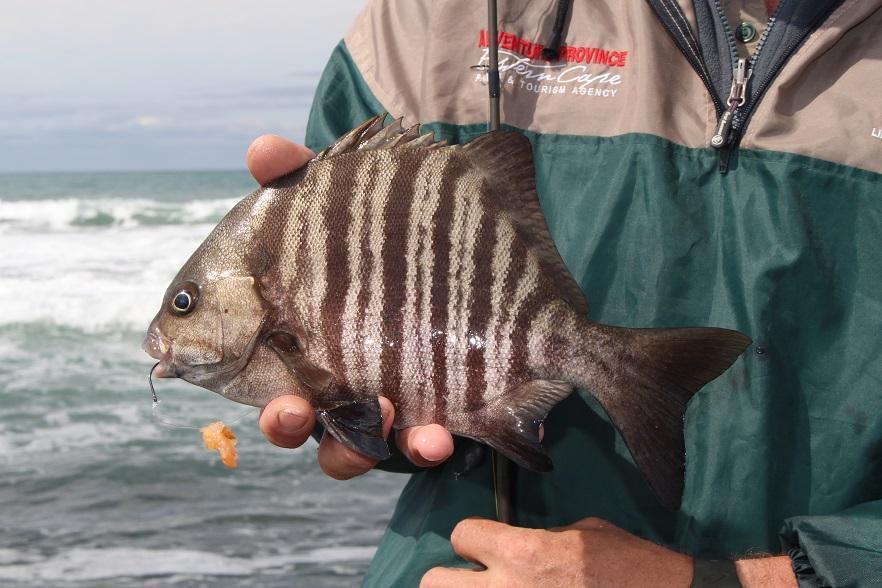
Ten dorsal spines, 18–19 dorsal soft rays, 3 anal spines and 13–14 anal soft rays, on a body the source calls short and deep. The colour behaviour is the memorable part: it changes from black to silver almost instantly to blend with its environment, and is occasionally mottled or marked with 7–9 crossbars. A fish that goes black in the bag and silver on the reef is one that photographs differently in two hands.
The family name is the identification fact worth keeping. Dichistiidae is a family of its own, and the genus name comes from Greek dichao, dichasis, divided in two parts. That matters because galjoen is routinely lumped into conversations about bream and kob; neither label is taxonomically right, and neither rule set is written for it.
FishBase also carries black bream and blackfish as English alternatives, and gives and in Chinese.
Range and habitat
Southeast Atlantic to southwestern Indian Ocean: southern Angola to Natal. GBIF holds 500 present records — 374 South African, 93 Namibian, 5 Mozambican, 1 Angolan, 1 Madagascan and 1 without country — and iNaturalist holds 156 observations. This is the best-photographed fish in this group, which fits a national fish that lives on the shore.
The environment line is marine, reef-associated, subtropical, 12°S–36°S and 10°E–34°E, with a depth range of 10 m to an unspecified maximum. An open-ended depth is a real limit on what can be said about deep water: the source commits to 10 m at the shallow end and to nothing at the other.
Habits and diet
The recorded diet is molluscs, crustaceans and other invertebrates. That is a bottom-and-structure diet, and it is the only feeding information on the page: no prey species, no feeding time, no seasonal shift.
The habitat sentence puts the fish on inshore reefs and in rocky and sandy areas, which matches the invertebrate list — reef and rock-sand edge are where a shellfish-and-crustacean feeder works. Two further lines matter: it is abundant in winter, and breeding occurs in deeper water. The first is an abundance statement, not a catch statement; the second places spawning away from the shallow reef the adults otherwise use.
The page also states that the species is becoming scarce because of overfishing, a sentence that sits oddly beside an IUCN entry of Not Evaluated.
Season and time of day
The spawning table gives January, February and March plus October, November and December, recorded separately for Angola, Namibia and South Africa with no locality finer than the country. The same six months appear three times, which is a country-level record rather than three independent findings.
The other seasonal facts are an abundance peak in winter and spawning in deeper water. No time of day is recorded.
The South African closed season runs from 15 October to the last day of February. That covers four and a half months of the six recorded spawning months and leaves March open. The overlap is a fact about two documents, not a claim that the closure was designed around this table.
Tackle and techniques
A 10 m shallow end plus reef association puts adults within reach of shore and shallow boat work; the unspecified deep end means the source will not support a statement about maximum fishing depth. The invertebrate diet points at bottom presentation over reef and rock-sand edge, which is inference from diet and habitat rather than a recorded method.
The sizes are moderate: 34.0 cm Lm, 80 cm maximum, 6.5 kg published maximum, and no common length. With no common length, the size of an average fish is not recorded, and a plan built on 80 cm would be built on the record end.
Bait, line class and rig are absent from the page.
Kitchen and handling
FishBase lists commercial and gamefish use but gives no culinary description: no flesh note, no fat content, no market form, no price. For a national fish that is a striking omission, and it is not filled here.
Handling therefore has one sourced anchor, the colour change, and one assumption that should not be made: that a well-known fish must be described as good eating. The source does not say it.
Regulations and conservation
South Africa sets galjoen at 2 fish per person per day with a 35 cm minimum, inside a closed season from 15 October to the last day of February. A recreational permit is required, the catch is for own use and may not be sold, and the general bag is 10 fish where no species rule applies.
Namibia sets galjoen at 30 cm within the combined bag of 10 fish per day across blacktail, galjoen, kob and West Coast steenbras; a permit is required.
Set the minimums against the maturity figure. The 34.0 cm Lm sits one centimetre below the South African 35 cm, so that rule falls just above the point where the fish breeds. The Namibian 30 cm sits four centimetres below it, which means a legal Namibian galjoen can be immature. Both statements are arithmetic across two sources.
The conservation position is the contradiction worth reporting. The IUCN entry is Not Evaluated, while the same page says the species is becoming scarce because of overfishing. No assessment and a scarcity statement can coexist, but a reader should not take the absence of a category as evidence of health.
How to catch it
Shore fishing
Fished with the listed approach, matched to the recorded depth and size.
Rock fishing
Fished with the listed approach, matched to the recorded depth and size.
Boat bottom fishing
Fished with the listed approach, matched to the recorded depth and size.
Where these facts come from
Check these pages before you rely on a size, range or protection status.
- FishBase — Dichistius capensis — FishBase · T2
- GBIF — Dichistius capensis occurrence records — GBIF · T2
- IUCN Red List — Dichistius capensis — IUCN · T1
- Photo record — iNaturalist — iNaturalist · T3
Fish in the same water
These fish live in the same place.

Guides for this water
Technique, gear and safety guides that fit Galjoen.