
Banded galjoen
Banded galjoen is a dichistiid recorded from Transkei in South Africa to Madagascar and as far south as Still Bay. It has 10 dorsal spines and 21 to 23 soft rays, lives in coastal waters and rivers, and feeds on molluscs and crustaceans. It reaches 35 cm TL with a common length of 20 cm and 1.7 kg, and its flesh is of excellent quality. Surf fishing, light spinning and estuary mouths are the methods listed.
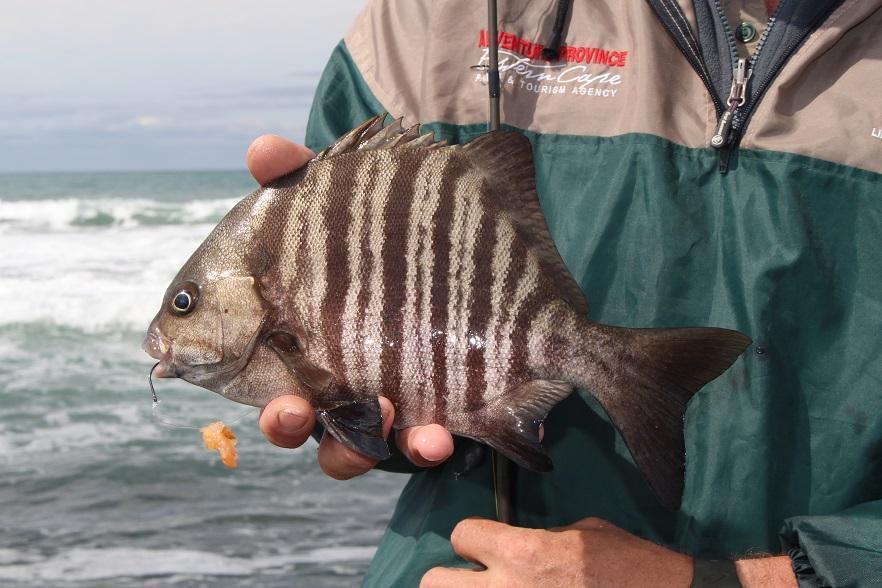
Dichistius multifasciatus is a dichistiid recorded from Transkei in South Africa to Madagascar, and as far south as Still Bay. FishBase gives 35 cm total length, a common length of 20 cm and 1.7 kg. It has 10 dorsal spines and 21 to 23 soft rays, lives in coastal waters and rivers, and feeds on molluscs and crustaceans. The flesh is of excellent quality, and the species is not evaluated by IUCN.
Identification
A short, deep-bodied fish with 10 dorsal spines and 21 to 23 soft rays, and three anal spines with 13 to 14 soft rays. The body is compressed and the head is small relative to the depth.
The colour is silvery olive to grey-brown, with a series of dark vertical bands along the flank. The bands are the field mark and give the species its common name.
FishBase gives 35 cm total length, a common length of 20 cm and 1.7 kg. It is much smaller than the galjoen proper, Dichistius capensis, and the banded pattern separates the two at a glance.
Distribution and Habitat
Western Indian Ocean: Transkei in South Africa to Madagascar, with records as far south as Still Bay, west of Mossel Bay. The South African east coast is the centre of the range.
It is found in coastal waters and rivers, over rocky shore and surf zones, from the surface down to about 30 m. FishBase records both marine and estuarine occurrences.
That shallow, surf-zone habit makes it a shore angler's fish. It is rarely a boat target and is usually taken on light tackle from the rocks or the beach.
Habits and Diet
FishBase records a diet of molluscs and crustaceans. It is a small bottom feeder that works rock and sand edges in the wash.
The flesh is of excellent quality, which is unusual for a fish of this size and is the main reason it is kept rather than released.
IUCN has not evaluated the species, so there is no global status to cite. South African recreational regulations are the only management layer.
Fishing Methods and Gear
Light surf tackle: a 9 to 10 ft rod, a 3000 to 4000 size reel, 15 to 20 lb braid and a 20 to 25 lb leader. A small running sinker and a size 2 to 1/0 hook are enough.
Sandworm, prawn, crab or mussel all work. Cast into the wash and let the surge move the bait rather than retrieving it constantly.
Small soft plastics and 20 to 30 g jigs take fish in clear water. Keep the lure close to the rocks and retrieve slowly.
Seasonal Window
FishBase does not provide monthly spawning data. The fish is present year-round, with warm months and moving water producing the most consistent fishing.
The best window within a day is the rising tide, from half-flood to high, and the first of the ebb. This is when the wash is oxygenated and bait is moving.
Dawn and late afternoon are the most comfortable times on exposed rocks. Night fishing works but the rocky ground demands care.
Edibility and Handling
Excellent quality flesh, firm and sweet, good for frying, grilling or soup. It is one of the better-eating small shore fish in the region.
Bleed and ice promptly. The fish is small, so it cools quickly, but it also dries out quickly in a dry box.
Handle with wet hands and return undersized fish at once. There is no minimum size in South Africa, so the decision to keep a fish is entirely the angler's.
Regulations and Conservation
South Africa: banded galjoen (Dichistius multifasciatus) has no minimum size and a bag limit of five per person per day under the recreational linefish regulations. A recreational permit is required, and boat-based fishing needs a vessel licence.
There is no species-specific closed season. The absence of a size limit puts the burden on anglers to release small fish voluntarily.
IUCN: Not Evaluated. The species is not currently considered threatened, but it is a small, shallow-water fish with limited management beyond the bag limit.
How to catch it
Surf fishing
Light spinning
20–30
Estuary mouth
Where these facts come from
Check these pages before you rely on a size, range or protection status.
- GBIF — Dichistius multifasciatus occurrence records — GBIF · T2
- IUCN Red List — Dichistius multifasciatus — IUCN · T1
- Photo record — iNaturalist — iNaturalist · T3
Fish in the same water
These fish live in the same place.


Guides for this water
Technique, gear and safety guides that fit Banded galjoen.