
Senegal seabream
The Senegal seabream is a small sparid of the eastern Atlantic and the southwestern Mediterranean. FishBase records it from the Cape Verde Islands north to Cadiz in Spain, with a separate Mediterranean range from Malaga to Gibraltar, and gives a maximum length of 30 cm SL, a common length of 15 cm SL and a length at first maturity of 11.4 cm.
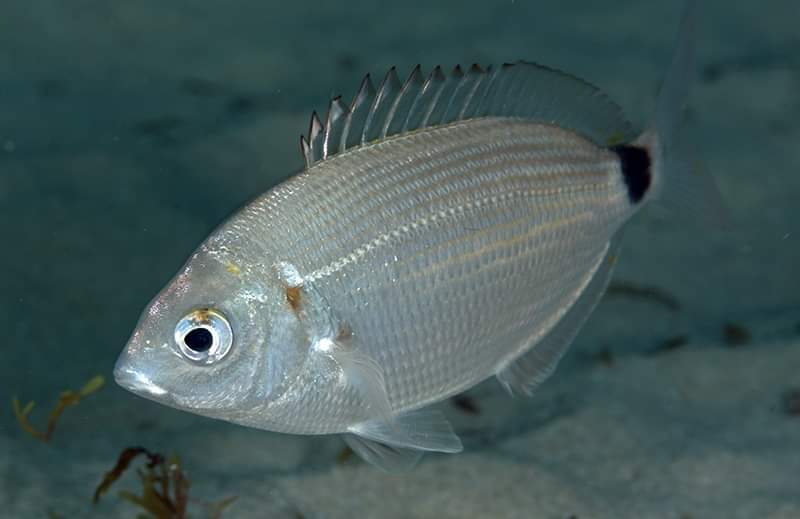
The Senegal seabream is a small sparid of the eastern Atlantic and the southwestern Mediterranean. FishBase records it from the Cape Verde Islands north to Cadiz in Spain, with a separate Mediterranean range from Malaga to Gibraltar, and gives a maximum length of 30 cm SL, a common length of 15 cm SL and a length at first maturity of 11.4 cm. It is benthopelagic on the upper continental shelf, recorded from the surface down to 100 m but usually at 30–50 m, and it is gregarious. It is commercial and an important food fish in its range.
Identification
Diplodus bellottii has 10–11 dorsal spines followed by 13–15 soft rays, and 3 anal spines followed by 13–15 soft rays; the body is fusiform and compressed side to side. As in the genus, the dorsal fin is single and runs most of the back, with the spiny section in front, and the caudal fin is forked. Sparids carry stout incisor-like teeth at the front of the jaws, backed by smaller teeth, which separates a seabream from a bass or another family's bream.
Colour and barring are hard to describe in writing. Several Diplodus species share the same coastline, and their patterns change with age and mood. FishBase gives the fin counts and body shape but no full colour diagnosis, so compare the fish with photographs and a regional key rather than a single band or spot.
Habitat and behaviour
The species lives on the upper part of the continental shelf, from the coastline to 100 m and especially between 30 and 50 m, over various types of bottom. It is gregarious and sometimes gathers in sizeable aggregations, which is why a boat that finds one school can often stay on it. The diet is small benthic molluscs and crustaceans, taken close to the bottom rather than in midwater.
Small size, schooling and a bottom-based diet make it a light-tackle target, usually over ground holding small shellfish and crustaceans rather than clean sand.
Seasonal window
FishBase's spawning table gives January to June off the Algarve in Portugal, and April to June for the eastern Atlantic as a whole; the combined record runs from January to June. Those are spawning records, not a promise of fish. They suggest a reproductive season in the cooler half of the year, while the warm months are when fish are most active and accessible.
In practice, late spring into autumn is the time to look for aggregations over shallow and mid-depth ground. Dawn and dusk usually beat the middle of the day, and moving water beats slack: a tide pushing bait over a reef edge or a gravel patch holds fish there longer than flat calm. In colder weather, expect fish deeper and tight to the bottom.
Gear and approach
A 2.4–3.0 m light rod, a 2500–4000 size reel, 10–15 lb braid and a 15–20 lb fluorocarbon leader is enough for a fish that rarely passes 30 cm. Use 1–2 oz of lead on a running ledger or small paternoster, and hooks from size 6 to 1/0 depending on bait size. Small hooks matter: the mouth is small and the bait is small.
Bait can be ragworm or lugworm, a strip of squid, a small prawn or mussel flesh. From rocks, a float rig with the bait just above the weed beats a bottom rig because it keeps the hook out of the snags. Small soft plastics and tiny jigs also take fish when they are grouped and feeding up in the water. A little groundbait — crushed shellfish, bread and fish oil — holds a school within range, if the pieces are small.
Play it gently; the mouth is soft and the hooks are small. Land it quickly, wet your hands if releasing, and put the small ones back so the school stays.
Edibility and regulations
FishBase records the species as a commercial catch and describes it as an important food fish. The flesh is white and mild, good fried, grilled or in soup; clean and chill promptly.
The IUCN Red List category is LC (Least Concern), assessed on 30 March 2011. No CITES or CMS listing is recorded and the species is harmless to humans.
Rules differ by jurisdiction. In EU waters there is no minimum conservation reference size listed for Diplodus bellottii, no EU-wide closed season verified and no EU-wide recreational bag limit verified. Spain and Portugal set recreational size and bag rules nationally or regionally — Spain through the autonomous communities, Portugal through the DGRM — and no species-specific minimum was verified for this sparid, so check the current rule for the coast where you land fish.
Where to look
GBIF holds 1,484 occurrence records, led by Spain (424), Mauritania (376), Portugal (165) and Western Sahara (126), followed by Senegal (44), Morocco (19) and Gambia (6). FishBase's distribution runs from the Cape Verde Islands north to Cadiz, with the Mediterranean range from Malaga to Gibraltar, and the habitat keyword is continental shelf.
Those counts follow survey and fleet coverage as much as the fish. Look for mixed bottom on the 30–50 m band, reef edges and gravel patches off Iberia and northwest Africa, and treat the Mediterranean part of the range as narrow and localised.
How to catch it
Boat bottom fishing
Fished with the listed approach, matched to the recorded depth and size.
Shore casting
Fished with the listed approach, matched to the recorded depth and size.
Rock fishing
Fished with the listed approach, matched to the recorded depth and size.
Where these facts come from
Check these pages before you rely on a size, range or protection status.
- FishBase — Diplodus bellottii — FishBase · T2
- GBIF — Diplodus bellottii occurrence records — GBIF · T2
- IUCN Red List — Diplodus bellottii — IUCN · T1
- Photo record — iNaturalist — iNaturalist · T3
Fish in the same water
These fish live in the same place.
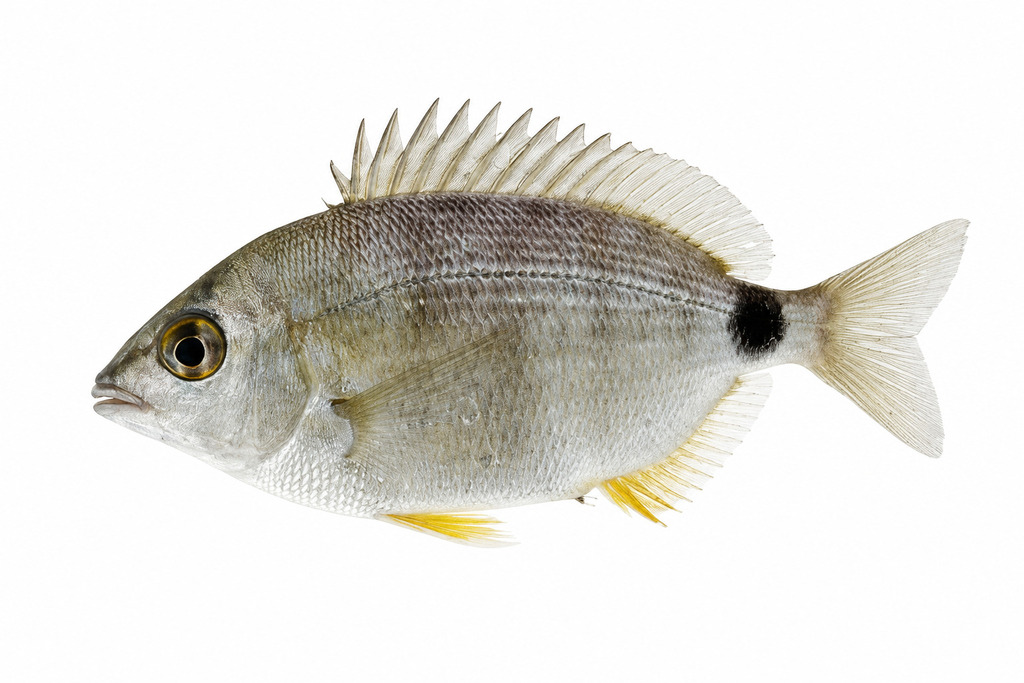
Annular seabream
- Family
- Sparidae
- Depth
- 0–90 m
- Season
- Jan, Feb, Mar, Apr, May, Jun, Jul, Aug, Sep
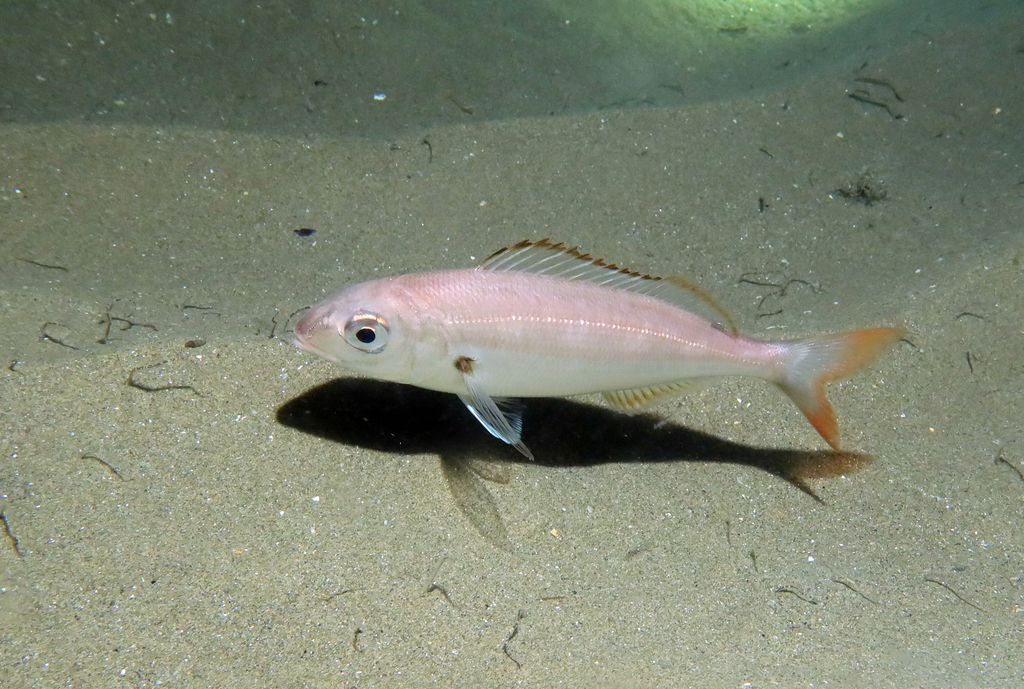
Axillary seabream
- Family
- Sparidae
- Depth
- 0–500 m
- Season
- Jan, Feb, Mar, Apr, May, Jun, Jul, Aug, Sep, Oct, Nov, Dec
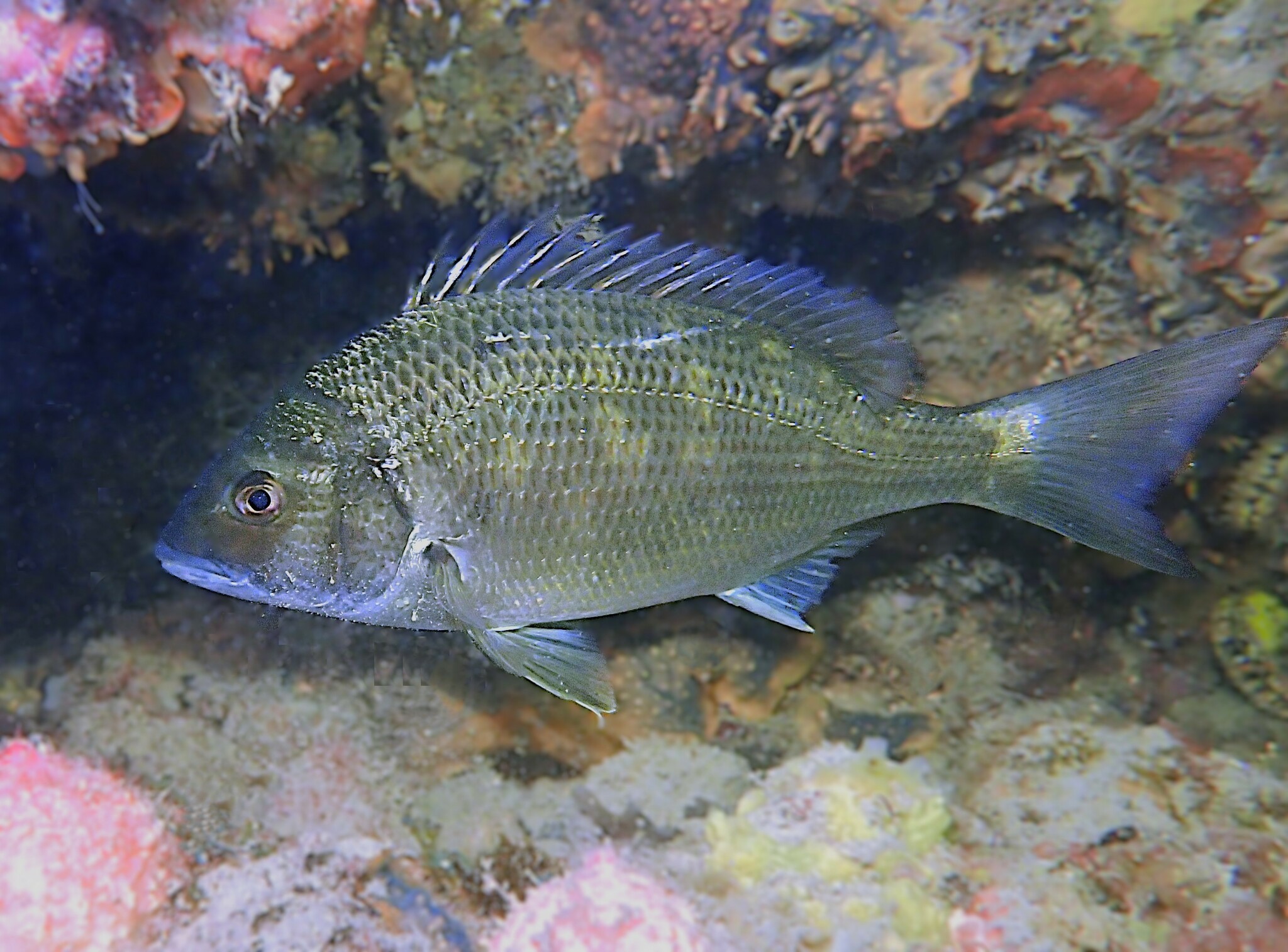
Black bream
- Family
- Sparidae
- Season
- Jan, Feb, Jul, Aug, Sep, Oct, Nov, Dec
Guides for this water
Technique, gear and safety guides that fit Senegal seabream.