
Cape white seabream
This is a generalist with three substrate words and five diet groups, and that combination is the whole problem. A fish that eats almost anything over almost any bottom gives the angler no single answer, so the only stable clue left is where two bottoms meet. The 0–50 m band makes every one of those seams reachable, which is why this species is met so often and planned for so badly.
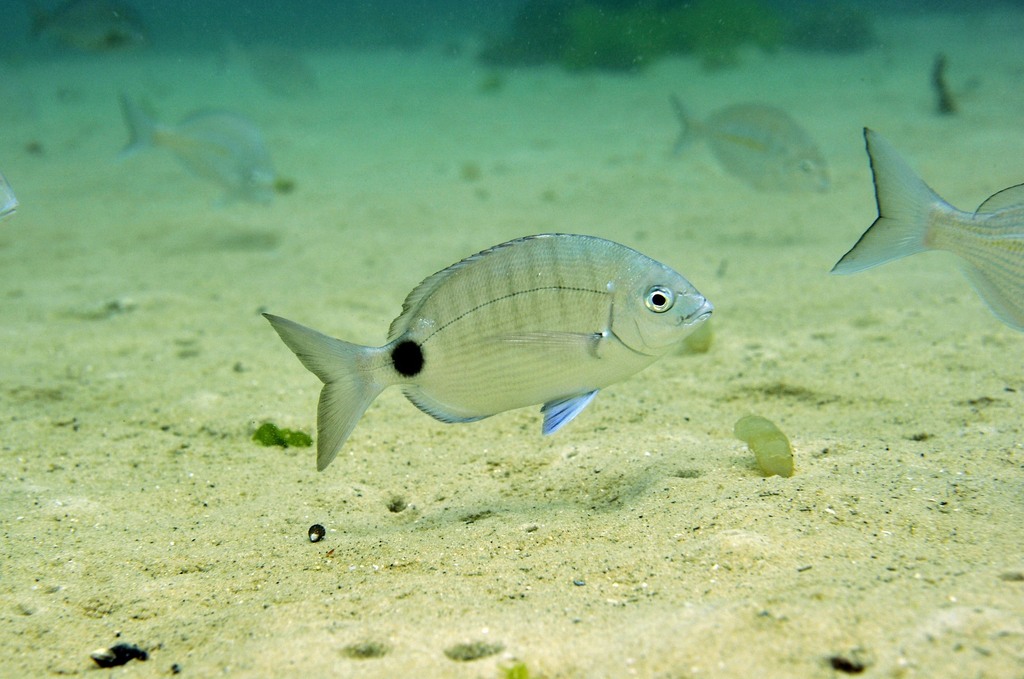
This is a generalist with three substrate words and five diet groups, and that combination is the whole problem. A fish that eats almost anything over almost any bottom gives the angler no single answer, so the only stable clue left is where two bottoms meet. The 0–50 m band makes every one of those seams reachable, which is why this species is met so often and planned for so badly.
Three bottoms on one line
Biology keywords are rocky, sandy and estuary. They are three permissions, not three preferences. The record also calls the fish reef-associated and gives a 0–50 m depth band, so the three words have to be read inside that band rather than across the whole coast.
Rock and sand are a pair that can be found on the same mark. Estuary is the odd one, because it describes a water body rather than a substrate. When the three are listed together, the practical translation is: the fish works edges, not centres. A uniform patch of any one of the three is less promising than the line where one ends.
Zero to fifty metres is all castable
The band starts at zero and stops at fifty. That is unusually generous for a sparid in this record set: the shallow end is surf and shore, and the far end is a short boat run. Unlike species whose shallow limit is already 20 m, this one can be met from the beach.
Depth therefore stops being the filter: a 5 m gutter and a 45 m reef are both legal water, and no usual depth is recorded to rank them. Substrate becomes the filter instead, which is why the three keywords carry more weight here than on a deeper species.
A generalist with five diet groups
The diet line lists crustaceans, fishes, molluscs, algae and worms. That is the full spread of an opportunistic bottom feeder, and it explains the bait entry: bait use is recorded as "usually".
For bait choice the list is permissive, not prescriptive. Prawn and crab cover crustaceans, worms are named outright, fish strip covers fishes, and squid or mussel covers molluscs. None is wrong, and the record ranks none. What the list does argue against is a single-bait, single-spot plan: five food groups imply a fish that moves between patches.
The rock-sand seam
If the fish uses rock, sand and estuary, the highest-value water is where those meet. A rock ledge with sand at its foot gives an ambush position and an open approach in one frame; a sand channel cutting through reef gives the same thing in reverse. The record does not describe ambush behaviour, but reef association plus a mixed diet fits a fish that uses structure and feeds on the open patches beside it.
That gives the layout. Put one bait on the sand within a cast of the rock, and keep it there. Move the second bait up and down the seam, not out into the flat. The middle of a large sand area is the one place all three keywords agree against.
An estuary tag without a brackish tick
Estuary is on the biology list, but the environment block records the fish as marine and does not tick brackish. The two entries do not cancel; they describe different things. An estuary tag can mean the seaward mouth, the tidal channel, or the plume over a reef, none of which requires the fish to tolerate low salinity.
The practical reading is the same as for the rock-sand seam: fish the mouth, not the head. A river mouth with rock and clean sand at its exit satisfies the tag without assuming the fish travels upriver. Nothing in the record supports a run into fresh water.
May to December, and a twenty-one-year life
Spawning runs from May to December, recorded for South Africa. The same block gives a maximum age of 21 years, which is old for a 45 cm fish, and first maturity at 21.1 cm against a 30 cm common length.
Those three numbers describe a fish that matures early, lives long, and is usually caught above its maturity size. A 21 cm fish has spawned; a 30 cm fish is the typical record; a 45 cm fish may be two decades old. The age figure is the one that changes behaviour: a slow-growing, long-lived sparid does not replace a removed big fish quickly, so the 45 cm end of the range is the part worth returning.
Before you read the bottom, read the name
The iNaturalist summary attached to this species describes Diplodus sargus, not D. capensis. The English table is looser still: Blacktail, Cape white seabream, Dassie and White seabream all point at the same fish, and White seabream is also a name used for other species. The country table lists Oman, which sits outside the stated Angola-to-Mozambique range. None of this changes the fishing, but all of it affects how photos and dots should be used as evidence about substrate.
A photograph labelled with this name may show a different sparid, and a dot in the wrong country a different coastline. When the substrate argument rests on "they catch them over sand here", the source of the "here" matters. Use the record's own biology keywords for the bottom, and use the photograph only for the fish.
Two global sources add coverage but not much resolution. GBIF carries only two declarations for this species — an Afrotropical regional entry from the Freshwater Animal Diversity Assessment and a global IUCN presence — and neither names a country. Wikipedia's revision 1354749198 is equally broad, placing it "around the coasts of Southern Africa". That is enough to confirm the coastline and not enough to tell a South African rule from a Mozambican one; for a minimum length or a daily limit, open the national fisheries notice, and the closed-season dates are a separate entry in the same notice.
Placing a bait on the seam
Work the seam in two passes. First, a static bait on clean sand within casting range of rock, on the theory that the fish patrols the open edge. Second, a bait that moves along the rock, covering the transition and not the structure itself.
Keep the release sizes in view: 21.1 cm is the maturity line, 30 cm the common fish, 45 cm the old one. The three-bottom, five-food description is a reason to fish edges; it is not an argument for fishing everywhere.
Where these facts come from
Check these pages before you rely on a size, range or protection status.
- FishBase — Diplodus capensis — FishBase · T2
- GBIF — Diplodus capensis occurrence records — GBIF · T2
- IUCN Red List — Diplodus capensis — IUCN · T1
- Photo record — iNaturalist — iNaturalist · T3
Fish in the same water
These fish live in the same place.
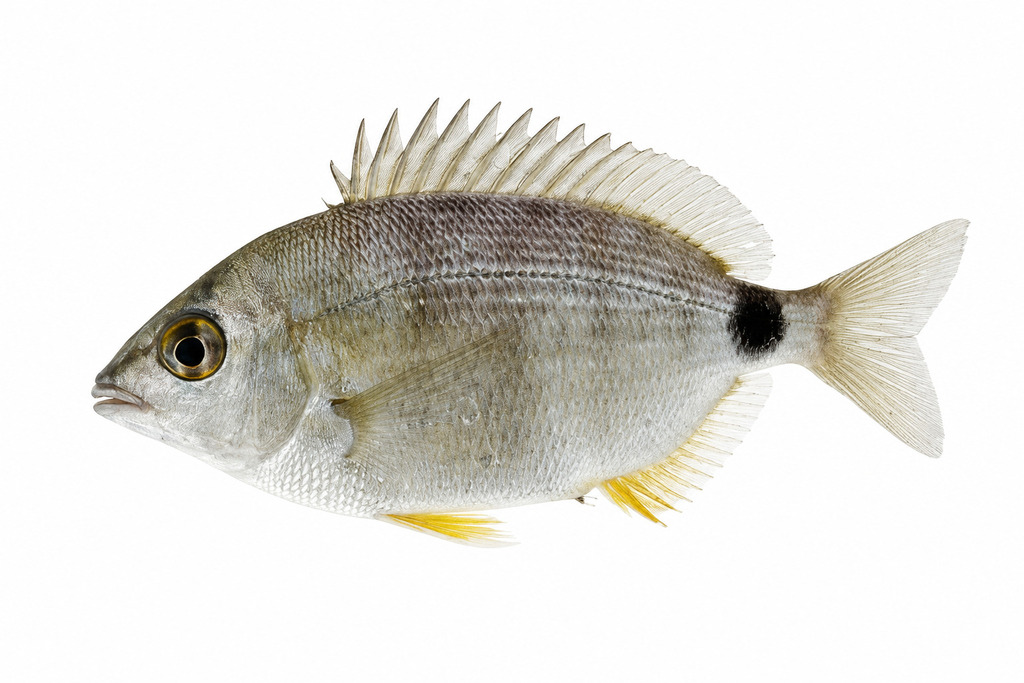
Annular seabream
- Family
- Sparidae
- Depth
- 0–90 m
- Season
- Jan, Feb, Mar, Apr, May, Jun, Jul, Aug, Sep
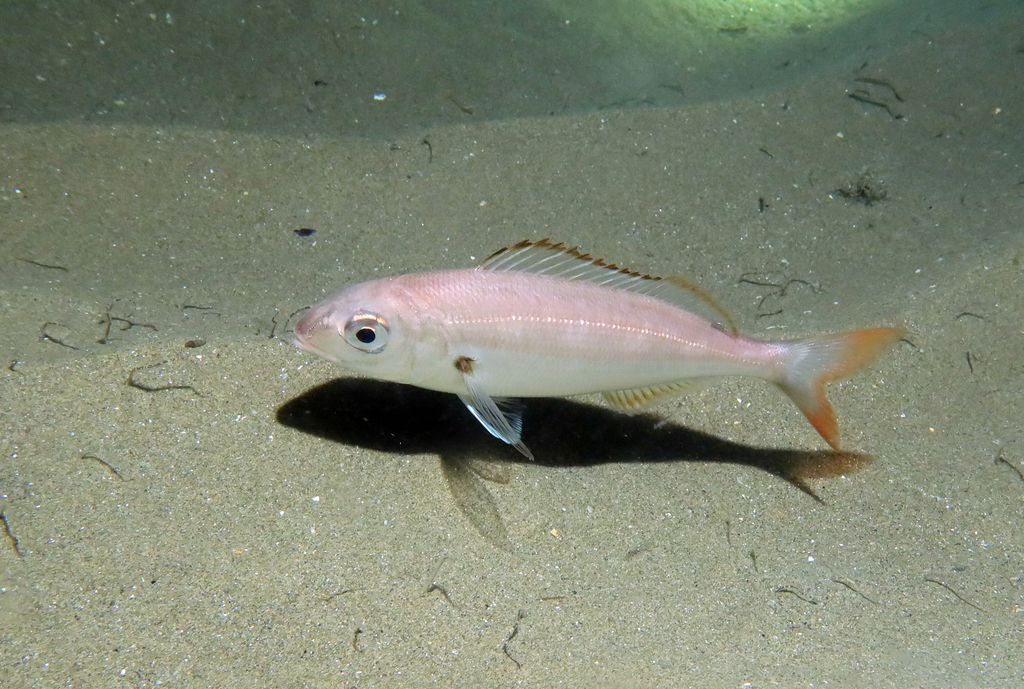
Axillary seabream
- Family
- Sparidae
- Depth
- 0–500 m
- Season
- Jan, Feb, Mar, Apr, May, Jun, Jul, Aug, Sep, Oct, Nov, Dec
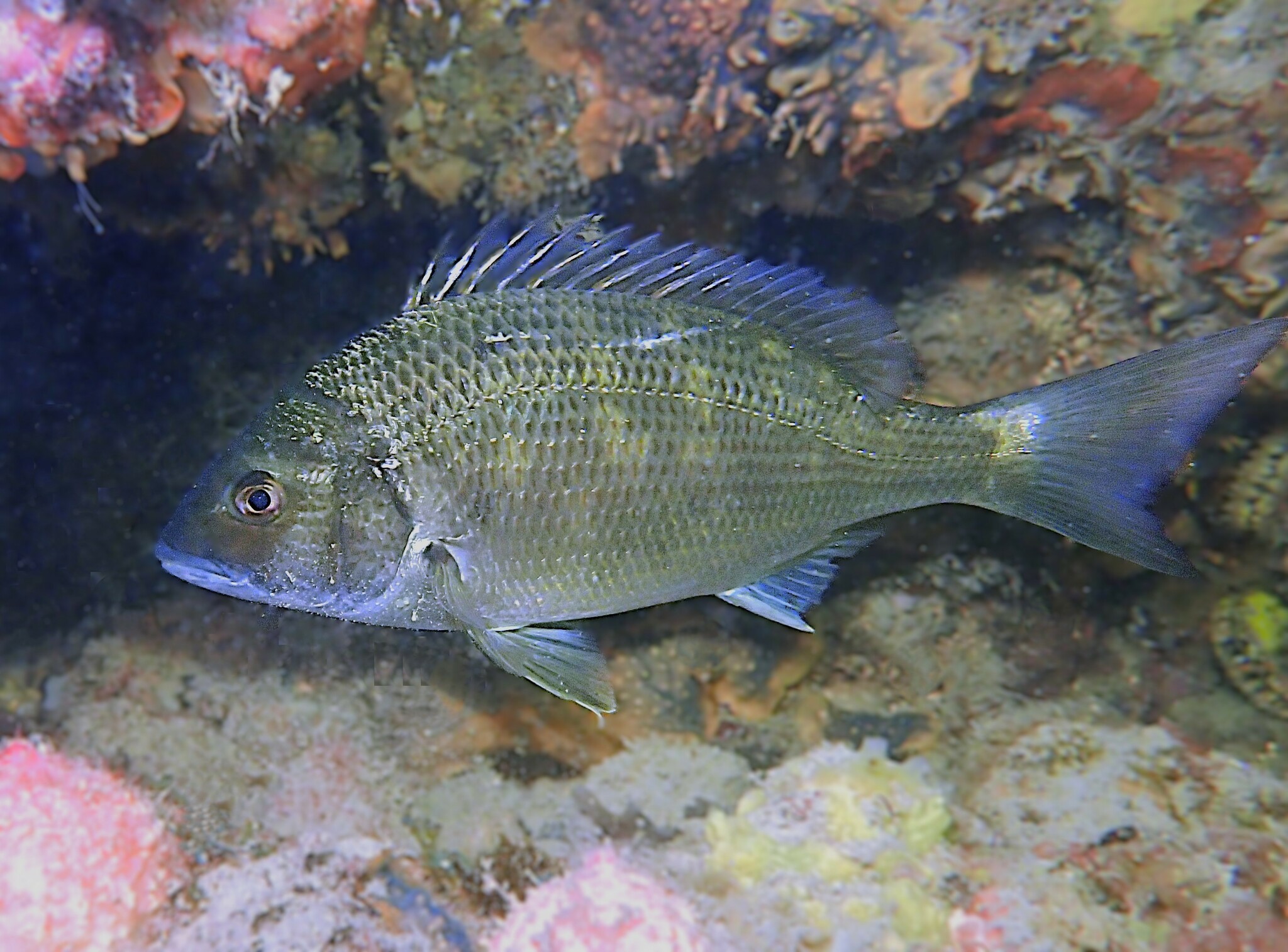
Black bream
- Family
- Sparidae
- Season
- Jan, Feb, Jul, Aug, Sep, Oct, Nov, Dec
Guides for this water
Technique, gear and safety guides that fit Cape white seabream.