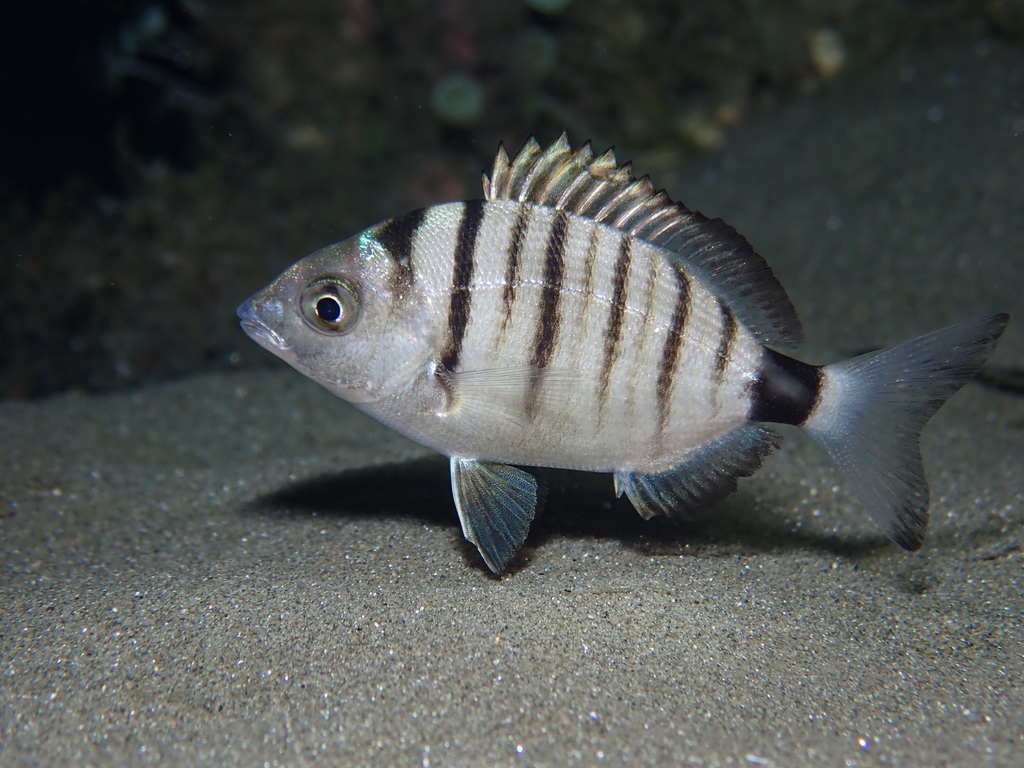
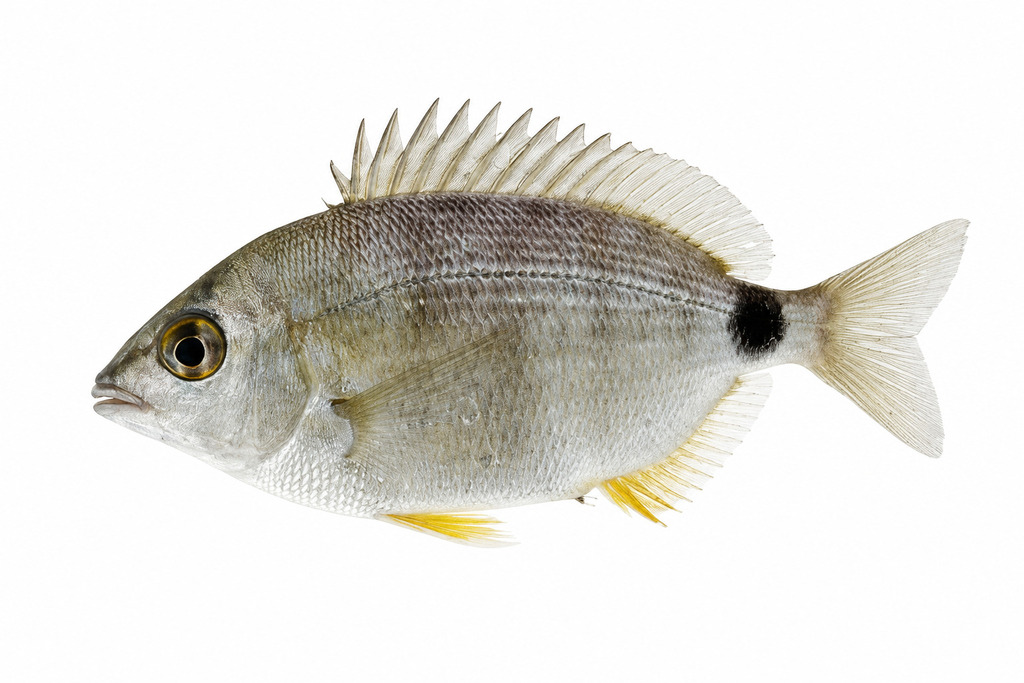
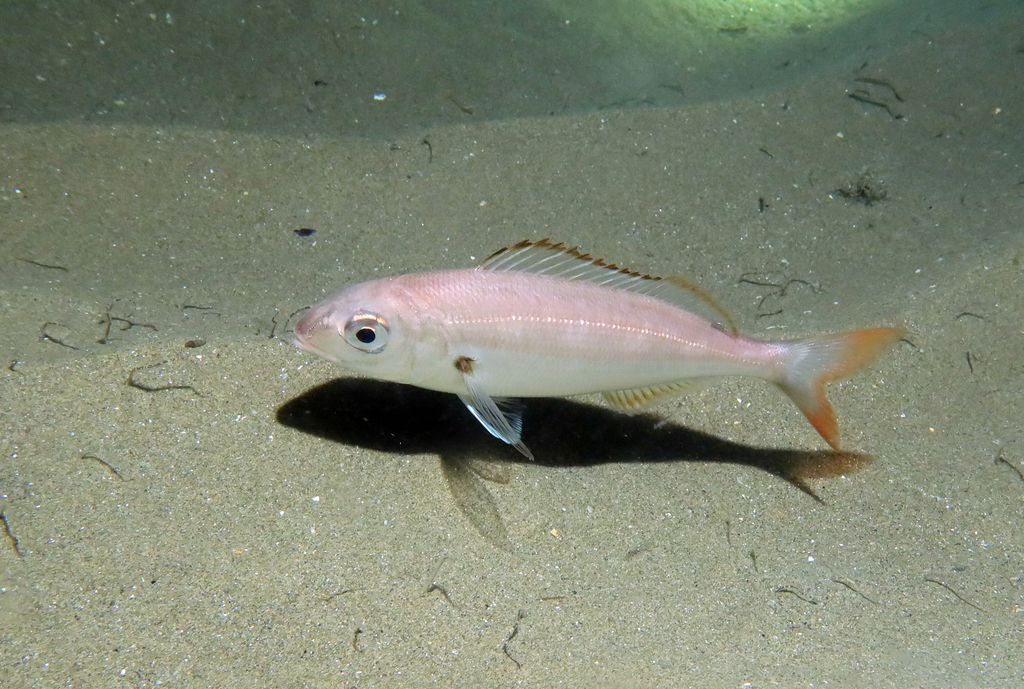
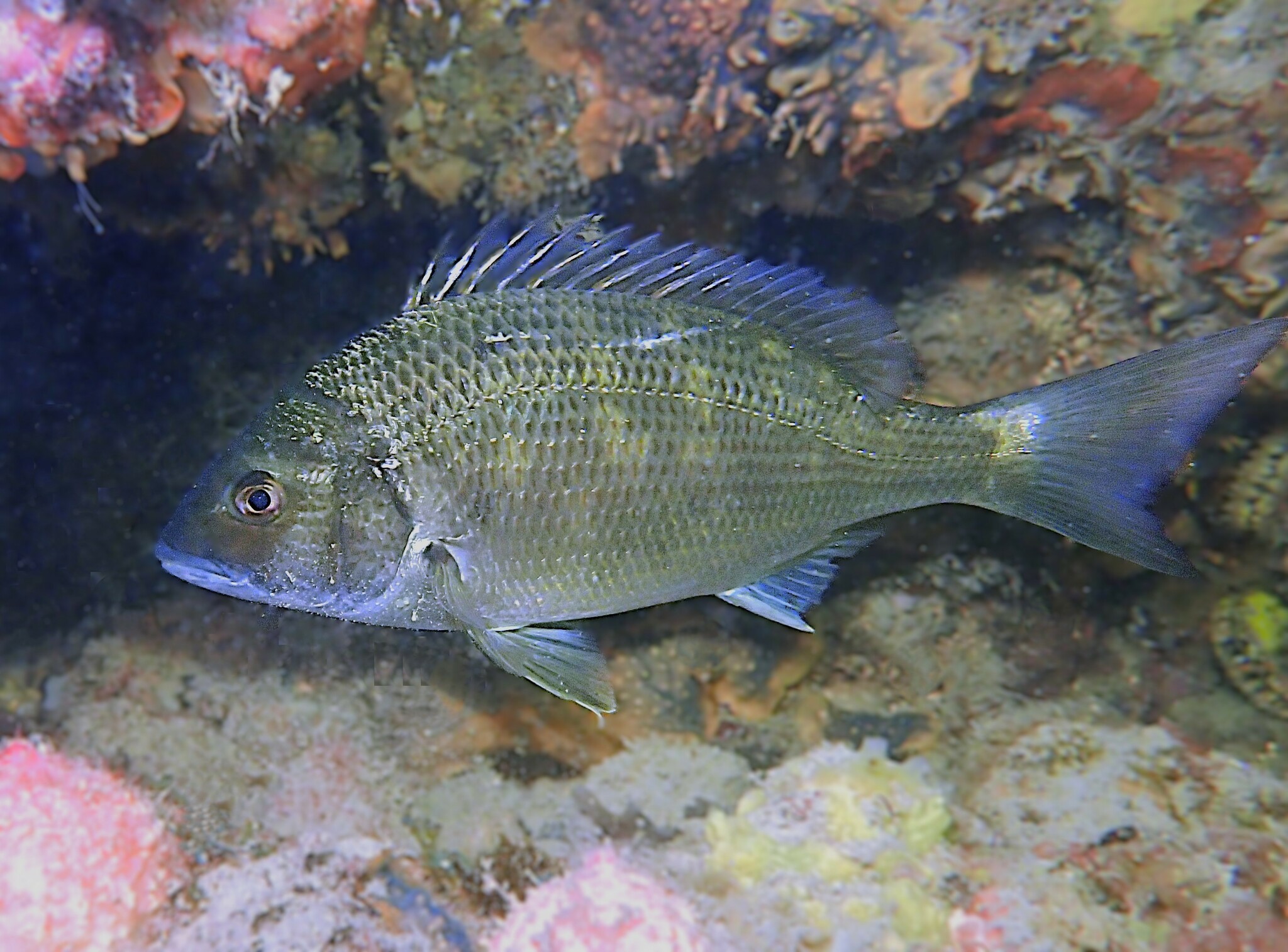
Sharpsnout seabream (Diplodus puntazzo) is a fish of the family Sparidae. FishBase gives its range as: Eastern Atlantic: Bay of Biscay (rare) to Sierra Leone, the Canary Islands, and Cape Verde, including the Mediterranean and Strait of Gibraltar and Black Sea. Also off South Africa. It is recorded from 0 to 150 m, in subtropical water. The recorded maxima are 60 cm TL, 1.7 kg. Diet includes algae and worms. IUCN status: Least Concern (LC). Chinese name: .
Five English names for one fish
The five entries are Puntazzo, Sharpsnout sea bream, Sharpsnout seabream, and Sheephead bream, with the third repeated under a different country. One spells the second word as two words, two run it together; one drops "snout" entirely. The FAO entry uses "Sharpsnout seabream", and iNaturalist's preferred common name is the same phrase with a capital S. None of these is wrong. They are regional and institutional usages that have accumulated around the same binomial.
Puntazzo is a genus used as a name
The American Fisheries Society entry is simply "Puntazzo". That is the genus name inside the binomial Diplodus puntazzo, used as a common name in its own right. The catalogue page does not list a synonym history that would explain the transfer, so this page does not invent one. The safe statement is narrower: the name exists in the common-name table as an AFS entry, and a reader who searches a market list for "puntazzo" is looking for the same fish that the FAO list calls a sharpsnout seabream.
The spelling split
"Sharpsnout sea bream" is recorded for Spain, while "Sharpsnout seabream" is recorded for Syria and for the FAO global list. The difference is one space. In an index or a database that matters, because a search for the two-word form will miss the one-word entry and vice versa. The species page itself uses "Sharpsnout seabream" in its title, and the document that commissioned this article used "Sharp-snout seabream" with a hyphen. Three typographic forms, one fish; the article keeps the hyphenated title and cites the others as they appear.
Sheephead bream, an American label
"Sheephead bream" appears twice in the table, both under the United States. The page gives no note on what regional fish that name usually denotes, and this page does not guess. What matters for identification is that the label is attached to Diplodus puntazzo in the catalogue, so an American list using it points here rather than to a different sparid. The other four names describe the snout; this one does not, which is exactly why it is easy to mis-file.
Two Chinese forms and a market name
FishBase's Chinese entries are and — the same name as traditional and simplified forms. The species document prepared for this site listed , a shorter market-style form. Both refer to the same fish, but only the longer form carries the genus element . A Chinese buyer asking for and a database keyed to are not using the same string, which is the same problem as the English spelling split in a different script.
Which name sits on which record
GBIF accepts Diplodus puntazzo (Walbaum, 1792) and holds 15,439 occurrence records for it, led by France with 2,794, Spain with 1,463 and Croatia with 430. iNaturalist uses the same binomial and shows 3,262 observations. FishBase's territory table contains 37 entries. The labels differ; the taxonomic backbone does not. France leading the record set is not a distribution statement: the text calls the species very common in the Mediterranean and less often found off the Iberian Atlantic coast and the Bay of Biscay. A database weighted towards France can coexist with that sentence without either source being wrong, because the counts measure sampling and the sentence measures presence. That is the practical test: when two sources disagree about a common name, compare the binomial and the accepted status before treating them as two species.
The distribution endpoint adds a South African presence attributed to WoRMS, a declaration absent from the FishBase range sentence. WoRMS's accepted record, AphiaID 127052, is credited to Walbaum, 1792, and retains the brackish flag, which is why the lagoon records in the text need no separate explanation.
What the fish does under any name
The biology is consistent across the labels. It is gregarious, lives in coastal water over rocky or sandy bottoms to 150 m but only occasionally beyond 50 m, and younger fish may enter brackish water, lagoons and littoral pools while adults often sit in the surf zone. It feeds on seaweeds, worms, molluscs and shrimps. The record calls it a permanent hermaphrodite with some protandric episodes, and places reproduction at the end of summer and in autumn. The environment line adds oceanodromous and a usual depth of 0–60 m. The Atlantic picture is thinner than the Mediterranean one: very common in the Mediterranean, present from Gibraltar to Sierra Leone and the Canary and Cape Verde islands, less often off the Iberian Atlantic coasts and the Bay of Biscay, scarce in the Black Sea. That ranked detail says more about abundance than a bare "Eastern Atlantic" label.
Naming it in the logbook
For the angler, the useful numbers are the 30 cm common length and the 60 cm maximum, plus the 1.7 kg top weight. A 30 cm fish is light-rod work; a 60 cm fish is a different fight, and the 1.7 kg figure belongs to the rare end rather than the school fish. Neither a maturity length nor a maximum age appears, so no release line can be derived from this page alone. The catalogue records both commercial and gamefish use, and points to aquaculture production data without stating a farmed volume. Write the binomial in the logbook and one of the common names beside it; that way a future search survives whichever spelling the local market adopts.
Regulations before you keep it
These are the published regulations for this fish. Read the number first. The notice below it is the actual regulation.
Minimum size1
The minimum size for Sharpsnout seabream in France is ≥18 cm.
| SAR à museau pointu | Diplodus puntazzo | 18 cm |
Every record above names its source and the date it was retrieved. See the regulation register for the full list, or how to read these regulations.
Where these facts come from
Check these pages before you rely on a size, range or protection status.
-
FishBase — Diplodus puntazzo
— FishBase · T2
-
GBIF — Diplodus puntazzo occurrence records
— GBIF · T2
-
IUCN Red List — Diplodus puntazzo
— IUCN · T1
-
Photo record — iNaturalist
— iNaturalist · T3