
Temminck's surfperch
A small ovoviviparous reef fish built like a freshwater crucian carp, found in eelgrass and rockweed along the Japanese coast. It mates in November, holds the sperm until the eggs mature, and gives birth to 5 to 7 cm young in April and May. A familiar breakwater target for families, and at its most worthwhile in winter when other species are scarce.

A small ovoviviparous reef fish built like a freshwater crucian carp, found in eelgrass and rockweed along the Japanese coast. It mates in November, holds the sperm until the eggs mature, and gives birth to 5 to 7 cm young in April and May. A familiar breakwater target for families, and at its most worthwhile in winter when other species are scarce.
A crucian carp that moved into the seaweed
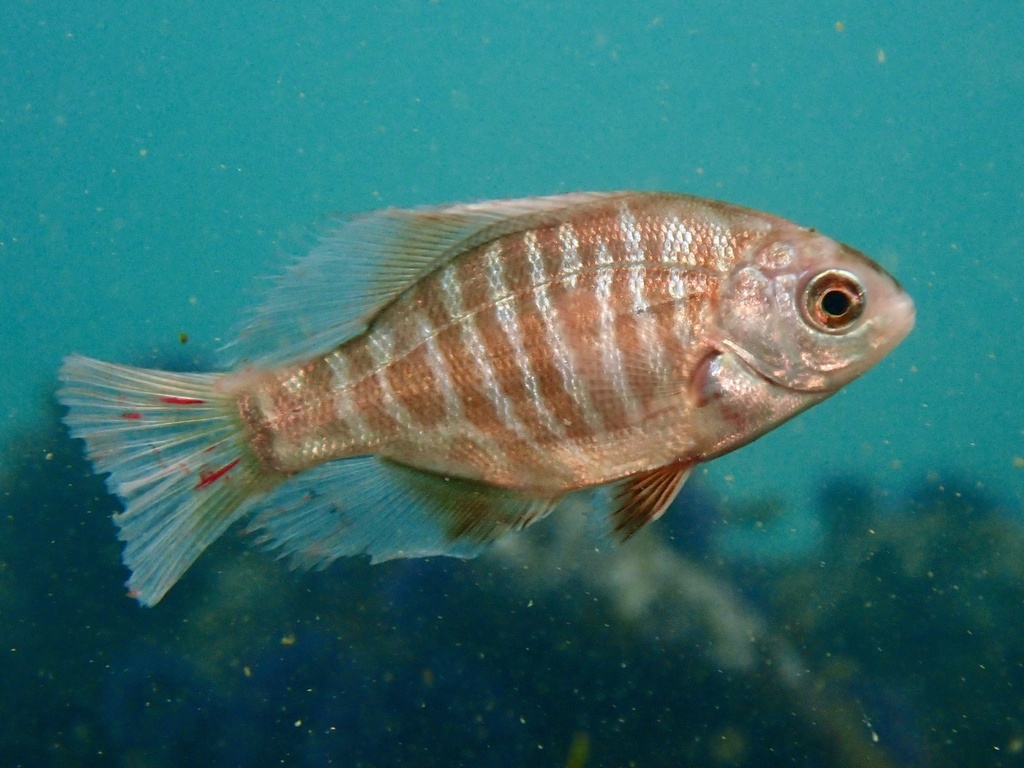
Ditrema temminckii is built like a freshwater crucian carp that has moved into the sea: an oval, compressed body, a small mouth and a slightly pointed snout. The back is iron-blue and the belly silver-white. Two brown spots sit on the preopercular margin below the eye, and there is a black point at the base of the pelvic fin. Those marks are the practical separation from the closely related matanago, whose forward spot is small and faint, which carries a black line along the pelvic spine, and which has proportionally longer pectoral, pelvic and caudal fins. Other red and blue forms exist in the same family, and Japanese sources concede that separating matanago from umitanago is genuinely difficult. FishBase gives 24 cm standard length and 144.2 g.
Eelgrass beds from Tsugaru to Kyushu
FishBase records the species from the northwest Pacific: Japan, Korea and the Yellow Sea. The Japanese aquarium account is finer. It gives the Pacific coast from the Tsugaru Strait to Fukushima, including Kanagawa's Ukishima; the Japan Sea and East China Sea coast from Tsugaru to northwest Kyushu; and Uwakai in Ehime. It adds the south and east coasts of the Korean peninsula, Ulleungdo, the Bohai Sea and water off Hangzhou in China. The fish lives in coastal eelgrass beds and on rocky reef, in schools, and feeds on small crustaceans, arthropods, polychaetes, mysids and plankton. It takes food by sucking up sand with the prey and expelling the residue through the gills, which is why bites over a sandy bottom can feel like very little at all.
Sperm stored from November to April
Reproduction is ovoviviparous, and the timing is unusual. Mating occurs in November, but the sperm is stored in the female's oviduct until the eggs mature in December or January; only then does fertilisation happen. Five to six months later the young are 5 to 7 cm long and are born in April and May — the aquarium account says May — at 3 to 86 per brood, with a second source giving 10 to 80. The aquarium puts the eating season in autumn and winter; the fishing encyclopedia puts it in the colder water from winter into spring. The two accounts differ at the edges but agree that winter and early spring are the best window. With few other species available, that is when specialist effort on this fish pays.
A pole, a ball float and a very light bite
This is a standard family-fishing target from breakwaters. The basic rig is an extendable pole with a ball float. A stream rod works, but a soft seiryu rod or a hera rod gives a better feel; the float is hard foam, 10 to 12 mm across, in fluorescent orange or yellow for visibility. Baits are bloodworm, sandworm, mysid or a kneaded paste. The mouth is small and the bite is light but repeated, and Japanese sources admit the delicate atari is a headache. That dictates a fine rig and small hooks. When the wind picks up, switch to a shorter rod fished close to the wall rather than letting the float drift away.
Fine line because the lip is thin
Tackle is deliberately light: a 3.6 to 4.5 m pole, 0.8 to 1.2 main line, 0.4 to 0.6 leader, sleeve hooks in sizes 3 to 5, a 10 to 12 mm ball float and a small split shot to sink the bait slowly. Weed beds snag readily, so the rig stays simple and the leader short, around 30 to 50 cm, for control. The mouth is thin, which means the hookset should come from the rod's flex rather than a snap of the wrist. A hard strike tears the lip and loses the fish, and the same thin lip argues for keeping the drag light.
Too soft for sashimi, good in a miso mince
The flesh is white and translucent with fine fibres, and it breaks up readily under heat; the aquarium account says it falls apart when boiled. It suits salt-grilling, deep-frying, simmering down as tsukudani and kombu-jime. On the Boso Peninsula the flesh is minced with miso into namerō. It is too soft for sashimi, but in season the sweetness and savour are better than that suggests. Japan has no nationwide recreational minimum size or closed season. No published species-level restriction was found for this fish; the prefectural fishery adjustment rules and cooperative angling rules of the main producing prefectures in Tohoku and Kanto still need to be checked one by one, and are marked as deferred here.
Where each fact came from, and the months that disagree
Taxonomy, distribution and length come from FishBase. The Japanese distribution, the details of ovoviviparity, the separation from matanago and the eating assessment come from the market fish encyclopedia. The November mating and April–May birth timeline, and the fishing detail, come from the fishing encyclopedia. Birth months are given as April–May in one source and May in the other; both are kept and neither is averaged.
How to catch it
Shore fishing
Fished with the listed approach, matched to the recorded depth and size.
Float fishing
Fished with the listed approach, matched to the recorded depth and size.
Small hook rig
Fished with the listed approach, matched to the recorded depth and size.
Where these facts come from
Check these pages before you rely on a size, range or protection status.
- FishBase — Ditrema temminckii — FishBase · T2
- GBIF — Ditrema temminckii occurrence records — GBIF · T2
- IUCN Red List — Ditrema temminckii — IUCN · T1
- Photo record — iNaturalist — iNaturalist · T3
Fish in the same water
These fish live in the same place.
Guides for this water
Technique, gear and safety guides that fit Temminck's surfperch.