
Blackthroat seaperch
Blackthroat seaperch is a heavy-bodied acropomatid of the eastern Indian Ocean and western Pacific, from northwest Japan to northwest Australia. It lives from 100 to 600 m in tropical water, reaches 40 cm TL, and feeds on crustaceans. Its dark throat gives it the Japanese name nodoguro.
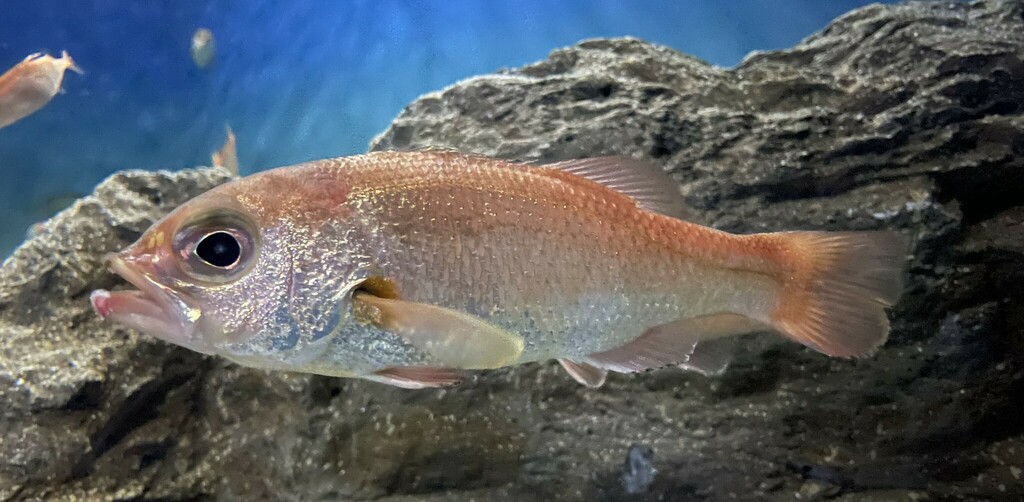
Blackthroat seaperch (Doederleinia berycoides) is a fish of the family Acropomatidae. FishBase gives its range as: Eastern Indian Ocean to Western Pacific: NW Japan to NW Australia. The body is compressed and firm, with a spiny first dorsal fin and a softer second one. It is recorded from 100 to 600 m, in tropical water. The recorded maximum is 40 cm TL. Diet includes crustaceans. IUCN status: Not Evaluated (NE). Chinese name: .
Identification
Blackthroat seaperch is a deep-bodied, rosy-red fish with a dark throat, a large eye and a blunt, rounded head; the Japanese name nodoguro refers to that black throat. The body is compressed and firm, with a spiny first dorsal fin and a softer second one. FishBase caps the species at 40 cm total length and puts the usual size near 30 cm. There is no weight or age record in the capture, so size is the practical benchmark: a 30 cm fish is a good one, and anything near 40 cm is at the top of the range. Three spines and six to eight soft rays support the anal fin. In the hand, the combination of red body, black gill membrane and big eye separates it from the smaller lanternbellies that come up in the same hauls.
Distribution and depth
The species ranges from north-western Japan south through the East China Sea, the South China Sea to north-western Australia, and east to the Ogasawara Islands, the Philippines and New Caledonia. FishBase lists ten countries and territories across that span, including Japan, both Koreas, China, Taiwan region, Indonesia and Australia. It is a demersal fish, and FishBase records a depth range of 100–600 m. In Japanese waters the commercial fishery works the continental shelf slope and margin at 80–150 m, shallower than the extreme of the recorded range. iNaturalist holds 24 observations, a low count that reflects how few people dive or fish at these depths.
Biology and sex
The species has become a target for stock enhancement in Japan, and that work has produced the clearest picture of its biology. Juveniles were first produced in captivity in 2013, and about 220,000 hatchery-reared fish were released experimentally into Toyama Bay between 2018 and 2023. Wild fish showed no significant bias in sex ratio and no histological sign of protandrous sex change, while hatchery populations are skewed toward males, which points to rearing conditions rather than a natural sex-change pattern. Females grow larger than males. Age is read from otoliths: fish of 80 mm fork length or less are all age zero, most of those between 101 and 160 mm are age one, and the 161–200 mm and 201–240 mm classes are dominated by ages two and three respectively. Fish below 180 mm total length, generally under two years old, account for much of the catch, and that is the pressure the assessment is built around.
Stock assessment
The southwestern Japan Sea stock has been assessed with an age-length key from otolith sections and catch records from the Shimonoseki and Hamada fishing ports in Yamaguchi and Shimane prefectures. Standardised catch per unit effort, in kilograms per tow per vessel, was calculated from offshore trawl logbooks. Biomass, fishing mortality and the relationship between spawning stock biomass and recruitment were estimated with an adaptive framework virtual population analysis, and a retrospective analysis was used to check the estimates. The conclusion was that stock biomass in the southwestern Japan Sea has been high and stable in recent years, and the authors went on to consider a management policy aimed at protecting small fish. For a deep-water species that is landed in relatively few ports, that kind of port-based assessment is the main public measure of how the stock is doing.
Gear and approach
A short, powerful rod rated for 200–400 g of lead, a reel with a large line capacity and braid of 30–50 lb test is the usual deep-drop set-up. Terminal tackle is simple: a heavy sinker on a sliding rig, two or three hooks on short leaders, and bait such as squid, mackerel or prawn. Slow-pitch jigs of 150–250 g work when the current is manageable. Keep the rig close to the bottom, lift it a metre and let it fall, and watch the line where it enters the water for the small tick that means a take. Fish hooked at this depth should be brought up slowly; a venting tool or a release weight is worth carrying if fish are to be returned.
Edibility and regulations
Blackthroat seaperch is one of the higher-priced demersal fish in the Japanese market, and large individuals are reported to fetch more than JPY 6,000–10,000 per kilogram. The flesh is firm, rich and suited to grilling, simmering or sashimi, which is why the species supports a directed fishery rather than a bycatch market. FishBase lists it as Not Evaluated, and there is no assessment date on record. Recreational retention is governed by prefectural and local rules rather than a single national limit, so the current rule at the port of landing decides what may be kept. Deep-water fish are also vulnerable to barotrauma, and a fish brought up from that depth has little chance of survival.
Where to look
The main grounds are the shelf slope of the Japan Sea, particularly off Toyama, Shimane and Yamaguchi, and the East China Sea edge. The species also occurs south to Taiwan region, the Philippines and north-western Australia, so the range is wide but the fish is always deep. Toyama Bay is the best-documented area because of the release programme and the port sampling behind the stock assessment. Look for a steep drop from the shelf, a contour where the current slows, and marks sitting just off the bottom rather than in mid-water.
Where these facts come from
Check these pages before you rely on a size, range or protection status.
- FishBase — Doederleinia berycoides — FishBase · T2
- GBIF — Doederleinia berycoides occurrence records — GBIF · T2
- IUCN Red List — Doederleinia berycoides — IUCN · T1
- Photo record — iNaturalist — iNaturalist · T3
Fish in the same water
These fish live in the same place.

Acoupa weakfish
- Family
- Sciaenidae
- Depth
- 1–20 m
- Season
- Jan, Feb, Mar, Apr, May, Jun, Jul, Aug, Sep, Oct, Nov, Dec

American angler
- Family
- Lophiidae
- Depth
- 0–800 m
- Season
- Mar, Apr, May, Jun

American eel
- Family
- Anguillidae
- Depth
- 0–464 m
- Season
- Jan, Feb, Mar, May, Jun, Jul
Guides for this water
Technique, gear and safety guides that fit Blackthroat seaperch.